

 1 week ago
10
1 week ago
10
ARTICLE AD BOX
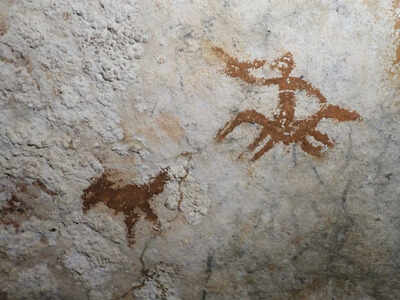
67,800-year-old hand stencil: The oldest dated rock art discovered in Indonesia (CP: Griffith University)
In a limestone cave on the Indonesian island of Sulawesi, a hand stencil has been dated to at least 67,800 years ago, making it the oldest known example of rock art currently identified anywhere in the world.
The finding comes from uranium series analysis of mineral layers that formed over the painted surface. Researchers say the date provides a firm minimum age for the artwork and pushes back the timeline for symbolic expression in the region. The cave lies in the southeastern part of Sulawesi, an area that has received far less archaeological attention than the well known Maros Pangkep karsts. The result adds to growing evidence that early human communities in Wallacea were producing complex imagery much earlier than once thought.
Sulawesi hand stencil dated to 67,800 years ago, oldest known cave art
The study "Rock art from at least 67,800 years ago in Sulawesi" reports that researchers discovered the stencil in Liang Metanduno cave on Muna Island, off the coast of Sulawesi. Scientists dated calcite deposits that had formed directly on top of the pigment. Using laser ablation uranium series methods, they calculated an age of 71.6 thousand years for the mineral layer, establishing a minimum age of 67,800 years for the painting beneath.That figure exceeds earlier minimum dates from the Maros Pangkep region in southwest Sulawesi by more than 16 thousand years.
It also edges past the previous oldest widely cited cave art date from Spain, which had been attributed to Neanderthals.Researchers documented 44 rock art sites across southeastern Sulawesi during recent fieldwork. Eleven motifs from eight sites were dated, including seven hand stencils and several figurative and geometric paintings.
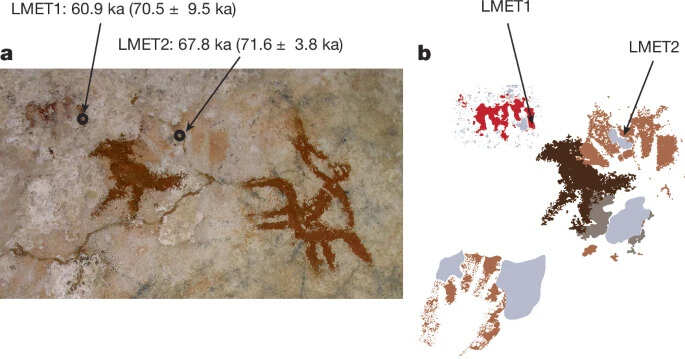
Sulawesi hand stencil dated to 67,800 years ago, oldest known cave art (Image Source - Nature)
Uranium series dating confirms deep pleistocene origins
Uranium series dating measures radioactive decay within calcium carbonate deposits.
In these caves, thin mineral crusts formed naturally over painted surfaces. By analysing those crusts, scientists can determine when the overlying layer developed, and therefore the earliest possible age of the artwork.In some cases, carbonate layers beneath the pigment were also dated, providing maximum age constraints. Together, these methods narrow the likely time window for creation.The results show that artistic activity in southeastern Sulawesi began far earlier than previously confirmed.
Painting in Liang Metanduno appears to have continued for tens of thousands of years, with later images added until around 20 thousand years ago.
Early art links sulawesi to the Sahul migration timeline
The discovery has implications beyond art history. During the Pleistocene, lower sea levels connected Australia, New Guinea and Tasmania into a single landmass known as Sahul. Archaeologists have long debated when humans first reached this region.Some models suggest arrival around 50 thousand years ago. Others argue for at least 65 thousand years.
The Sulawesi hand stencil supports the longer timeline, indicating that people with symbolic traditions were present in Wallacea before or during the initial peopling of Sahul. Southeast Sulawesi sits between Borneo and Papua, along likely maritime routes used by early migrants. The new dates strengthen the case for seafaring journeys across this chain of islands.
The claw-like hand motif shows early symbolic variation
The stencil itself is unusual. After the negative outline was created, the finger shapes were deliberately narrowed, producing a claw-like appearance. This modification has not been widely recorded elsewhere. Researchers suggest it may reflect symbolic ideas linking humans and animals, themes that appear in other early Sulawesi imagery. The exact meaning remains uncertain. For now, the cave walls in southeastern Sulawesi offer a quiet record of artistic activity stretching deep into human prehistory, extending further back than previously confirmed.







 English (US) ·