

 1 hour ago
3
1 hour ago
3
ARTICLE AD BOX
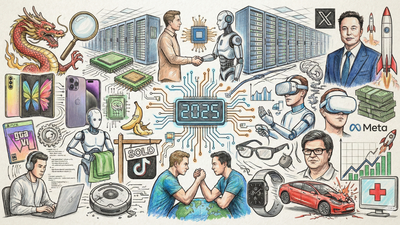
Twenty-six letters, twelve months, and more plot twists than a season finale. That was 2025 in technology—a year when Chinese AI labs shocked Silicon Valley, when the thinnest iPhone ever made couldn't find buyers, when humanoid robots started folding laundry, and when a bankruptcy court claimed one of the most beloved names in consumer robotics. It was the year Elon Musk ping-ponged between politics and tech empires, Mark Zuckerberg wrote record-breaking paycheques to fuel AI ambitions while his metaverse dreams quietly faded, and a meme about impossibly tiny bananas somehow captured the zeitgeist of AI's creative explosion. There were shockwaves from unexpected players, familiar faces making dramatic pivots, and technologies that went from niche to necessary faster than you could say "neural network." Here's how the year unfolded, one letter at a time.
Twenty-six letters, twelve months, and more plot twists than a season finale. That was 2025 in technology—a year when Chinese AI labs shocked Silicon Valley, when the thinnest iPhone ever made couldn't find buyers, when humanoid robots started folding laundry, and when a bankruptcy court claimed one of the most beloved names in consumer robotics.
It was the year Elon Musk ping-ponged between politics and tech empires, Mark Zuckerberg wrote record-breaking paycheques to fuel AI ambitions while his metaverse dreams quietly faded, and a meme about impossibly tiny bananas somehow captured the zeitgeist of AI's creative explosion. There were shockwaves from unexpected players, familiar faces making dramatic pivots, and technologies that went from niche to necessary faster than you could say "neural network."
Here's how the year unfolded, one letter at a time.
A for Agentic AI
The shift was subtle at first, then suddenly everywhere. Generative AI—the technology that could write your emails and create images—started evolving into something more autonomous, more proactive. Enter agentic AI: artificial intelligence that doesn't just respond to prompts but anticipates needs, takes initiative, and acts as a genuine companion rather than a tool.
Every tech company pivoted hard toward this vision, positioning their AI not as a feature but as your digital sidekick.
Microsoft pushed Copilot as your work partner, Google reimagined Assistant as a proactive helper, and OpenAI hinted at agents that could handle complex tasks across multiple platforms. The promise was simple: AI that works for you, not just with you.
B for Blackwell
Nvidia's Blackwell architecture turned out to be the dark horse nobody saw coming—or rather, everyone underestimated.
What started as the next iteration of Nvidia's GPU lineup became the backbone of the entire AI revolution. Blackwell chips found their way into everything: powering the latest gaming PCs with unprecedented performance, driving AI workstations for creative professionals, and most importantly, becoming the engine room of massive AI data centers worldwide.
The architecture's ability to handle both training and inference workloads with remarkable efficiency made it indispensable.
When tech giants scrambled to build out their AI infrastructure, Blackwell was what they were scrambling for. Jensen Huang's leather jacket became even more iconic as Nvidia's market cap soared.
C for Compute crisis
All those AI breakthroughs? They came at a cost—literally. The already-tight supply of computing resources turned into an all-out crisis. GPU prices had skyrocketed earlier, but 2025 saw the crunch extend to storage and memory in ways nobody anticipated.
Big Tech's race to build AI data centers created unprecedented demand for every component imaginable. Memory giants like Samsung, SK Hynix, and Micron faced an impossible choice: continue supplying consumer markets or redirect everything to the tech giants waving massive purchase orders.
They chose the latter. Memory and storage prices hit record highs as supply for regular customers dried up. The message was clear: in the age of AI, if you're not building a data center, you're at the back of the line.
D for DeepSeek
China's DeepSeek didn't just enter the AI race—it shocked everyone watching. The company emerged seemingly from nowhere with models that rivaled, and in some cases outperformed, Western counterparts at a fraction of the reported cost. Their technical papers suggested training methods that were more efficient, their architecture choices that were unconventional yet effective. Silicon Valley had grown comfortable assuming the AI lead was secure; DeepSeek shattered that assumption.
The implications rippled across the industry: Could China leapfrog in AI development? Were Western companies overspending on compute? The geopolitical dimensions of artificial intelligence suddenly felt very real, very urgent.
E for Elon Musk
What a year for Elon. He went from tech entrepreneur to playing politician, advising on government efficiency and policy, only to pivot back to his tech empire with renewed vigor. His involvement in political circles raised eyebrows and questions about conflicts of interest, but Musk seemed energized by the chaos.
Between steering Tesla through production challenges, pushing SpaceX toward Mars, and amplifying xAI's ambitions, he somehow found time to be everywhere at once.
His political dalliance appeared to inform his business strategy, particularly around AI regulation and policy—conveniently aligning with his own ventures. Whether you admired his audacity or questioned his judgment, ignoring Musk in 2025 was impossible.
F for Foldables
Foldables stopped being a novelty and started getting serious—literally unfolding into new dimensions. The year saw tri-fold devices move from concept to commercial reality, with screens that folded twice to create tablet-sized displays from pocket-friendly form factors. Samsung and Huawei led the charge, but Chinese manufacturers pushed innovation boundaries with designs that were increasingly durable and practical.
The crease problem that plagued early foldables became less pronounced, and battery technology finally caught up to power these expansive displays. Tri-folds represented the next evolution, suggesting a future where our devices could morph between phone, tablet, and even laptop-like experiences. The form factor was finding its purpose.
G for GTA VI
Another year, another cycle of hope and disappointment for Grand Theft Auto fans.
2025 was supposed to be the year—leaks suggested it, industry insiders hinted at it, and Rockstar's cryptic posts teased it. But as months passed, that release window kept sliding. The game had become something of a legend before even launching, with expectations reaching impossible heights. Rockstar remained characteristically silent, letting anticipation build while perfecting whatever masterpiece they were crafting.
Meanwhile, the gaming community oscillated between excitement and exasperation, creating memes about growing old waiting for GTA VI. The wait continued, the hype persisted, and the question remained: would 2026 finally be the year?
H for Humanoid robots
Tesla's Optimus made its first real-world appearances, moving beyond controlled demonstrations to actual tasks. Watching a humanoid robot fold laundry or navigate a warehouse was equal parts fascinating and unsettling.
But Tesla wasn't alone—China entered the humanoid robotics race with remarkable speed and scale. Companies like Unitree and others showcased robots with impressive mobility and dexterity, often at price points that made Western competitors nervous.
The vision of humanoid robots in homes, factories, and service roles suddenly seemed less science fiction, more near-future reality. Technical challenges remained—battery life, decision-making, cost—but the pace of progress suggested a decade of humanoid robotics ahead.
I for iPhone Air
Apple's iPhone Air finally arrived, and it was everything design enthusiasts hoped for: impossibly thin, gorgeously crafted, a marvel of engineering. At just 5.5mm thick, it redefined what a smartphone could look like. But there was a problem—consumers didn't bite. The compromises required for that thinness (smaller battery, no physical SIM slot, limited camera capabilities) proved too much for most buyers.
Enthusiasts admired it, reviewers praised its design language, but sales were modest. The iPhone Air became a beautiful statement piece that reminded everyone: sometimes people actually want functionality over pure aesthetics. Apple had created a technological showcase that struggled to find a market.
J for Job cuts
The job cuts that began during the pandemic never really stopped, but 2025 had a clearer villain: artificial intelligence.
Amazon, Microsoft, Salesforce, and IBM all announced significant layoffs, with AI efficiency cited as a primary factor. Roles in customer service, data entry, content moderation, and even some coding positions evaporated as AI tools proved capable of handling the work. The companies framed it as "transformation" and "optimisation," but the human cost was real.
Tech workers who survived earlier rounds found themselves vulnerable again, this time to algorithms rather than economic downturns.
The conversation about AI's impact on employment shifted from theoretical to urgent, as white-collar workers faced the disruption that previous technological waves had brought to manufacturing.
K for ‘Killer’ AI
The phrase took on a grimmer meaning. Several incidents in 2025 involved AI systems making decisions that resulted in deaths—autonomous vehicles in fatal accidents where the AI's judgment failed, medical AI systems providing incorrect diagnoses that led to patient deaths, and automated defense systems that misidentified targets.
Each case sparked intense scrutiny. The technology wasn't malicious, but it was consequential in ways that abstract discussions about AI safety had never quite captured.
Regulators scrambled to respond. Tech companies issued statements about improving safeguards. But the incidents laid bare an uncomfortable truth: AI had reached the point where its failures could be lethal, and society wasn't prepared for that responsibility.
L for Liquid Glass
Apple's iOS 26 introduced "Liquid Glass," a design language that made interfaces feel more fluid and tactile than ever. Building on earlier neumorphism and glassmorphism trends, Liquid Glass brought depth, reflection, and motion to every interaction. UI elements appeared to float in layers, responding to device tilt with subtle parallax effects. The aesthetic was stunning—icons that seemed to contain actual depth, notification panels that rippled like water, transitions that flowed rather than snapped.
Critics noted it was more evolutionary than revolutionary, but users loved how it made their iPhones feel fresh and premium. It represented Apple's continued obsession with making digital interfaces feel physical and intuitive.
M for Mark Zuckerberg and Meta
Mark Zuckerberg went all-in on AI in 2025, writing checks that made even Silicon Valley veterans do double-takes. Meta's AI division became the destination for top talent, with compensation packages reaching unprecedented levels.
Zuckerberg personally recruited researchers from competitors, offering not just money but resources and freedom to push boundaries. Meta's AI models improved rapidly, their infrastructure expanded massively, and Llama became increasingly competitive with closed models.
But the metaverse? That vision remained on life support. VR headsets got incrementally better, but the grand vision of digital worlds where we'd live and work felt further away than ever.
Zuckerberg had pivoted, even if he wouldn't admit the metaverse dream was fading.
N for Nano Banana
The Nano Banana phenomenon took the internet by storm, showcasing AI image generation's ability to create viral moments. The concept was simple: AI-generated images of impossibly tiny bananas in absurd contexts—used as phone stands, earrings, computer mice, anything imaginable. What started as a joke demonstrated how far image generation had come in understanding scale, context, and physics.
The meme spread globally, spawned countless variations, and became shorthand for AI's creative potential.
Brands jumped on the trend, artists riffed on it, and for a few weeks, everyone was sharing their own Nano Banana creations. It was silly, but it showed how AI tools had become accessible and fun for everyone.
O for Outages
2025 was the year the internet kept breaking. Major outages hit with alarming frequency: AWS went down for hours, affecting countless services; Microsoft's Azure experienced multiple significant disruptions; even Google's typically reliable infrastructure suffered notable failures.
Each outage revealed how fragile our cloud-dependent world had become. Streaming services disappeared, productivity tools vanished, smart home devices stopped responding—modern life ground to a halt.
The root causes varied—software bugs, configuration errors, hardware failures—but the impact was consistent: panic and productivity loss. The incidents sparked conversations about over-centralisation and the need for better redundancy, though nothing fundamentally changed.
P for Perplexity
Perplexity and its CEO Aravind Srinivas became impossible to ignore, generating headlines for both impressive achievements and controversial moves. The AI-powered answer engine gained serious traction as a Google alternative, offering cited responses and conversational search. Srinivas positioned the company as David against Google's Goliath, attracting significant funding and user growth. Then came the audacious move: attempting to acquire Google Chrome when regulatory pressure mounted.
The bid was ultimately unsuccessful, but it demonstrated Perplexity's ambitions. Controversies around content sourcing and attribution followed, with publishers questioning how Perplexity used their content. Love it or hate it, Perplexity had made itself central to conversations about search's future.
Q for Quantum computing
Quantum computing graduated from promising research to delivering actual breakthroughs. IBM, Google, and startups like IonQ announced quantum systems solving problems classical computers couldn't touch—drug discovery simulations, optimisation challenges, and cryptographic calculations that would take conventional systems millennia.
The number of stable qubits increased dramatically, error correction improved, and practical applications emerged.
It wasn't yet the quantum revolution that would break all encryption or revolutionise every industry, but the trajectory became clear. Quantum computing moved from "someday technology" to "in the next few years," with governments and corporations investing billions to lead the race.
R for Roomba
iRobot, maker of the iconic Roomba, filed for bankruptcy in a stunning fall from grace.
The company that pioneered consumer robotics couldn't compete as cheaper alternatives flooded the market and bigger tech companies entered the space. Amazon's failed acquisition attempt left iRobot in financial limbo, and despite the Roomba's cultural status and brand recognition, the business model couldn't sustain itself.
It was a reminder that being first doesn't guarantee long-term success, and that even beloved brands can collapse when market dynamics shift.
The Roomba name would likely survive through acquisition, but iRobot as an independent innovator was finished.
S for Sora
OpenAI's Sora did for video what Nano Banana did for images—demonstrated how far AI generation had come while creating viral moments. Sora's ability to generate coherent, high-quality video from text prompts was genuinely impressive, producing clips that looked professional and realistic. Filmmakers experimented with it, marketers explored applications, and the internet created countless demonstrations.
The implications for content creation, film production, and media were massive. Concerns about deepfakes and misinformation intensified, but the creative possibilities were undeniable. Sora represented another frontier crossed: AI wasn't just creating still images or text anymore, but convincing moving pictures.
T for TikTok
TikTok's 2025 was a rollercoaster of bans, lifelines, and eventual sale. The app was banned, then granted temporary reprieves, then banned again as political and security concerns ping-ponged through Washington.
After months of uncertainty affecting millions of American users and creators, a deal finally emerged: Oracle and a consortium of investors acquired TikTok's US operations, maintaining the app's functionality while satisfying government concerns about data and Chinese ownership.
The acquisition was messy, expensive, and left questions about the platform's future independence. But TikTok survived, transformed from Chinese tech export to American-owned entity, fundamentally changed but still operational.
U for US tech giants vs EU
The transatlantic tech war intensified. The EU continued aggressive regulatory action against American tech giants, with Google facing additional antitrust cases, Meta fined for data privacy violations, Apple pressured over App Store practices, and Amazon investigated for marketplace dominance. Each case involved hundreds of millions or billions in potential fines and structural changes to business models.
US tech companies complained about regulatory overreach targeting American innovation, while EU regulators insisted they were protecting consumers and competition. The conflict reflected deeper tensions about digital sovereignty, taxation, and whose rules govern the internet. Neither side showed signs of backing down.
V for Vibe coding
Coding culture evolved beyond syntax and logic into something more... vibrational.
"Vibe coding" became the term for a development approach that emphasised intuition, flow state, and aesthetic pleasure in the coding process itself. It wasn't just about writing functional code—it was about the experience of creation, the rhythm of problem-solving, the satisfaction of elegant solutions. Developers shared their coding setups, playlists, and rituals for achieving the right headspace.
AI coding assistants actually facilitated this by handling routine tasks, freeing developers to focus on the creative, satisfying aspects.
Critics dismissed it as pretentious, but practitioners insisted that treating coding as a craft rather than just work produced better results.
W for Wearables
Wearables continued their evolution, increasingly powered by AI, yet still searching for the killer application that would make them truly essential. Smart glasses from Meta and others improved, fitness trackers got more sophisticated health monitoring, and smartwatches added more features.
AI integration enabled better health insights, predictive notifications, and contextual assistance. But despite incremental improvements, wearables remained supplementary devices rather than primary ones.
The promise of seamless AI assistants on your wrist or face remained mostly unfulfilled. They were useful, certainly more capable than previous generations, but the transformative wearable experience everyone predicted still felt just out of reach.
X for xAI
Elon Musk's xAI had a colossal year filled with drama, ambition, and controversy. The company built one of the world's largest AI training facilities, deployed it faster than anyone thought possible, and pushed Grok—xAI's chatbot—as a politically unfiltered alternative to "woke" AI. The facility's energy consumption and environmental impact drew criticism, while Grok's deliberately provocative tone generated both enthusiasm and concern.
Musk positioned xAI as the counter to AI "censorship," though critics noted his own platform moderation inconsistencies. The company raised massive funding, hired aggressively, and demonstrated that even in a crowded AI field, Musk's brand of chaos could carve out space.
Y for Yann LeCun
One of AI's founding figures made shocking moves. Yann LeCun, Meta's chief AI scientist and a Turing Award winner often called the "godfather of AI," announced his departure to start his own venture.
Even more provocatively, he publicly declared that large language models were overrated, arguing the field had become too narrowly focused on scaling up transformers. His new company would explore alternative architectures and approaches, betting that the current LLM paradigm had fundamental limitations.
Coming from someone of LeCun's stature, the statement sent shockwaves through AI circles, validating concerns some researchers had quietly shared and suggesting the next wave of AI might look very different from today's GPT-style models.
Z for Zenith
Tech valuations reached stratospheric heights in 2025, with AI companies commanding eye-watering multiples that made even dot-com bubble veterans nervous. Startups with minimal revenue but AI in their pitch decks raised hundreds of millions at billion-dollar valuations. Nvidia briefly became the world's most valuable company, its market cap swelling past $3 trillion. The hype cycle seemed unstoppable—every earnings call mentioned AI dozens of times, every product launch promised AI integration, every company rebranded as an "AI-first" organisation.
But whispers of sustainability concerns grew louder.As 2025 drew to a close, the alphabet of technology told a story of an industry in dramatic transformation. AI had moved from tool to agent, from novelty to infrastructure. Companies rose and fell with remarkable speed. Innovations that seemed impossible became mundane within months. And through it all, the pace only accelerated. Looking ahead, one thing seemed certain: if 2025 taught us anything, it's that in technology, the only constant is that whatever seems revolutionary today will be foundational tomorrow.
The question isn't whether things will change—it's whether we can keep up.








 English (US) ·