

 1 hour ago
3
1 hour ago
3
ARTICLE AD BOX
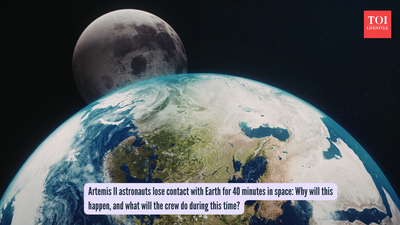
Imagine voyaging through the void, farther from home than anyone has ever been. For the Artemis 2 crew, this isn't science fiction; it's happening right now. While you read this article, the crew might have already ventured beyond the last point of contact with Earth to take a 'stroll' ahead of the Moon.Launched just days ago on April 1, their Orion spacecraft is looping around the Moon, pushing human exploration back to where it all began over 50 years ago. But space doesn't just test machines; it actually challenges the human spirit.Out there in space, where Earth is a tiny blue and green marble, beyond a point, there are no updates, no guidance - just you, your crew, and the infinite black.This moment of disconnection hits hard. Astronauts train for it, but nothing fully prepares them for the psychological weight of true isolation, and past missions like Apollo have already taught that.
Yet, it's also a chance for reflection, wonder, and even unity back home.As the crew approaches the Moon's far side, the world holds its breath. What goes through their minds in that quiet? How does it feel to be cut off, staring at the lunar surface up close?
Representative Image
The 40 minutes of no contact for the Artemis II crew
Picture this: you're strapped into the Orion spacecraft, the Moon looming large outside the window. Around 4:17 am IST on Monday, April 6, 2026, the spacecraft slips behind the lunar far side.
For about 40 minutes, the Moon will block all radio and laser signals to Earth, and no voices from Houston's mission control will be heard by the crew, with whom they have been communicating so far.NASA confirms this brief communications blackout is a fully planned mission milestone, caused by basic physics and geometry.
Why will the crew lose contact?
Orion's signals, which are primarily radio waves, with some laser communications, travel exclusively in straight lines as electromagnetic waves.Earth-based antennas in NASA's Deep Space Network need an unobstructed line of sight to maintain the link. As Orion passes behind the Moon's far side, the lunar surface positions itself squarely in the signal path.The Moon's solid rocky composition completely blocks these radio waves, instantly severing all contact since signals can't penetrate or bend around the massive body.The four astronauts, Commander Reid Wiseman, pilot Victor Glover, and mission specialists Christina Koch and Jeremy Hansen, might find themselves utterly alone, each lost in private thoughts amid the cosmic dark.
What will the astronauts do during this time span?
It's profound, this blackout, as no one has ventured this far with a crew since Apollo to experience that faint glow of instruments, the sheer scale of space pressing in. They'll use the time for lunar flyby tasks like clicking photos, analysing geology, looking at the Moon's rugged beauty up close, and following up on research work. But beneath the work, there's an emotional pull—the Earth shrinking to a distant speck, home out of reach.
Similar instances from Apollo's Past
This isn't new territory. Over 50 years ago, Apollo 11's Michael Collins orbited solo while Armstrong and Aldrin walked the surface. For 48 minutes behind the Moon, Collins lost contact with everyone. In his 1974 memoir Carrying the Fire, he wrote about feeling "truly alone" and "isolated from any known life," yet free of fear or loneliness. Later interviews revealed the radio quiet brought "peace and tranquillity," a welcome pause from mission control's constant calls.Artemis 2 pilot Victor Glover talked about that calm before his mission. "When we're behind the Moon, out of contact with everybody, let's take that as an opportunity," he told BBC News. "Let's pray, hope, send your good thoughts and feelings that we get back in contact with the crew." Glover hopes the world unites in those minutes, channelling positive energy.
Tensions back on the Earth
At Cornwall's Goonhilly Earth Station, a massive antenna has tracked Orion's path, feeding data to NASA. Chief technology officer Matt Cosby told the BBC, "This is the first time we're tracking a spacecraft with humans on it. We're going to get slightly nervous as it goes behind the Moon, and then we'll be very excited when we see it again, because we know that they're all safe." Teams worldwide brace for the gap, knowing reconnections should be swift once Orion emerges








 English (US) ·