

 4 days ago
11
4 days ago
11
ARTICLE AD BOX
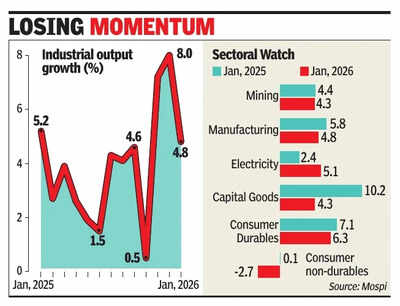
India's industrial output growth dipped to a three-month low in January, registering a 4.8% rise. This slowdown was primarily driven by a sluggish manufacturing sector, with capital goods moderating and consumer non-durables contracting. Experts anticipate global uncertainties and geopolitical tensions will continue to impact the industrial sector's sentiment and performance.
NEW DELHI: Industrial output growth slowed to a threemonth low in January due to a sluggish manufacturing sector while the capital goods sector moderated and the consumer non-durables contracted.
Data released by the National Statistics Office (NSO) on Monday showed industrial output growth rose an annual 4.8% in January, slower than the upwardly revised 8% in Dec and below the 5.2% recorded in January last year.Experts said global uncertainty and geopolitical tensions are expected to weigh on sentiment and this could have an impact on the industrial sector. The data showed the manufacturing sector rose 4.8% in January, slower than the 5.8% in January last year and well below the 8.4% recorded in December last year.
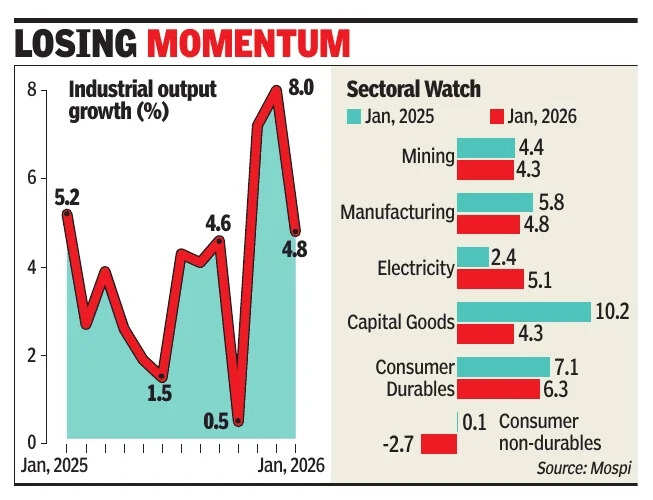
The electricity and mining sector held steady, clocking growth of 5.1% and 4.3% respectively during the month but compared to Dec growth softened. The electricity sector had grown by 2.4% in January last year while the mining sector had risen 4.4%.The capital goods sector, a key gauge of investment activity, grew by 4.3% during January, slower than the 10.2% in the year earlier period. The consumer durables sector rose 6.3% in January, slower than the 7.1% in January last year while the consumer non-durables sector contracted by 2.7% during the month compared to an expansion of 0.1% in January last year.
“Next fiscal year, we expect industrial production to remain healthy , given expectations of robust private consumption and growth in investments–the GST cuts and continuing direct benefit transfers by the states will support private consumption, while private investments could see a mild revival,” said Dipti Deshpande, principal economist at ratings agency Crisil.“But ongoing geopolitical developments will bear watching as they pose a risk to exports and commodity prices. Elevated uncertainty could deter investments,” said Deshpande.





 English (US) ·