

 1 hour ago
2
1 hour ago
2
ARTICLE AD BOX
4 min readOsloMay 30, 2026 11:42 PM IST
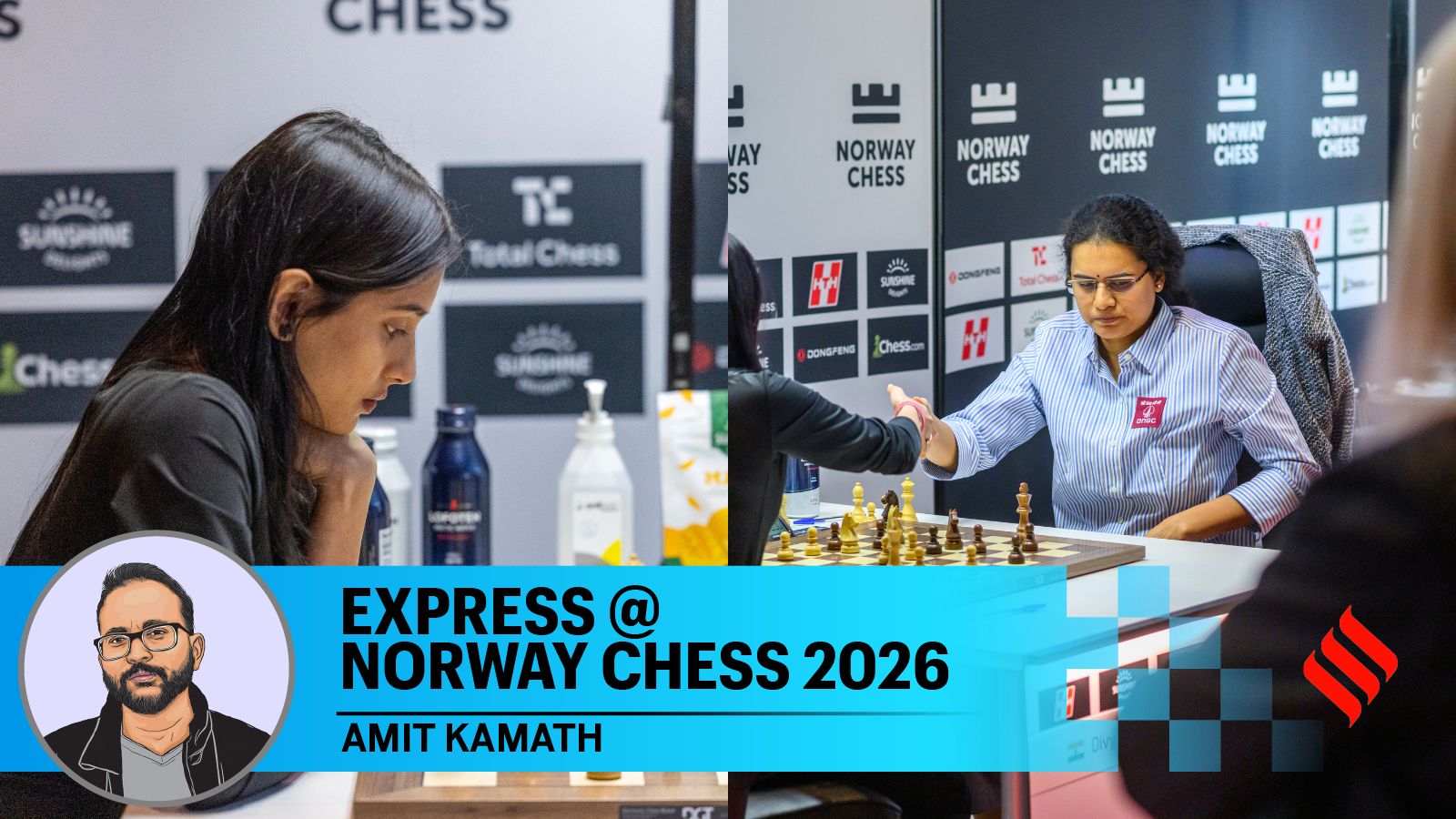 Koneru Humpy and Divya Deshmukh play an Armageddon game at Norway Chess 2026. (Credit: Michal Walusza/Norway Chess)
After Divya Deshmukh prevailed in a nerve-wracking Armageddon game against compatriot Koneru Humpy, she turned up for media interactions with tiny droplets of tears in her eyes. Not emotion. Not happiness.
“I’m just exhausted,” she said.
In her first appearance at Norway Chess, one of the strongest invitational tournaments she has been part of, Deshmukh had gone through the Armageddon four times in four days — prevailing three times before her luck ran out in the fourth. The tears were not dramatic. They were simply what four consecutive days of maximum pressure looked like on a human face.
The Armageddon has been Norway Chess’ defining innovation since 2019. When a classical game ends in a draw, players have a few minutes to compose themselves and draw up battle plans before returning for a sudden-death tiebreaker. White gets 10 minutes on the clock. Black gets seven. But black only needs a draw to win the Armageddon. White must win outright. It has all the harakiri of a penalty shootout in football, or a bowl-out in a T20 World Cup — except the asymmetry makes it something more interesting than pure nerves. Norway Chess’ own stats show white maintains only a slight edge: 52 percent.
In the first four rounds of Norway Chess 2026, 19 of the 24 games have been decided by the Armageddon. The classical games are almost a prelude.
Each player has found a favourite corner of the Deichman Bjørvika — the spacious five-storey public library in Oslo where the tournament is taking place — to retreat to when the draw is signed and the tiebreak looms. Gukesh and his coach Grzegorz Gajewski disappear to a cosy corner on the third floor, on the other side of the playing arena. Deshmukh takes the leather chairs that overlook the glistening waters of the Oslofjord, discussing tactics with her coach over the phone. The library, built for quiet contemplation, has become a war room.
Indian players have developed a particular reputation in the format. At last year’s edition, Arjun Erigaisi won four of his five Armageddon games. Before this season — where Gukesh has lost two of his three — the world champion had won six of eight across two appearances, a remarkable record given that faster time controls are not considered his strength.
Magnus Carlsen, who has his own exceptional record in the format, was asked about it at the pre-tournament press conference. His answer acknowledged both sides of the argument.
Story continues below this ad
“As a Norwegian speaking in the birthplace of this format, it’s pretty exhausting for the players to play that every day. It’s just a maximum of 17 minutes, but it’s pretty tough on the nervous system. It’s more intense than the classical games for sure.” He noted that Norway Chess’ own time controls — 120 minutes with a 10-second increment from move 41 — were already designed to create wild time scrambles at the end. Adding an Armageddon on top was a true test of character.
Then he added: “But I also think that it’s excellent entertainment and we are an entertainment product after all.”
Deshmukh, sitting by the Oslofjord with tears of exhaustion still drying, would probably agree with the first part. The crowds watching her survive three of four would agree with the second.








 English (US) ·