

 11 hours ago
5
11 hours ago
5
ARTICLE AD BOX
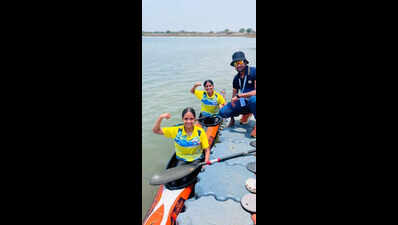
Bhopal: Paddlers from the majority states participating in last week’s National Kayaking and Canoeing Championship in Chhattisgarh registered podium finishes, racing boats carved in a garage in Madhya Pradesh.Of the 24 states that participated in the event, paddlers from 22 arrived in boats that came out of the production line at the garage.It all started on normal training day in 2019, around the time Covid arrived leaving a devastating trail of death and disruption across the globe. Mayank Thakur, a national-level canoeing and kayaking coach from Madhya Pradesh, saw something in the eyes of his charges that was deeper than fatigue and bordered on frustration and disillusionment.Their helpless gaze conveyed a larger story of systemic apathy, which saw the paddlers being edged out in competitions, not as much down to lack of skill or training as the cost of imported boats that was far beyond what they could afford.“I simply could not stand idly by watching potential losing out to price tag,” Thakur recalled.Driven by a conviction that he had to be the agent of the change that he wished to see in Indian water sports, Thakur moved from the shoreline to a workshop.
Trading his stopwatch and training whistle for tools and blueprints, he converted his modest Bhopal garage into a small manufacturing unit for affordable kayaks and canoes.“We started with a simple goal — to make boats that athletes could afford,” the coach said, adding, “Everything else just fell into place as we went along on this journey.”The outcome of his entrepreneurial foray was immediate and unmistakable, as locally produced boats, priced at a fraction of their imported counterparts, began appearing at training centers across the state.“For the first time, I could afford my own kayak,” said Ankit Pachori, the first canoeist from Madhya Pradesh to have represented India at the World Championship.Coaches, too, hailed the welcome shift brought about by Thakur’s initiative, saying that Indian paddlers are now training more consistently, traveling with their own equipment and competing with new belief and confidence.“Seeing paddlers, who raced our boats, on the podium was a truly emotional and rewarding moment,” Thakur said, adding, “It proved that access to affordable boats, and not talent, was the missing piece in Indian water sports.”Both athletes and officials credited the initiative with leveling the playing field. “Equipment costs have always been a major obstacle to chasing glory in water sports,” Prashant Kushwaha, the president of International Canoe Federation (ICF), told TOI, adding, “We welcome more such initiatives that give paddlers access to affordable boats.”“This (the initiative) has altered the sport’s economics while giving more competitive edge to our paddlers,” Kushwaha said.For athletes and their families who once weighed the expense of a single boat against household needs, the change has been life-altering. “My parents would worry about the expenses of these boats,” said Namita Chandel, a young paddler from Seoni, adding, “Now the affordable boats mean that I can practise every day, not just when one is available.”Encouraged by the response to his venture, Thakur now plans to scale up production while coming out with new and improved designs, based on feedback from paddlers, without compromising on the price tags.His workshop has already begun training local youth in boat building — turning a solution into a small industry. “This started as a coach’s response to frustration in the eyes of his charges. Now it’s about fuelling dreams — one affordable boat at a time,” the coach signed off saying.


 English (US) ·