

 8 hours ago
5
8 hours ago
5
ARTICLE AD BOX
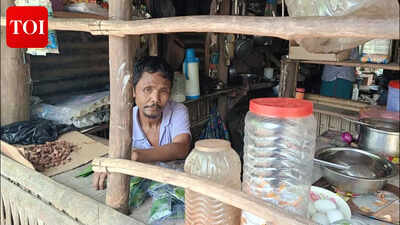
Hahim (Assam-Meghalaya border): At a tiny shop beside a “special” inter-state boundary pillar in Hahim, Emos Marak weighs biscuits, cigarettes, and a decision that could redefine a decades-old boundary dispute between Assam and Meghalaya.For Marak, a Garo shopkeeper from Salpara village in the once-disputed Assam-Meghalaya border belt, the 2026 Assam assembly election is not simply another political exercise. For him, it is an “election of separation” — not because of rivalry between parties or states, but because many villagers like him have decided they will no longer vote in Assam by crossing the pillar, which was installed after joint verification by the administrations of both states in a historic bid to resolve the boundary dispute.The concrete pillar beside his shop may appear ordinary, but for residents of Hahim it represents a historic shift. It marked the first physical demarcation of the boundary.Hahim falls within one of the six disputed sectors where both states reached a settlement last year. That breakthrough followed the 2022 agreement signed by the Assam and Meghalaya govts, resolving disputes in six of the 12 contested stretches covering more than 2,700 sq km along the 884-km border.
Yet the pillar has not ended uncertainty. The final govt notification is still awaited, meaning the land remains officially unsettled even as the marker stands on the ground. This unresolved status has left residents caught between administrative transition and emotional division. Meghalaya authorities have reportedly told Salpara residents — whose homes fall beyond the pillar on their side — not to participate in the Assam election.“Since our childhood, there was no visible boundary between Assam and Meghalaya. People moved freely, and many residents voted in elections in both states because they possessed voter cards issued by both administrations. Now, with the pillar in place and instructions coming from the Meghalaya side, we want peace and clarity and have therefore decided not to vote in Assam this time,” said Marak.Hundreds of such “dual voters” are common in the border villages of Kamrup district that remained disputed.
For decades, residents in these areas voted in both Assam and Meghalaya because both states claimed these villages and extended services such as electricity, ration supplies, water, and other welfare benefits.In Hahim too, this overlapping governance shaped everyday life. The border point is marked by scattered homes, a few roadside shops, and police check posts from both states.Salpara, where Marak lives, has around 150 families. Nearby Athiabari has roughly 200.
In earlier elections, many residents from these villages, especially Salpara, voted in Assam. This time, however, locals say the atmosphere is different. Political parties from Assam are reportedly avoiding crossing the pillar during campaigning. Hahim comes under the ST-reserved Boko-Chhaygaon constituency, where Congress’s Ramen Singh Rabha and BJP’s Raju Mech are among the prominent contenders.Residents interpret this restraint as an effort not to disturb the ongoing process of final boundary settlement between Assam’s Kamrup district and Meghalaya’s West Khasi Hills.Achyut Rabha, a citizen of No.-2 Samuka in the Hahim area, said, “Assam’s political leaders are effectively making a point by staying on their side of the pillar. We want the next govt to identify which areas remain within Assam so that the dispute can be settled.”Although Hahim has not witnessed serious border violence in recent years, tensions have erupted at other points along the Assam-Meghalaya boundary from time to time over allegations of encroachment from both sides.Election officials say joint verification in Hahim was done and then the pillar was erected, but the final determination of which households will remain in Assam and which will fall under Meghalaya has not yet been made. A senior Assam administration official said, “For Hahim, there has been no official notification specifying which locations are included in Assam and which are not.” The official added that those villagers choosing not to vote in Assam may believe their homes now fall in Meghalaya, but that assumption has not yet been formally confirmed.






 English (US) ·