

 6 days ago
9
6 days ago
9
ARTICLE AD BOX
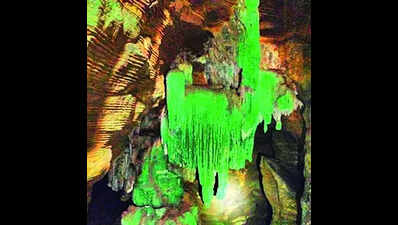
Forest Dept Says Visuals ‘Misinterpreted’
RAIPUR: The row over Bastar’s fragile Green Cave has entered a more nuanced phase, with Chhattisgarh forest department strongly defending its actions of making it more protective with bit of construction work while scientists continue to caution against human interference in the sensitive cave ecosystem.
The debate centres on the cave locally known as Salma Sitara Gufa, part of the famous Kutumsar cave complex. While recent visuals triggered claims that dust from construction has dulled the cave’s green formations, and a cave ecologist has strongly disagreed with the idea of opening highly sensitive sections for construction and tourism, the PCCF Arun Pandey said the perceived discolouration is being misinterpreted.
The matter is now under judicial watch, with the high court asking the Kanger Valley National Park director to file an affidavit detailing safety and conservation measures in next hearing on Mar 3.At the heart of the latest round of controversy are visuals circulating from the site, with some locals and environmental voices claiming that dust from recent works has dulled the cave’s green formations. The forest department, however, has denied any such damage and says the work underway is aimed at protection, not commercialization.
Cave ecologist and former Pt Ravishankar Shukla University professor Atanu Kumar Pati, who has studied the Kutumsar cave complex for over two decades, has urged the state to take a more conservative approach. He argues that the Green Cave is not an isolated pocket but part of an interconnected cave ecosystem whose microclimate, microbial communities and cave-adapted fauna can be destabilised by even small disturbances.
“Thousands enter Kutumsar on national holidays and accidental damage to stalactites is common. These formations take centuries to grow. Once broken, they cannot be recreated,” he said. Pati pitched a restricted model — permitting only regulated, genuine research access and keeping highly sensitive caves away from mass tourism.Principal Chief Conservator of Forests Arun Pandey told TOI that the department is using natural materials — bamboo and stones — to create safer movement routes, and stressed that “no concrete work” is being done.
The cave’s mouth is being secured to prevent entry by animals and anti-social elements. Pandey argued that safety measures are necessary because entry currently involves climbing and unsafe movement, increasing the risk of vandalism or accidental damage.
He also linked the exercise to conservation management, pointing out that Kanger Valley has been placed on UNESCO’s tentative World Heritage list and that the park has 11 caves, of which only three have been opened for tourism over the last four decades. “Kanger Valley has special floral and faunal diversity and unique geomorphological structures like limestone caves. If such uniqueness remains inaccessible, what does uniqueness mean?” he said, adding that advice has been sought from the Geological Survey of India.A wildlife expert said flagged biodiversity concerns, noting that the area around the cave is frequented by protected species such as sloth bears and the Small Indian Civet, both Schedule I animals, and warned that making such habitats busier can run counter to the conservation mandate of a national park.“There is no dust settling. What people are seeing is a high-resolution camera effect,” said another officer, responding to the allegations on latest visuals showing dull images of the green algae.Offering a different perspective, cave scientist Dr Jayant Biswas had recently told reporters that conservation should not automatically mean closure. He said the so-called Green Cave is not a separate discovery but a green chamber linked to the Kutumsar system and stressed that only a small fraction of Kanger Valley’s caves have been mapped so far. Biswas’s key point was that visitor pressure at Kutumsar is already rising without a scientifically defined carrying capacity, and opening another cave — under strict safeguards — could help distribute footfall while improving awareness and local livelihoods. He also flagged a larger gap, noting that speleology remains outside mainstream higher education in India, leading to limited scientific understanding and public mistrust around cave management.For now, the Green Cave stands at the crossroads of two competing ideas one that sees controlled access as a path to awareness and conservation, and another that believes even minimal human presence could irreversibly alter a geological system shaped over millennia. As Bastar weighs access against preservation , the Green Cave has become more than a geological curiosity.






 English (US) ·