

 1 week ago
9
1 week ago
9
ARTICLE AD BOX
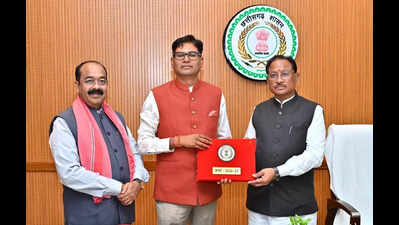
RAIPUR: In a budget framed around the idea of taking government action from “intent to impact”, insurgency-hit Bastar and comparatively backward Surguja districts have been given a stitched-together development package that reads like a roadmap for daily life in the tribal belt for increased accessibility, more local jobs, stronger institutions, and a tighter security grid.
The 2026–27 plan spreads money across sports, tourism, transport, nutrition, livelihoods, health and irrigation, taking it all beyond security operations to the region’s next chapter of exploration.At the community level, the budget tries to widen the “public space” in districts where isolation is often the biggest handicap. It has planned to spend ₹10 crore for the Bastar–Surguja Olympics, a programme the government is pitching as more than a sports event — a way to bring young people out of the shadows of conflict, identify talent, and create shared platforms across villages and blocks. In the same spirit of stitching remote pockets into the mainstream, the state has provided ₹10 crore for the Mukhyamantri Bus Seva Yojana for the tribal belt, a move that could decide whether a student can reach a coaching centre, a patient can reach a hospital on time, or a farmer can access a mandi without losing an entire day to distance.The budget also bets on tourism as a “home-grown” income stream in forested districts where formal jobs are limited.
It has set aside ₹10 crore for the Chhattisgarh Homestay Policy, which is expected to nudge local entrepreneurship, the kind that keeps money in the village economy: families hosting travellers, local food supplies, guides, transport, crafts and small services. If the policy is executed well, it could create a chain of micro-incomes without large industrial footprints.On livelihoods, the package turns to what can work quickly in tribal households: small, scalable assets.
The budget allocates ₹15 crore to promote goat rearing, pig rearing and beekeeping, to diversifying incomes beyond seasonal wage labour. Alongside this, it provides ₹15 crore for additional nutrition support, reflecting an attempt to tackle a persistent weakness of the region, high nutrition vulnerability — while also strengthening the household safety net.The real impact here will be seen if these programmes are taken to the last mile with training, veterinary support, market links and sustained follow-up rather than one-time distribution.The strongest long-term signal in the Bastar–Surguja package is the focus on institutions, especially health and education, because they shape whether a region retains talent or loses it. The budget provides for the functioning of new medical colleges in Dantewada, Kunkuri and Manendragarh, which could gradually reduce dependence on far-off centres for specialist care. In a region where emergency care often depends on time and distance, strengthening local medical capacity can translate into direct lives saved over the years.
The budget also proposes a new Prayas residential school in Bijapur, a move meant to expand access to structured education and coaching support for children from remote areas.If there is one line item that defines “development at scale”, it is irrigation, officials said. The budget notes that ₹2,024 crore has been approved for works linked to the Indravati river barrage in Bastar, with related irrigation interventions also flagged for districts including Bijapur and Kanker. Running alongside this development thrust is a clear security reinforcement. The budget provides for 1,500 new Bastar Fighter posts, underlining that the state is not separating development from stabilisation. This will help deepen localised security presence with an approach intended to prevent vacuums in interior areas even as more services move in.Whether it becomes transformative will depend less on the announcements and more on delivery.
How fast buses actually run, whether homestays are supported and marketed, whether livestock schemes get market linkages, and how quickly big-ticket irrigation works move from approvals to execution."In a state with a large rural and tribal population, such support carries social significance, although welfare spending must increasingly connect with income generation and productivity. Long-term growth cannot depend only on subsidy-based support. Chhattisgarh has relied on its mineral resources. Transitioning towards value addition and broadening into manufacturing and services will be crucial for long-term economic stability," said Pragati Krishnan, professor in School of Studies in Economics, Pt.
Ravishankar Shukla University.






 English (US) ·