

ARTICLE AD BOX
MCA expands CSR activities to 28 development sectors as 27,188 companies report CSR spending in FY 2023-24.
Corporate Affairs Ministry highlights CSR growth from ₹10,065.93 crore in FY 2014-15 to ₹34,908.75 crore in FY 2023-24
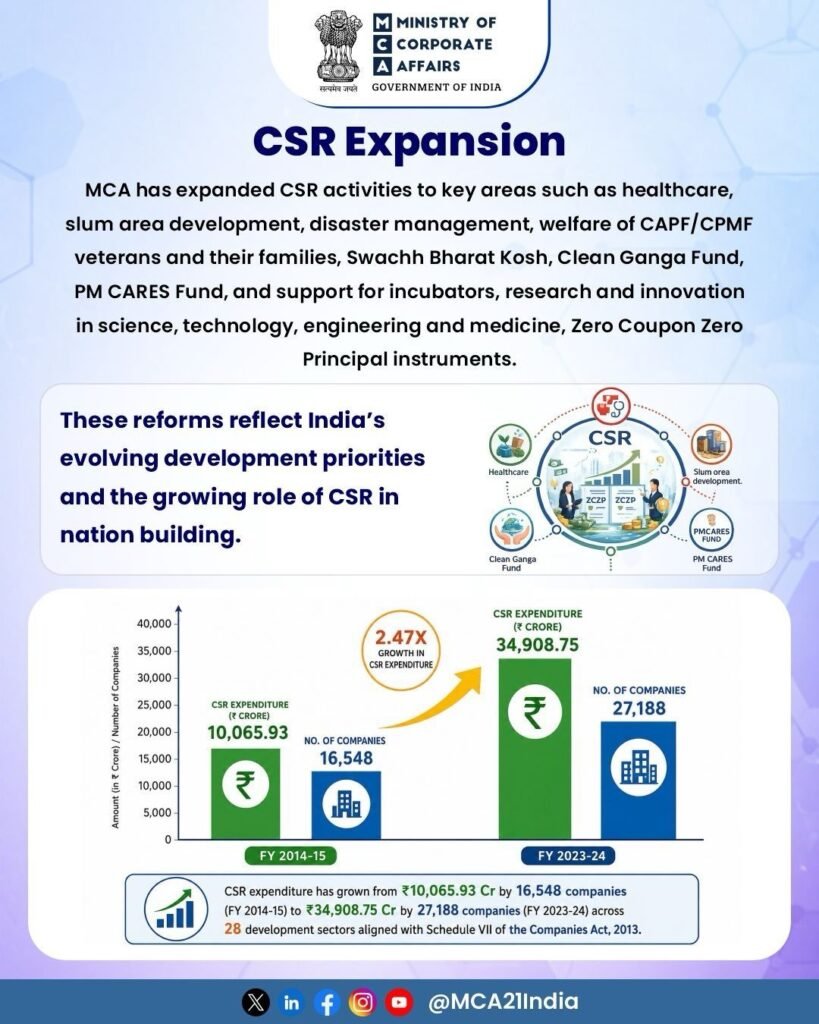
NEW DELHI (India CSR): The Ministry of Corporate Affairs (MCA) has expanded the scope of Corporate Social Responsibility (CSR) activities in India by including several key development areas aligned with the country’s emerging social, environmental, and institutional priorities. CSR now covers 28 development sectors aligned with Schedule VII of the Companies Act, 2013.
The expanded CSR framework now covers important areas such as healthcare, slum area development, disaster management, welfare of CAPF and CPMF veterans and their families, Swachh Bharat Kosh, Clean Ganga Fund, PM CARES Fund, support for incubators, research and innovation in science, technology, engineering and medicine, and Zero Coupon Zero Principal instruments.
The move reflects India’s changing development needs and the growing role of CSR in nation building.
CSR Becomes a Wider Development Tool
CSR in India has evolved from a compliance-driven activity to a broader development instrument. The MCA’s expansion of eligible CSR areas indicates that corporate resources are now being encouraged to support both traditional welfare activities and new-age development priorities.
Healthcare, sanitation, disaster response, research, innovation, urban improvement, environmental protection, and social welfare have become major focus areas under the CSR ecosystem.
This wider approach allows companies to align their CSR projects with national priorities while also addressing local community needs.
 Source: MCA. Govt of India.
 CSR Spending Shows Strong Growth
According to the MCA data highlighted in the communication, CSR expenditure in India has grown significantly over the last decade.
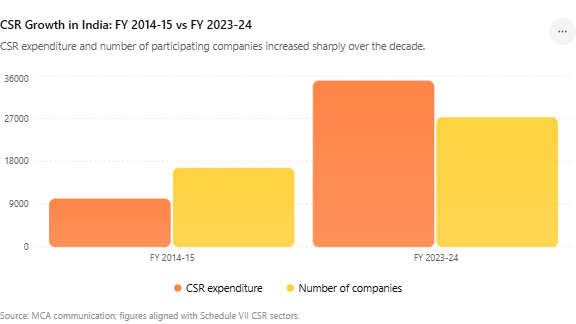
CSR expenditure increased from Rs. 10,065.93 crore in FY 2014-15 to Rs. 34,908.75 crore in FY 2023-24.
The number of companies participating in CSR also grew from 16,548 companies in FY 2014-15 to 27,188 companies in FY 2023-24.
This means CSR spending has grown 2.47 times during this period. The activities now cover 28 development sectors aligned with Schedule VII of the Companies Act, 2013.
Healthcare and Disaster Management Get Stronger Focus
Healthcare has remained one of the most important CSR areas in India. The expansion reinforces the importance of corporate participation in strengthening health systems, supporting medical infrastructure, promoting preventive healthcare, and improving access to services.
Disaster management has also gained significance. India frequently faces floods, cyclones, earthquakes, heatwaves, and other natural disasters. Corporate support through CSR can help in preparedness, relief, rehabilitation, and long-term community resilience.
Support for Veterans and Families
The inclusion of welfare measures for CAPF and CPMF veterans and their families adds a national service dimension to CSR.
Companies can now support initiatives that benefit personnel who have served in security forces and their dependents. This may include education, healthcare, livelihood support, skill development, rehabilitation, and welfare programmes.
This step links CSR with national gratitude and social responsibility towards those who have contributed to public security.
Funds for National Missions
The CSR expansion also includes contributions to important national funds such as Swachh Bharat Kosh, Clean Ganga Fund, and PM CARES Fund.
These funds support large-scale national missions. Swachh Bharat Kosh focuses on sanitation and cleanliness. The Clean Ganga Fund supports the rejuvenation and conservation of the river Ganga. PM CARES Fund supports emergency and relief measures during crisis situations.
By allowing CSR contributions to these funds, the government has created a direct route for companies to participate in national development programmes.
Research, Innovation and Incubation Included
A major feature of the expanded CSR scope is the inclusion of support for incubators, research, and innovation in science, technology, engineering, and medicine.
This is important for India’s future development. CSR can now support innovation ecosystems, start-up incubation, applied research, and technology-led solutions for social problems.
This shift shows that CSR is not limited to charity or welfare. It can also become a driver of knowledge creation, innovation, and sustainable development.
Zero Coupon Zero Principal Instruments
The inclusion of Zero Coupon Zero Principal instruments is another important reform. These instruments are linked with the social stock exchange framework and can help channel funds towards social enterprises and non-profit organizations.
This creates a new path for CSR-backed social investment. It can strengthen credible social organizations and improve funding access for impact-driven institutions.
CSR and Nation Building
The expansion of CSR activities reflects India’s evolving development priorities. It also highlights the growing expectation that businesses should contribute meaningfully to society.
CSR is no longer seen only as a statutory obligation. It is becoming a structured platform for corporate participation in national development.
Companies now have a larger canvas to design impactful projects. They can work in healthcare, sanitation, urban development, research, environment, social innovation, national relief, and welfare of vulnerable communities.
Companies Need Strategic CSR Planning
With the expanded scope, companies will need stronger CSR planning. They must identify priority areas, select credible implementing partners, measure impact, and ensure compliance with the Companies Act, 2013.
The growth in CSR spending also increases the need for transparency, accountability, and outcome-based reporting.
A strong CSR strategy should not only meet legal requirements but also create measurable social value.
Growth Chart: Key Facts on CSR Expansion
Key Facts
- CSR expenditure grew 2.47X from ₹10,065.93 crore in FY 2014-15 to ₹34,908.75 crore in FY 2023-24.
- Company participation increased from 16,548 companies to 27,188 companies.
- CSR now covers 28 development sectors aligned with Schedule VII of the Companies Act, 2013.
Copyright@India CSR®

ADVERTISEMENT

ADVERTISEMENT

ADVERTISEMENT

ADVERTISEMENT










 English (US) ·