

 2 days ago
11
2 days ago
11
ARTICLE AD BOX
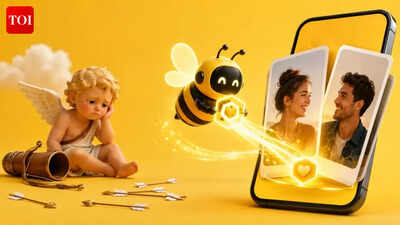
Remember the time when your best friend gave you a list of specific instructions, asking you to show up at a bookstore?“Yellow really pops, and those studs from your last birthday! And don’t be late, okay?”All this, because she had meticulously planned a “meet cute” between you and a guy she knew through mutual connections, and thought that it would be a good idea to set you two up.Decades ago, “dating” used to follow a route similar to this one — friends setting you up with their acquaintances, or you coming across people at get-togethers and hitting it off over a bowl of snacks or a round of dumb charades, and so on.But the 21st century decided to tweak that round of charades — dumb or not.This century started off with the birth and rapid growth of social media, saw it boom and its bane, and witnessed those platforms evolving into a space to find, meet, and interact with “friends of friends” — no more bookstore dates required.
Those platforms eventually became spaces where the friend circle expanded, and romance occasionally bloomed.But that was not enough — hardly any digital innovation ever is.So, enter dating apps: more exclusive spaces for mingling. Unlike the social media platforms, these spaces aspired to skip the initial "friendzone" and get to the “good part” where flirtatiousness — especially towards women — largely bordered on too audacious, frequently invasive, and more often than not, alarming.
The concept behind the dating app was to pick a person based on a grocery list — only this time, it was a list of your preferred criteria for a companion instead of your weekly meal prep. The idea was: you make a comprehensive list, you come across someone who holds your attention/interest, you check that person’s profile against your checklist, and you swipe right on that particular person (swiping left means you are discarding the option).
With some luck from Cupid, if the same person swipes right on your profile — after the same drill — “it’s a match!”It would not be an exaggeration to say that the “spark” was replaced by a thorough compatibility check, and chemistry was not organic in *most* cases.Most dating apps followed the same method of matchmaking — almost like a digitized version of the matrimonial ads in newspapers. In a way, it is a polished and modernized version of an arranged marriage; not necessarily with the proposition of marriage in mind, though.
And instead of your parents, you are looking for the fish yourself. So, technically, it is a matrimonial website — but with much more relaxed end goals.Of course, it did not take long for Cupid to assume some crooked traits in order to succeed at the game of modern dating/romance sans the pressure of rushing to an ultimate destination. In fact, over the years, Tinder, the dating app that stirred the conversation the most, earned its rep as the “hooking up app” — a not-so-insignificant step away from the dating scenario.
People did not have much interest in getting to know each other, let alone forming a meaningful attachment; they were more aligned with the “skip to the good part” bit (the pun must be translated here).A few more dating apps, lukewarm responses, and a lot of unsavoury female experiences later came Bumble — the app where women had the agency to “make the first move.”What did that mean?Suppose you, as a woman, are pursuing a heterosexual prospect.
You swiped right on a man. If they did the same, and turned it into a “match” — the ball is in your court, whether or not, or how you want to start the chat.Bumble, amongst the pool of dating apps, truly had better women-first approaches compared to its contemporaries. Later, however, they relaxed the “only” women making the first move feature, allowing men to have the opportunity to start the conversation as well.Although it was positioned as an online dating platform, Bumble came with three separate wings — one for dating, one for finding a best friend in the era of digital friendships, and one for people, especially women, in business, trying to expand their professional network.Sounds like a dream in the sea of shitty dating apps, right?Now imagine the disappointment when the same platform announces that they are about to roll out an AI-enabled experience — moving away from the swipe feature!It is true to a certain extent — in such a saturated modern matchmaking market with so many dating apps, especially amidst a seriously deteriorating dating standards where women would rather stay single than be involved in a scenario that has no real scope of translating into something substantial, swiping on a dating app may seem more like a chore than an intentional ritual.
There may even be times when one might randomly swipe left on someone out of acquired habit instead of taking a good look at them.
But what if the person they swiped left on was their sole mate on the platform (yes, pun is always intended)? What if one misses out on crossing paths with them, just because their thumb ached from swiping while the dating pool ran dry?Bumble believes that, in order to have that answer, one has to let it “Bee.”Enter the AI-matchmaker of Bumble, Bee, which, according to founder Whitney Wolfe Herd, is supposed to be “revolutionary for the category.”In practical terms, Bumble plans to phase out the left/right swipe, the move Tinder already made, in favor of an AI-driven matching system. The new platform, which is slated to roll out in Q4 2026, will be an “AI-enabled” overhaul of Bumble’s dating app.Translate this whole hullabaloo in plain English: Soon you will not be flicking faces anymore — you will be chatting with a chatbot.And even though the last quarter of 2026 seems a little in the future, reportedly, Bee is already being tested in a small NYC pilot. Bumble’s support page says the feature is currently available only to a small selection of invited members in New York City, and that Bee will guide users through questions about relationship preferences, values, and what truly matters in a partner before searching for compatible people and notifying users in-app.On the surface, it seems like nothing but getting a new bestie/wing-person to sift through a pool of prospects, but the subtext is stranger: Bumble is not merely tweaking the app, but trying to replace the oldest gesture in app dating with a machine that asks, learns, filters, and decides. While onboarding the app, Bee will ask you several questions, will “learn [your] values, relationship goals, communication style, lifestyle, and dating intentions” by chatting with you, and then will search for people “tailored just for you” and ping you when it finds a possible match.
Bee will pair two users who share key goals and interests, then notify both with a description of why they might click.The company line is simple: less browsing, less friction, “deeper, more compatible connections.”So, instead of scrolling endlessly, you will enter a new “Dates” mode where Bee suggests people who seem compatible. In future updates, Bumble says Bee will even suggest date ideas and collect anonymous feedback after a date, acting like that ultra-helpful friend who sets you up on blind dates and then pesters you for a report.Now, Bumble’s intentions do not appear misplaced — they claim that this could be the antidote to swipe fatigue. In fact, Herd said, “people are feeling exhausted, they’re feeling fatigued – the swipe has degraded their love lives.”And that is not untrue as well. A Forbes health survey found nearly 78% to 80% of online daters felt emotionally or physically burned out by swiping.Bee might prove to be a good Samaritan to vet your matches based on “you” and then deliver a finer prospect with real potential.
The whole deal does sound proficient.But dating has never really been a problem of efficiency. In today’s era, where most people are running against time and circling back for the n’th time to keep up with their hustlemania, it is about consistency — it is about the willingness to show up amidst the tired, despite the exhaustion. And that is a problem of being human in the era that is hellbent on trading the last morsel of leisure for a productivity tracker.
A dating app trying to fix uncertainty with compatibility checks, ambiguity with more prompts, and chemistry with match scores — all these may sound neat in the sense of calculation, but they do not make much sense beyond a product pitch.
Real life is messier, and still glorious as hell. Trying to turn something so humane into a highly optimized experience seems like a failed attempt at trying to be a competent sorting hat — only much grumpier.Sure, the great swiping game is not some boon to descend upon us — it already is a shoddy promise that vows to put its viewfinder to work looking for a soulmate, only to end up paying its due to the algorithm. But the illusion of an artificial intelligence that assures you to translate your desire into a better-structured spreadsheet and preserve the “spark” while being at coding and calculations is simply ludicrous!And then, there is this privacy question underneath all this intrusion to work the “AI-enabled intuition.”
To give Bee data to work with, Bumble is set to retool profiles. So, instead of judging a person at a glance, you’ll fill out “chapter-based” profiles, showcasing different facets of your life. Each “chapter” might cover your hobbies, career, childhood — whatever you deem match-worthy. Users can then browse those story chapters, not just static photos, to find common ground.
Bumble explains, this yields “more data to feed into [the] AI system and algorithms”.
In short, the more you tell Bee about yourself, the better it can pair you with someone whose puzzle pieces fit.That means the app is not just reading what users click; it is asking them to narrate their emotional lives to a system that then does the choosing. The company may present that as personalization, but for users, it is also a new intimacy bargain: tell the machine more about yourself so the machine can find you love.
In an era when people already worry about data trails, profiling, and whether platforms know them too well, that feels more like a surveillance consultant in a cute makeover of Cupid.And just how safe is that? In today’s time, where data privacy is already a serious concern, feeding a dating app your most intimate information does not sound like a safe bet.This debate also comes at a time when many young people already substitute digital companions for real ones.
Studies show a growing number of lonely singles are bonding with AI chatbots or virtual partners.One 2025 study detailed how 2.44% of Danish high-school students now engage in mutual participative conversations or seek emotional support from chatbots. Another study published by Harvard Business Review in April last year confirmed that, indeed, AI companionship and therapy are now the number one use case of generative AI. Another study, titled ‘Counterfeit Connections: The Rise of AI Romantic Companions’, published by the Wheatley Institute at Brigham Young University and the Institute for Family Studies, found that almost one in five US adults (19%) have chatted with an AI system designed to simulate a romantic partner.
This rate is even higher among young adults (18-30), with nearly one in three young adult men (31%) and one in four young adult women (23%) reporting such interactions.Why is this AI dependence growing gradually?Stanford Medicine researchers warn that these chatbots simulate deep, empathetic relationships and can exploit vulnerable users. Chatbots will shower you with flattery, instant validation, and easy agreement — because they’re built to keep you hooked — but often at the expense of real emotional pushback.
Sure, the AI plays nice, but ultimately, it lacks the “rough spots” of true friendships and romances that teach us boundaries and resilience.
As Stanford put it, AI companions offer “frictionless” relationships that may actually increase isolation for users who skip real social challenges.Come to think of it, Bee might just turn into a double-edged sword: if singles become more comfortable asking Bee for advice than a friend or date, they might sink further into a lonely bubble. After all, if we’ve already handed our love lives to an app, why not just outsource friendship, counseling, and even parenting to AI too?For a generation already used to mediated friendship, endless scrolling, and loneliness disguised as convenience, Bumble’s AI turn can feel like one more nudge away from real social risk and real human contact.For a dating app like Bumble, that emerged with its unique selling point of empowering women and letting them have their agency, this is beyond ironic. After building their entire brand on “women make the first move,” it is moving further away from that simple human rule and toward a system that does the first sorting, the first inference, and arguably the first emotional framing, too.The wider dating-app world is already giving up on the act of dating itself.
After spending years failing to find what the apps promised, users are now being greeted with more dead ends, more burnout, while simultaneously starving off actual human connections.Bumble’s Q1 2026 results show total revenue down 14.1% to $212.4 million and total paying users down 21.1% to 3.2 million from 4.0 million a year earlier. So, AI-powered romance may be the marketing story, but survival is the business strategy.But what about the survival of romance, then? What about companionship? What about finding your soulmate in an era where people either order books from Amazon or skim through ebooks instead of visiting the bookstore in town?In an age where AI composes the message draft, checks the grammar, tallies those prompt answers against some utopian compatibility calculator, and decides who checks the boxes and who does not — where will we look for that old, awkward, embodied randomness of attraction instead of engineered plausibility?There is a reason why finding “your person,” seeking companionship, falling in love — all these are attributed to being struck by Cupid.
Because, at its best, it is supposed to be somewhat irrational on the face of manicured perfection. It is supposed to be about the awkward opener, the bad joke, the uncanny timing, the moment of mutual recognition that no algorithm could predict. Organic romance is messy because people are messy.
A machine can sort that mess. It cannot make the mess meaningful.Sure, Bee, armed with all your information, can put its best foot forward with confidence when it comes to stepping into the world of dating — but what is chemistry without a fair amount of mess, a bunch of typos, some more double texts, and a hell of a lot of mischief!By late 2026, a select few Bumble users will get to test this AI-fueled experiment.Will Bee really unearth hidden love matches, or will it leave us in a cold/mess?Time shall tell.But one thing is clear as day: Bumble is literally betting its last arrow on Bee.In today’s world, that is already saturated with curated nonchalance, we do not need intimacy that is filtered and pre-approved by software.Rather, any chance you get, pop a pill of an un-airbrushed approach, wear your heart on your sleeve, and pick up those AI-safe arrows — you may miss the target a few times, but at least taking that aim will make you feel more alive than any AI-approved date!







 English (US) ·