

 1 week ago
12
1 week ago
12
ARTICLE AD BOX
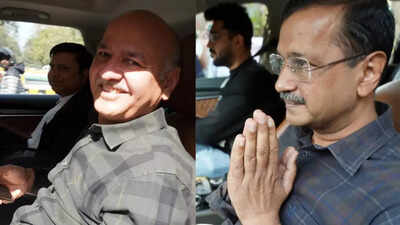
In a major development in the Delhi excise policy case, a Rouse Avenue court in the national capital on Friday discharged all 23 accused, including former chief minister Arvind Kejriwal and former deputy chief minister Manish Sisodia.
In a major development in the Delhi excise policy case, a Rouse Avenue court in the national capital on Friday discharged all 23 accused, including former chief minister Arvind Kejriwal and former deputy chief minister Manish Sisodia, in the case registered by the Central Bureau of Investigation (CBI).The order was pronounced by Special Judge (PC Act) Jitender Singh of the Rouse Avenue Court. The Court ruled that there was no overarching conspiracy or criminal intent in the formulation of the Delhi Excise Policy 2021–22 and held that the prosecution’s case did not withstand judicial scrutiny.
What is the case about?
The case stems from allegations of corruption in the now-scrapped Delhi Excise Policy 2021–22 introduced by the Aam Aadmi Party (AAP) government.In August 2022, the CBI registered an FIR following a complaint by Delhi Lieutenant Governor V.K. Saxena. The agency alleged that irregularities were committed in the formulation and implementation of the excise policy.According to the CBI, the policy was designed to favour select private liquor entities. It alleged that license fees were reduced and profit margins were fixed in a manner that benefited certain private players.
The agency further claimed that alleged loopholes were intentionally created after the tender process to extend undue advantage to specific licensees.The CBI also alleged that kickbacks were generated as part of the arrangement and that the Delhi government suffered financial losses. It claimed that a criminal conspiracy was hatched at the stage of policy formulation itself.Based on these allegations, 23 individuals were named as accused in the case, including Kejriwal and Sisodia.
The verdict
After hearing arguments in the matter, the Special Court discharged all 23 accused.In its order, the Court held that no prima facie case was made out against any of the accused persons. It concluded that the material placed on record did not establish an overarching conspiracy or criminal intent behind the framing of the excise policy.The judge observed that the prosecution’s case failed to meet the threshold required to frame charges.
It ruled that the case, as presented by the CBI, did not withstand judicial scrutiny.The discharge order effectively brings an end to the criminal proceedings in this case at the trial court stage, unless challenged before a higher court.
Court’s observations on conspiracy allegations
A key aspect of the Court’s order relates to its findings on the alleged conspiracy.The Court noted that the CBI attempted to construct a narrative of conspiracy in relation to the policy.
However, it held that the agency’s theory was based on conjecture rather than concrete evidence.The judge observed that the material relied upon by the prosecution did not establish the existence of a criminal conspiracy at the stage of formulation of the policy. The Court found that the allegations of deliberate loopholes and intentional benefit to select entities were not supported by sufficient evidence to make out a prima facie case.In discharging the accused, the Court concluded that the essential ingredients required to proceed with a criminal trial were not satisfied.
Criticism of investigative approach
The Court also made significant observations regarding the investigative approach adopted by the CBI, particularly in relation to approver statements.In its order, the judge strongly criticised the practice of granting a pardon to an accused, turning him into an approver, and subsequently using his statements to fill gaps in the investigation or to implicate additional accused persons.The Court observed that such an approach was improper. It warned that permitting this course of action would amount to a grave violation of constitutional principles.The judge’s remarks indicate that the Court was not satisfied with the manner in which the prosecution sought to rely on approver testimony to strengthen its case.
Recommendation for departmental inquiry
In a significant remark, the Court stated that it would recommend a departmental inquiry against CBI officials for making public servant Kuldeep Singh the accused number one in the case.While discharging all accused, the Court expressed concern over the decision to array Kuldeep Singh as the primary accused. The recommendation for a departmental inquiry underscores the Court’s disapproval of certain aspects of the investigation.Background of the excise policy
Complete timeline: Delhi excise policy case
2021Nov 17, 2021: The Aam Aadmi Party government implements the Delhi Excise Policy 2021‑22, aimed at reforming liquor retail and wholesale.2022 — Allegations, Withdrawal & Investigations
- July 8, 2022: Delhi Chief Secretary submits a report to Lieutenant Governor V.K. Saxena alleging procedural irregularities in the policy’s formulation.
- July 22, 2022: Lt‑Gov Saxena recommends a CBI probe into alleged irregularities in the excise policy.
- July 31, 2022: The excise policy is withdrawn amid mounting questions about irregularities.
- Aug 17, 2022: Central Bureau of Investigation (CBI) registers a case against 15 people, including then Deputy CM Manish Sisodia, alleging irregularities in the formulation and implementation of the policy.
- Aug 19, 2022: CBI conducts searches, including at Sisodia’s premises.
- Aug 22, 2022: Enforcement Directorate (ED) registers a money‑laundering case arising from the CBI FIR.
Late 2022
- Nov 25, 2022: CBI files its first charge sheet in the case.
- Dec 15, 2022: A court takes cognisance of the initial CBI charge sheet.
- 2023 — Arrests and Further Probes
- Feb 18, 2023: CBI summons Manish Sisodia.
- Feb 26, 2023: CBI arrests Manish Sisodia after prolonged questioning.
- Feb 27, 2023: A special CBI court remands Sisodia to CBI custody for further interrogation.
- Feb 28, 2023: Sisodia moves the Supreme Court of India challenging his arrest; bail is refused. He and other jailed leaders resign from the Delhi cabinet.
2023 – Mid & Late
- March 2023: ED arrests Sisodia again in the parallel money‑laundering case linked to the excise policy.
- October 2023: ED conducts additional raids and arrests AAP leader Sanjay Singh in the liquor policy money‑laundering investigation.
- Oct 2023–Mar 2024: ED issues a series of summons to Arvind Kejriwal in connection with the excise policy scandal. He skipped multiple summons.
2024
- Mar 21, 2024: Delhi High Court refuses to grant Kejriwal protection from coercive action by ED; he is arrested by the ED in the money‑laundering case linked to the policy.
- Jun 20, 2024: A trial court grants bail to Kejriwal in the money‑laundering case; the High Court stays the order on ED appeal, so he remains in custody.
- Jul 12, 2024: Supreme Court grants interim bail to Kejriwal in the ED case to campaign in elections.
2025
- Assembly Elections 2025: AAP loses Delhi polls after key leaders face legal battles in the excise policy cases.
- Continuing Policy Impact: The old excise regime continued, and new policy drafting was repeatedly delayed, affecting liquor regulation in the national capital.
2026 — Court dischargeFeb 27, 2026: A special court at the Rouse Avenue Court discharges all 23 accused, including Arvind Kejriwal, Manish Sisodia, and others, in the CBI’s excise policy case.
The court held there was no prima facie case or overarching conspiracy proven against any accused, effectively ending the trial at the Delhi trial court stage for the CBI case.
Key takeaways
- A Special Court has discharged all 23 accused in the Delhi excise policy case.
- The accused included former CM Arvind Kejriwal and former Deputy CM Manish Sisodia.
- The Court found no prima facie evidence of criminal conspiracy.
- It held that the prosecution’s case did not withstand judicial scrutiny.
- The Court criticised the CBI’s reliance on approver statements.
- It warned that using approver testimony to fill investigative gaps could violate constitutional principles.
- The judge stated that a departmental inquiry would be recommended against CBI officials for making Kuldeep Singh accused number one.
- The case originated from allegations of irregularities in the Delhi Excise Policy 2021–22 and an FIR registered by the CBI in August 2022 following a complaint by the Lieutenant Governor.
The discharge order marks a significant development in one of the most closely watched cases arising out of the now-scrapped excise policy, with the trial court concluding that the prosecution failed to establish the foundational elements required to proceed with criminal charges.





 English (US) ·