

 2 hours ago
3
2 hours ago
3
ARTICLE AD BOX
4 min readNew DelhiMar 6, 2026 04:16 AM IST
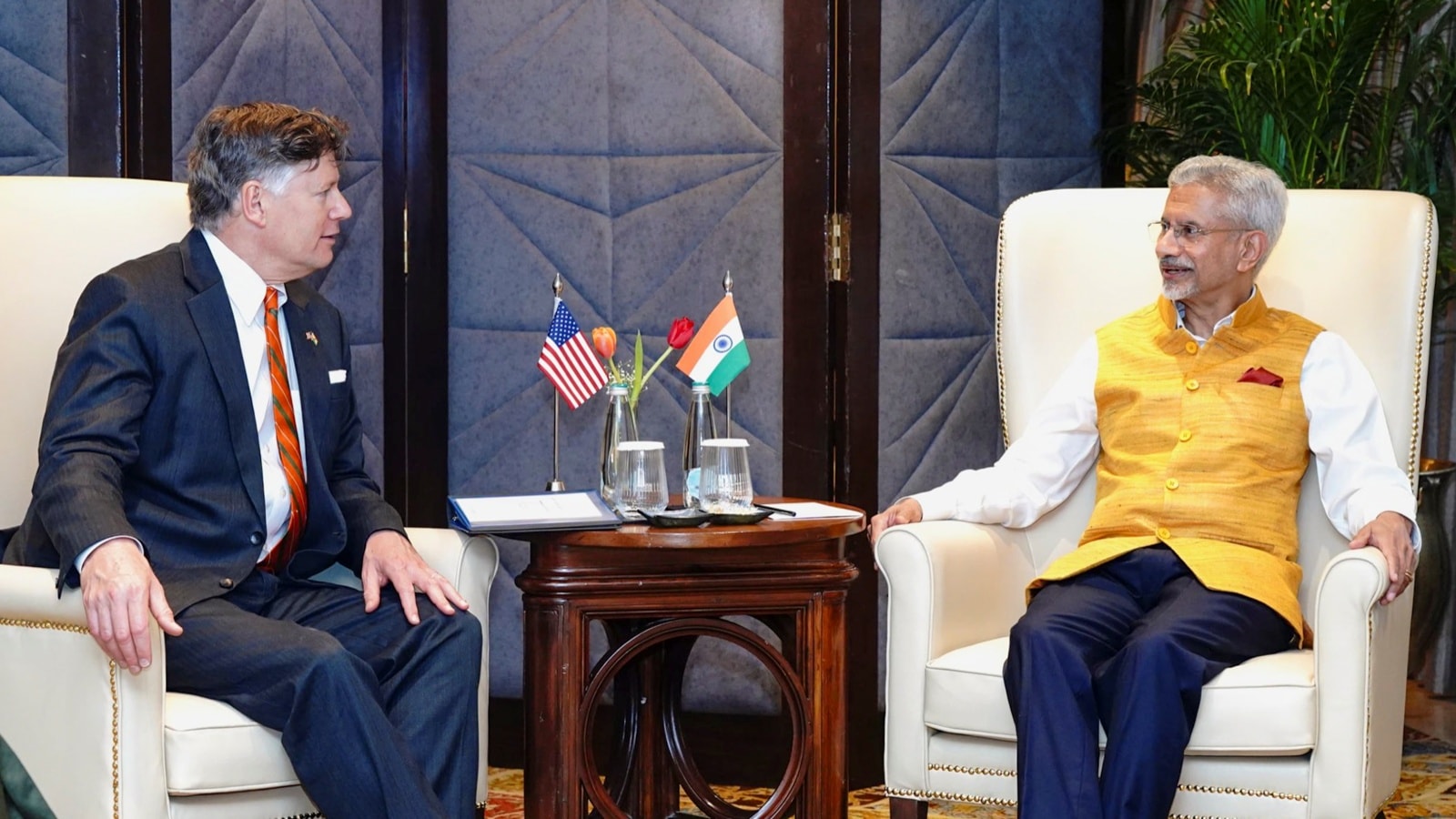 External Affairs Minister S Jaishankar meets US Deputy Secretary of State Christopher Landau on the sidelines of the Raisina Dialogue, in New Delhi. (@DrSJaishankar/ X via PTI Photo)
Amid the ongoing conflict in the West Asia region, a diplomatic battle played out between the US and Iran in Delhi on Thursday after a US submarine torpedoed an Iranian warship, which had taken part in a military exercise in India last month, in international waters in the Indian Ocean.
US Deputy Secretary of State Christopher Landau, while speaking at the Raisina Dialogue organised by think tank ORF, said: “I think the endgame is a Middle East that is not a threat to other parts of the world… We tried very, very hard to explain our red line (to Iran), which is no development of a nuclear weapon. I mean, could you imagine…what a threat to the world it would be to have an Iran that basically was able to blackmail the world with a nuclear device.”
“We tried very hard to talk sense into the Iranians… And ultimately we concluded that that was not going to work. So these are unsettled days right now. But I think the truth is, this part of the world has been quite unsettled for quite a long time. And if you look at the roots of a lot of this, they can be traced back to Tehran,” he said, adding that he was a teenager when Shah Mohammad Reza Pahlavi was overthrown, and since then Iran has been in a “death to America posture”.
Iran’s ambassador to India Mohammad Fathali, who on Thursday received envoys from Pakistan and Russia, along with Foreign Secretary Vikram Misri, at the Iranian embassy for the condolence book messages for Iran’s Supreme Leader Ayatollah Ali Khamenei, said: “We don’t want war, but we are ready for war… We entered the negotiation table (with US, Israel) despite being aware of their intention… they destroyed the negotiation table.” “We showed sincerity, they showed open hostility, and they started the war, but the duration of the war is in our hands, this is very important,” the Iranian envoy said.
Fathali said Iran does not target its neighbouring countries, but alleged that some regional bases were used by the United States. “They know very well where the location of Iran is. Unfortunately, the Zionist regime wants to destroy and disturb all the regions,” he said.
The envoy also claimed that three F-15 fighter jets had been shot down during the conflict.
“Iran is not attacking its neighbourhood. We don’t attack our neighbours; they provide the bases. You heard that three F-15s were shot down. We have a good relationship with our neighbours. We announced to all neighbours that we will attack the bases of the United States.”
Story continues below this ad
On March 3, for the first time since Iran’s Supreme Leader Khamenei was killed in strikes by Israel and the US, India referred to the West Asia situation as “conflict in Iran and the Gulf region” and said “many lives have been regrettably lost and we express our grief in that regard”.
Ministry of External Affairs spokesperson Randhir Jaiswal issued a detailed statement – without naming Khamenei – to make four points: express “deep concern and great anxiety” over the fast-deteriorating situation, impact on Indian nationals in the region along with trade and traffic, express condolences over the deaths due to the strikes, and Delhi’s efforts to help those in distress.
India’s outreach to Tehran as Foreign Secretary Misri signed the condolence book is seen as an evolution of its position in the last six days, after much criticism about its “silence”. Delhi has been trying to diplomatically balance the two sides. Misri also met US Deputy Secretary of State Landau at the Raisina Dialogue.
With Iran retaliating by targeting countries hosting US personnel and, in the process, widening the theatre of conflict, Delhi has linked the conflict to India’s “critical stakes” in the “security and stability of the region” and said “some Indian nationals have lost their lives or are missing” following the attacks in the last few days.
Story continues below this ad
Without naming Iran, Modi has spoken to the leaders of UAE, Saudi Arabia, Qatar, Oman, Bahrain and Kuwait, condemning the violation of their sovereignty and territorial integrity and “the urgent need to restore peace and stability in the region through dialogue and diplomacy”.

Shubhajit Roy, Diplomatic Editor at The Indian Express, has been a journalist for more than 25 years now. Roy joined The Indian Express in October 2003 and has been reporting on foreign affairs for more than 17 years now. Based in Delhi, he has also led the National government and political bureau at The Indian Express in Delhi — a team of reporters who cover the national government and politics for the newspaper. He has got the Ramnath Goenka Journalism award for Excellence in Journalism ‘2016. He got this award for his coverage of the Holey Bakery attack in Dhaka and its aftermath. He also got the IIMCAA Award for the Journalist of the Year, 2022, (Jury’s special mention) for his coverage of the fall of Kabul in August 2021 — he was one of the few Indian journalists in Kabul and the only mainstream newspaper to have covered the Taliban’s capture of power in mid-August, 2021. ... Read More
Stay updated with the latest - Click here to follow us on Instagram
© The Indian Express Pvt Ltd




 English (US) ·