

 1 hour ago
3
1 hour ago
3
ARTICLE AD BOX
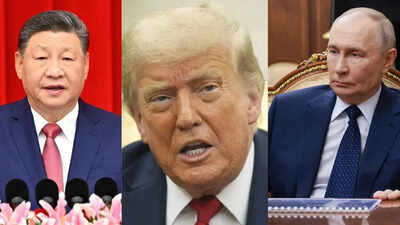
Xi Jinping; Donald Trump; Vladimir Putin
US President Donald Trump has reignited his controversial push to bring Greenland under American control, this time amid heightened diplomatic and economic tensions with Europe.
Citing national security concerns and perceived threats from Russia and China, Trump has intensified his rhetoric—including refusing to rule out how far he would go to secure the Arctic island.He has argued that Greenland is "critical" to US interests:“If we don’t go in, Russia’s going to go in, and China’s going to go in,” he has claimed.So, does the US really face “threats” from Moscow and Beijing vis-à-vis Greenland — or is this largely Trump’s rhetoric? Let’s analyse.No Nobel, no peace?It is no secret that Trump has long coveted the Nobel Peace Prize, which is awarded by the Norwegian Nobel Committee. In a letter to Norway’s Prime Minister Jonas Gahr Støre, the 47th commander-in-chief wrote he was “no longer bound to think of peace” after being snubbed for the world’s highest peace award.In the same letter, Trump explicitly linked his grievance over the Nobel to Greenland, arguing that US control of the island was essential for global security.
Considering your country decided not to give me the Nobel Peace Prize for having stopped 8 wars plus, I no longer feel an obligation to think purely of peace. The world is not secure unless we have complete and Ttotal control of Greenland.
US President Donald Trump
And days later, he said this:
I don't care about the Nobel Prize. First of all, a very fine woman (Maria Corina Machado) felt that I deserved it and really wanted me to have the Nobel Prize, and I appreciate that. If anybody thinks that Norway doesn't control the Nobel Prize, they are just kidding.
US President Donald Trump
Throughout 2025, Trump repeatedly demanded the Peace Prize, claiming to have halted eight wars since assuming office for his second term in January. The committee ultimately awarded it to self-exiled Venezuelan opposition leader María Corina Machado, much to the Republican’s disappointment.In a bizarre twist, Machado recently met Trump at the White House and “shared” her Nobel with him, prompting the Norwegian Nobel Committee to issue a clarification that the prize cannot be shared or transferred once awarded.Trump’s remark about “no longer thinking about peace” has heightened global anxieties at a time when the world already feels on edge because of his unpredictability.Why Greenland matters to US (and others)Trump is not the first US president to seek control over Greenland, the world’s largest island, with a population of only 56,609 as of 2023. Nor is this the first time he has floated the idea: in 2019, during his first term, the Republican proposed “acquiring” the territory, prompting swift rejection from both Greenlandic and Danish leaders.
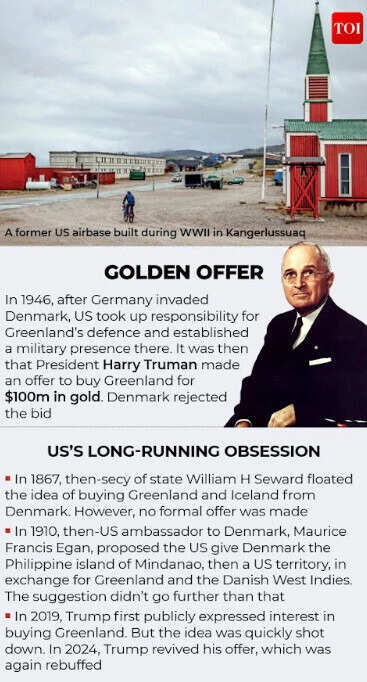
America's long-running obssession with Greenland
Analysts have pointed to a range of factors behind why the United States would like to control Greenland.
- Location: Greenland lies between the United States, Europe, and Russia, placing it in a strategic position for early-warning systems in the event of missile attacks.
- Minerals: The island is known for its abundance of largely untapped raw materials, ranging from oil and gas reserves to critical mineral deposits and a trove of rare earth elements.
- Shorter shipping routes: Rapid ice melt could open new sea lanes, significantly cutting Asia–Europe travel times compared with the existing route that passes through the Suez Canal.
- The ‘GIUK’ Gap: Greenland forms an important pillar of the so-called GIUK (Greenland–Iceland–United Kingdom) Gap, a key naval chokepoint and maritime passage linking the Arctic and Atlantic oceans. This makes it crucial for controlling access to the North Atlantic, both for trade and security.
- The Golden Dome: Trump has stressed that Greenland is also vital for the “Golden Dome,” the ambitious $175 billion missile defence system announced by him in May last year. The programme's stated aim is to counter long-range ballistic threats to America.
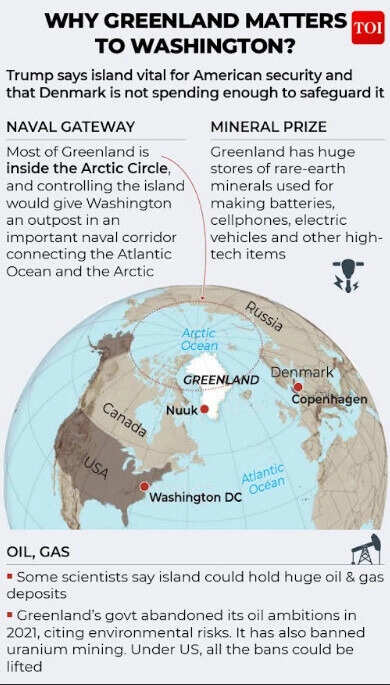
Why Greenland matters to Washington
But what makes the island significant to Russia and China?The Russia questionRussia does not have a direct territorial interest in Greenland. Instead, its strategic focus in the Arctic is centred on its own northern coastline and military infrastructure. While Moscow has expanded its Arctic presence in recent years, experts say this does not translate into designs on Greenland.Crucially, Russia has publicly denied any interest in the island. Russian foreign minister Sergei Lavrov dismissed suggestions that Moscow was eyeing Greenland, saying it was “not an object of Russian interest” and warning that US rhetoric risked creating unnecessary tensions within Nato.
We have no relation to that (alleged Russian threat to Greenland). We are certainly watching this serious geopolitical situation and will make our conclusions when it’s settled.Russian foreign minister Sergei Lavrov
However, experts say there is no truth to Trump’s claim that Russian destroyers and submarines are “all over Greenland.” “There are no Russian or Chinese ships all over the place around here. Neither Russia nor China has the capacity to occupy Greenland or to take control over it,” The Associated Press quoted Andreas Osthagen of the Norway-based Fridtjof Nansen Institute as saying.And how is China involved?The China pictureChina’s interest in Greenland is economic rather than military. Beijing has eyed the island’s mineral wealth, particularly rare earth elements that are critical to global supply chains.The US Geological Survey estimates Greenland holds one of the world’s largest untapped rare earth reserves. Chinese firm Shenghe Resources holds a minority stake in the Kvanefjeld mining project, though large-scale extraction has yet to begin due to environmental concerns and logistical challenges.
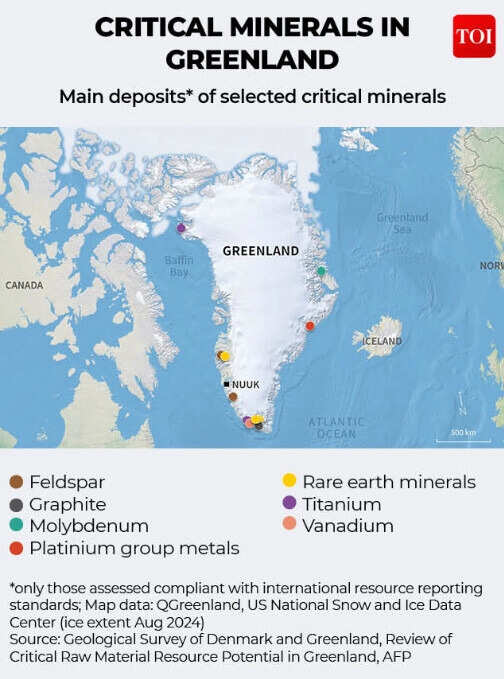
Why Greenland matters to Washington
Beijing, for its part, has rejected suggestions that it poses a security threat to Greenland. Chinese officials have said China respects Arctic sovereignty and international law, and that its activities in the region are focused on scientific research, trade routes and resource cooperation — not territorial expansion.
We have no intention of competing for influence with any country, nor would we ever do so.
Chinese foreign ministry
In 2018, China declared itself a “near-Arctic state” in an effort to gain and assert greater influence in the region. The move was opposed by Washington, with the-then secretary of state Mike Pompeo asking:
Do we want the Arctic Ocean to transform into a new South China Sea, fraught with militarisation and competing territorial claims?
Then-US secretary of state Mike Pompeo in 2018
Still, analysts note that China’s footprint in Greenland remains limited and closely scrutinised by both Denmark and the United States.How US can counter Russia and China ‘threats’ in GreenlandThe United States has had boots on the ground in Greenland since the 1940s when, during World War II, it secured the island to prevent it from falling into Nazi Germany’s hands.
Denmark, which had been occupied by Germany—leaving Greenland briefly unprotected—regained control after Berlin’s surrender in 1945.
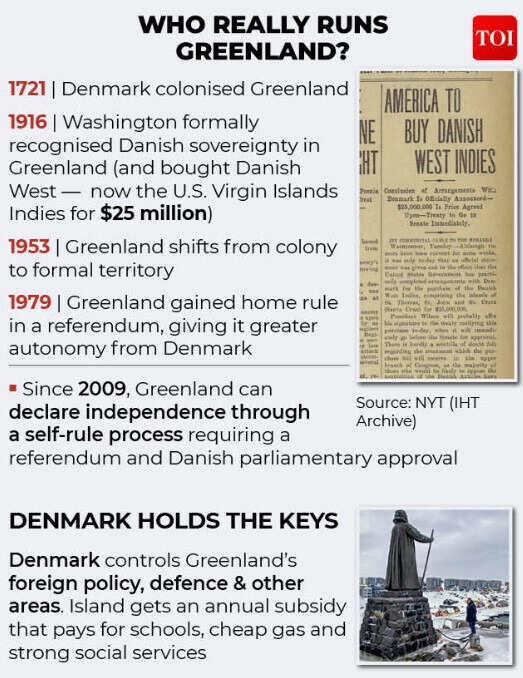
Who really runs Greenland?
In 1951, the bilateral Defence of Greenland treaty was signed to allow the United States to maintain troops on the island. To dissuade Trump from pursuing any unilateral action, Greenland and Denmark have repeatedly pointed out that American forces are already present on the territory under the pact.This would allow the US to thwart any potential attempt by Russia or China to seize Greenland. Moreover, as both the United States and Denmark are Nato members—while Greenland itself is not, but is covered through Denmark—any such attempt would trigger Article 5 of the Nato charter, under which “an attack against one (member) shall be considered an attack against all.” Additionally, in June 2025, Denmark’s Parliament approved legislation allowing US bases on Danish soil, a move that would further strengthen America’s military presence in the region.
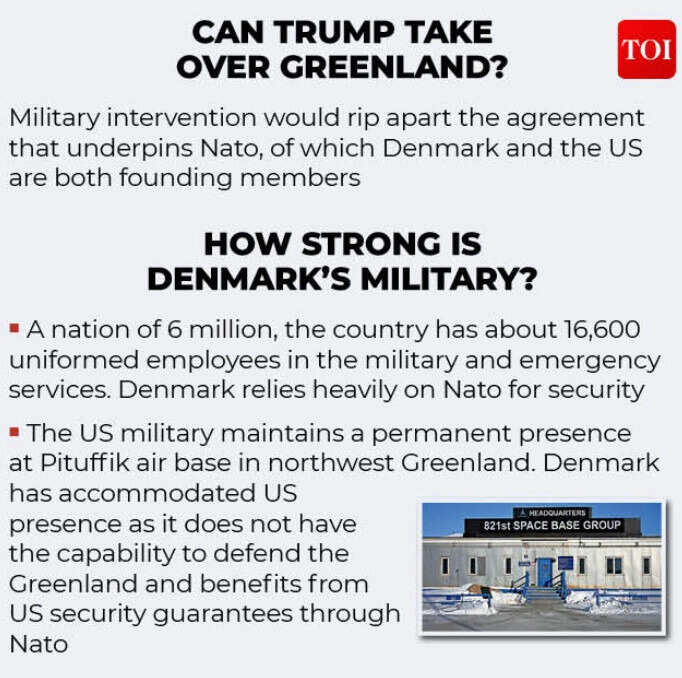
Can Trump take over Greenland?
To secure its interests, Washington operates the remote Pituffik Space Base in northwestern Greenland. Formerly known as Thule Air Base, the facility supports missile warning, missile defense, and space surveillance operations for both the United States and Nato.Does Greenland really face ‘danger’ from Russia and China?Taken together, expert assessments, allied intelligence, and public statements from Moscow and Beijing suggest that Greenland does not face an immediate or direct military threat from either Russia or China.Russia has explicitly said it is not interested in Greenland, while China’s engagement with the island remains limited, commercially oriented, and closely monitored by Denmark and the United States. There is no evidence of Russian or Chinese naval build-ups around Greenland of the kind Trump has described, nor of any plan to seize or militarise the territory.European policy experts argue that while the Arctic is becoming more strategically important, existing frameworks — including Nato, bilateral defense agreements, and Arctic Council mechanisms — are already managing these risks.“There is no serious or immediate security threat that would justify US talk of using force,” Fabian Zuleeg, chief executive of the European Policy Centre, has said, adding that Trump’s framing of Russia and China as imminent dangers to Greenland is “misleading.”What's next?Denmark’s Nato allies have rallied around Copenhagen and Greenland, even as Trump has escalated pressure through trade. The president has announced 10% tariffs on several European countries, effective February 1, with rates set to rise to 25% from June 1.For now, analysts believe economic coercion is far more likely than military action. Any attempt — by the US, Russia or China — to forcibly alter Greenland’s status would trigger Nato’s Article 5, placing Washington in direct conflict with its own allies.Such a move would also set a destabilising global precedent, potentially emboldening Russia in Ukraine and China in Taiwan — while leaving the United States with little moral or diplomatic ground to oppose them.As the EU's foreign policy chief Kaja Kallas put it succinctly: “China and Russia must be having a field day. They are the ones who benefit from divisions among allies.”






 English (US) ·