

 2 days ago
10
2 days ago
10
ARTICLE AD BOX
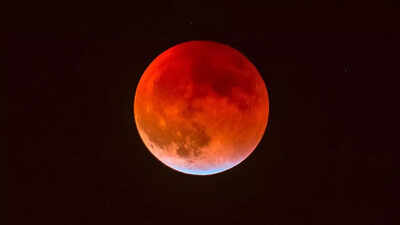
There are some nights when the sky seems to join our festivals.On one such night in early March 2026, as India prepares for Holi, the Moon itself will appear dipped in colour. Not powdered pink or playful green, but a deep, coppery red — as if the Earth has quietly offered its own gulal to the heavens.
Astronomers call it a total lunar eclipse. Our ancestors saw it as a moment of pause. Spiritual traditions saw it as a threshold. And Holi, arriving at the same time, gives this celestial event a rare, poetic context.Scientifically, the phenomenon is simple and wondrous. During a total lunar eclipse, the Earth moves exactly between the Sun and the Moon. Direct sunlight is blocked, but Earth’s atmosphere bends and filters the light that passes around it.
Blue wavelengths scatter away, while red wavelengths travel onward and gently bathe the Moon. What we see is not the Moon changing colour, but Earth’s own atmosphere projected onto it.
In a very real sense, the Moon reflects us — our air, our planet, our fragile blue home — back into the night sky.In 2026, this eclipse coincides with Phalguna Purnima, the full moon traditionally associated with Holika Dahan and the emotional climax of the Holi story.
This rare overlap has practical consequences too. In many Indian traditions, rituals are avoided during a grahan and its associated sutak period — a time meant for stillness rather than celebration. As a result, Holika Dahan will be observed on different dates across regions, from March 2 to March 4, depending on local panchang calculations.
What might appear as confusion is, in fact, cultural adaptability — an ancient calendar responding intelligently to cosmic rhythms.Astrology, often misunderstood as fatalistic prediction, originally evolved as a symbolic language linking human life with celestial cycles. A full moon represents culmination, emotional intensity, and release. An eclipse amplifies this symbolism — a moment when familiar light disappears, urging reflection rather than action. In traditional Indian thought, this was never about fear. It was about restraint.
When the sky pauses, so do we.This is where spirituality enters quietly.Holika Dahan is not merely the burning of a demoness from mythology. It is the burning of arrogance, entitlement, and unexamined ego — qualities that repeatedly consume societies from within. Prahlada survives not because fire fails, but because surrender dissolves fear. When a blood-red Moon hangs above such a ritual, the symbolism deepens.
Nature seems to remind us that destruction and renewal are not violent acts; they are cosmic processes.Modern science tells us eclipses are predictable, harmless, and beautiful. Spiritual wisdom tells us that predictability does not cancel meaning. A heartbeat is predictable. Sunrise is predictable. Yet both remain sacred.Holi itself is not just about colours thrown outward. It is about colours released inward — grudges softened, hierarchies blurred, laughter made equal.
The eclipse does not diminish Holi; it refines it. It nudges celebration away from noise and toward awareness. In some regions, the fire will be lit earlier. In others, later. But everywhere, the deeper message remains unchanged: timing may vary, transformation does not.There is something profoundly humbling about realising that the red Moon of an eclipse is created by Earth’s atmosphere — the same thin layer of air we pollute, protect, breathe, and forget.
On that night, the Moon will glow red because of us. Perhaps that is the most spiritual lesson science can offer.As colours return to our streets the next morning, the sky will have already played its part. The cosmos will have reminded us — gently, silently — that festivals are not separate from nature, that rituals are not opposed to reason, and that spirituality does not reject science. It listens to it.Holi 2026 will arrive on different dates, in different ways, across India. But under one sky, one Moon, and one shared breath of atmosphere, Earth will have already celebrated — by colouring the Moon itself.That night, the gulal will not be thrown.It will be reflected.Authors: Shashank Joshi and Shambo Samrat Samajdar






 English (US) ·