

 1 hour ago
5
1 hour ago
5
ARTICLE AD BOX
India Today's OSINT team analyses wartime communication during the US Operation Epic Fury and India's Operation Sindoor. A comparison of messaging, speed, and institutional involvement in two modern conflicts.
Representative image generated using AI
Wars are devastating, and no country or military wishes a war upon itself. Yet they remain a reality of the modern world, and no leadership can simply wish a conflict away. When the world’s most technologically advanced and well-funded military goes to war, however, it inevitably becomes a case study for others. For militaries around the world, such conflicts offer lessons to observe and analyse. It may be impossible for most forces to match the technological sophistication or vast resources of the United States Armed Forces. But there is one aspect of warfare that does not necessarily require an unlimited budget or cutting-edge technology: communication during conflict.
Wars, conflicts, and skirmishes often differ in magnitude, intensity, and objective, but what should remain constant, however, is communication. Not merely to hype a narrative, but to achieve operational success and minimise “fatal” misunderstandings. What we are seeing in the case of the United States in its ongoing war with Iran is, if not perfect, the communication from Washington has been clear, concise, effective, and timely so far. However, the question is: Did India do the same during its Operation Sindoor, a war on terror that lasted for over five days? Did India keep the BLUF, Bottom Line Up Front? 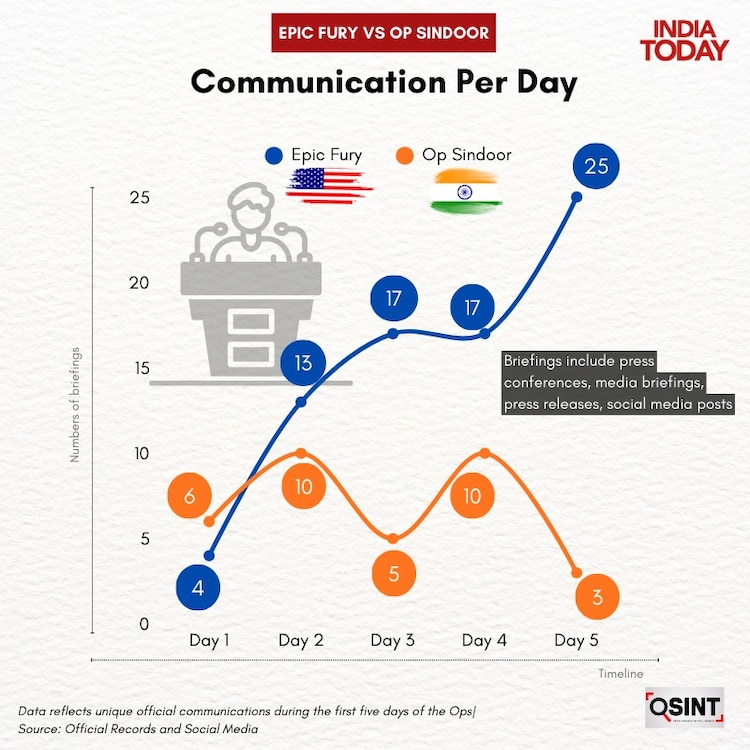
India Today’s Open Source Intelligence (OSINT) team tracked communications issued by US officials during the ongoing Operation Epic Fury and compared them with India’s messaging during Operation Sindoor. We examined the data from the first five days of the West Asia conflict and compared it with India’s five-day conflict of May 2025.
What we found is that although India had a sublime edge militarily, it lacked effective communication, giving space for speculation to flourish and avoidable narratives to gain momentum. On the other side, US communication has been comprehensive and precise. While not necessarily perfect or instantaneous, the developments are being communicated effectively.
LAYERS OF COMMUNICATION
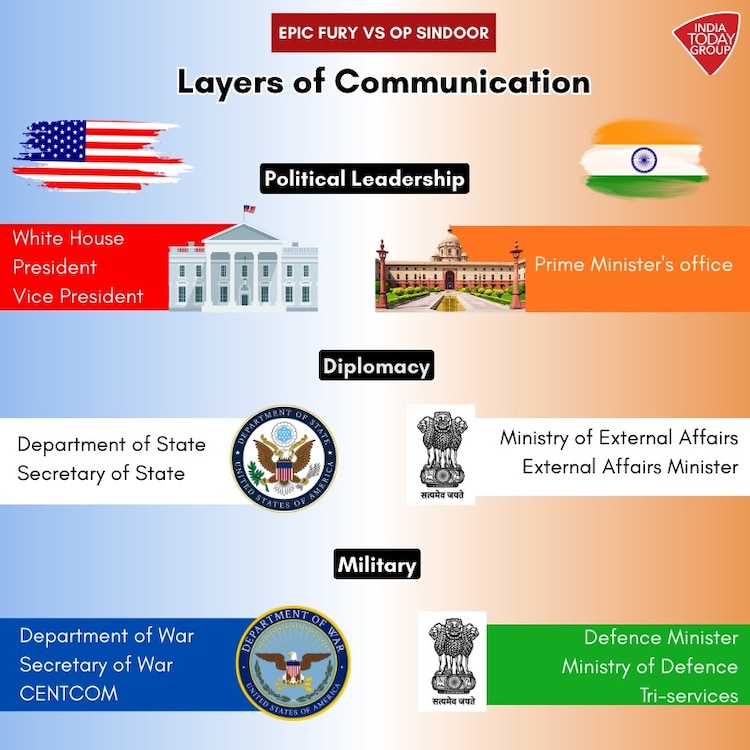
One of the clearest distinctions between the United States’ communication amid the ongoing Operation Epic Fury and India’s communication during Op Sindoor lies in the degree of institutional participation in official public messaging. While both countries display political, diplomatic and military presence in their communication apparatus, the difference lies in what these layers actually communicate.
In the US case, communication is distributed across multiple institutional levels. Messaging comes from the President and the Vice President, the White House, the Department of War, the Secretary of War, the Secretary of State and CENTCOM. Most of these actors regularly communicate operational progress, acknowledge losses and outline objectives achieved. This multi-layered structure allows developments on land, at sea and in the air to be addressed simultaneously at both political and military levels.
India’s communication during Operation Sindoor was comparatively narrower, both in institutional spread and in the scope of information placed in the public domain. Messaging largely came through joint press briefings by the MEA and the MoD, represented by tri-services officials at the spokesperson and secretary levels. Additional communication appeared through PMO press releases, mainly related to CCS meetings, and through statements by the External Affairs Minister on diplomatic engagements. Notably, India’s political leadership largely remained “unseen” from direct public messaging about the situation while the operation was underway. In effect, the Indian approach appeared to compartmentalize communication across political, diplomatic, and military domains and the boundaries between them never blurred.
Although operational details are not expected to be fully disclosed during an ongoing conflict, some degree of clarity is still necessary to reduce speculation and limit the spread of misleading narratives.
HOW FREQUENT AND VOLUMINOUS WAS COMMUNICATION?
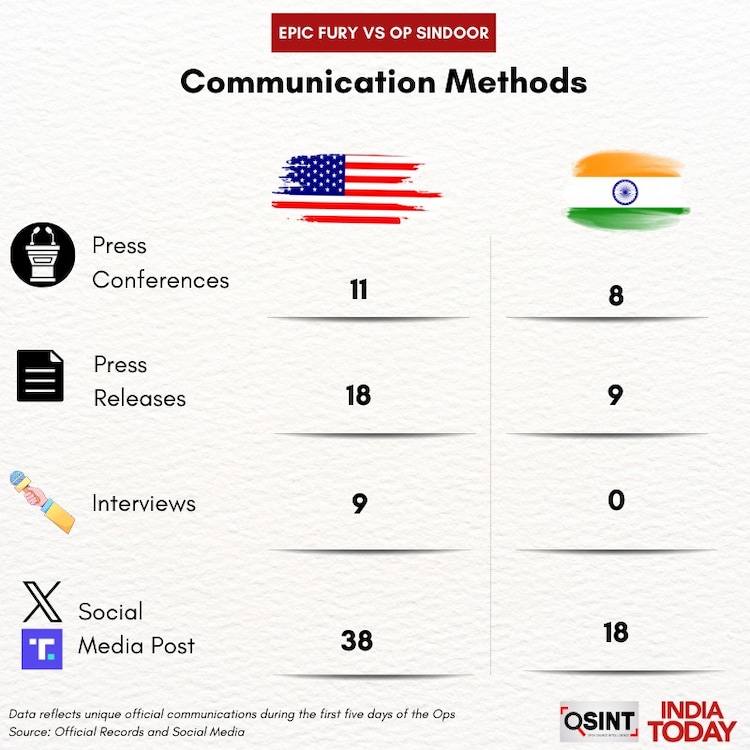
Communication during Operation Epic Fury appears significantly more voluminous and layered. In the first five days, the US issued 18 press releases, held 11 press briefings, and people in positions gave at least nine interviews. Crucially, the messaging is focused on what is happening on the ground, how operations are unfolding, and whether the objectives are being achieved. Senior leadership, including the Secretary of War, the CENTCOM commander, and, at times, the President and the Secretary of State, address the media, reinforcing the message through audio, video, interviews, and written releases.
India’s Operation Sindoor saw nine press releases and eight briefings, but the communication remained relatively limited in its variety. While the briefings were substantive, many of the press releases were generic, and most media interactions were led by officials from the MEA and the Ministry of Defence, with limited participation from the top military leadership and little visible involvement from senior political leaders.
That said, India’s communication did show improvement compared with earlier conflicts, such as the Galwan clashes or the aftermath of the Balakot air strikes. This time, the messaging was supported by evidence and operational footage, which helped shape the narrative more effectively. However, if the United States is taken as a global benchmark for wartime communication, India still has some distance to cover.
TIMELINESS: HOW QUICKLY THE FOG IS CLEARED?
In the US case, communication often came within hours, if not almost instantly. Incidents such as reports of F-15E losses, the sinking of Iranian vessels, or casualties among US personnel were addressed quickly, helping contain speculation and clarify the operational picture.
India’s communication during the May conflict was comparatively slower. False claims were rarely countered immediately. The joint MEA and MoD press briefings remained the most effective communication channel, but they were largely limited to once-a-day schedule. An exception occurred on May 10, when the MEA conducted five briefings from early morning until late at night as clarity emerged around the ceasefire understanding. Outside of this episode, much of the official communication focused more on diplomatic developments than on battlefield updates.
PIB Fact Check did attempt to counter misinformation, but largely toward the later stages of the conflict. Its activity increased around May 10, by which time several narratives had already gained significant traction across social media.
QUALITATIVE ASPECT: SPECIFIC, PRECISE AND (IF) VAGUE
The qualitative difference lies in how clearly each side communicates its version of events. While Donald Trump often frames developments with exaggeration, the broader Washington establishment tends to convey its position with relative clarity. Losses may not always be emphasised politically, but the administration still acknowledges incidents and provides its account of events.
In the US case, messaging has generally been specific and direct, with little ambiguity. Exceptions appeared when Washington found itself on the defensive, such as after the elementary school strike, though even then, Trump reportedly stated he was willing to “live with whatever the truth is.”
India’s communication during Operation Sindoor was less specific beyond identifying terror and military sites targeted. The extent of “asset” damage inflicted on Pakistan remained unclear for months. Only after the dust settled did the Air Force and other services begin revealing details, and even now, several questions remain unanswered, giving air to speculations.
- Ends
Published By:
bidisha saha
Published On:
Mar 12, 2026 16:03 IST





 English (US) ·