

 49 minutes ago
3
49 minutes ago
3
ARTICLE AD BOX
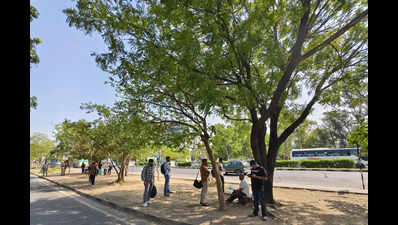
Chandigarh_Tribune flyover: the case against it- environment issues - tree cutting of 700 trees including 472 mango trees declared as heritage-I, lack of requisite clearances, obstructing the view of the Shivaliks, against pedestrian/cycle vision of city. But most importantly the question mark remains whether it would be able to solve the main aim- traffic decongestion on the Dakshin Marg .Photo_ BALISH AHUJA Chandigarh_Tribune flyover: the case against it- environment issues - tree cutting of 700 trees including 472 mango trees declared as heritage-I, lack of requisite clearances, obstructing the view of the Shivaliks, against pedestrian/cycle vision of city. But most importantly the question mark remains whether it would be able to solve the main aim- traffic decongestion on the Dakshin Marg . Photo_ BALISH AHUJA
Chandigarh: Nearly a decade after it was first conceptualised, the proposed Industrial Area flyover continues to draw sharp criticism, with doubts mounting on its capacity to ease traffic congestion at one of the city’s busiest junctions.Opponents have long argued against the project on multiple fronts, citing large-scale tree felling, adverse environmental impact, damage to the city’s architectural heritage, and violation of the Chandigarh Master Plan 2031 (CMP-2031).The core issue is whether the flyover can deliver on its intended purpose in a city where traffic patterns have changed dramatically since the project’s planning stages.According to vehicle registration data, around 4 to 5 lakh additional vehicles have been added to Chandigarh’s roads since the 2017 vehicle census that formed the basis of the project.
Traffic volumes have risen not only at the Industrial Area chowk, once the city’s busiest rotary, but across multiple major junctions.A recent RITES report reveals strikingly similar traffic loads at key points. Industrial Area chowk receives 1,33,053 vehicles per day, while Gurdwara Chowk receives 1,33,404 vehicles. Other prominent rotaries and intersections, including Transport Chowk, Poultry Farm Chowk, and Matka Chowk, are also receiving comparable traffic pressure.
Mukesh Anand, former UT chief engineer in whose tenure the project was conceived and developed, acknowledged the shift in the city’s needs. “Times and requirements of the city have changed a lot since then. The volume of traffic and the total number of vehicles registered in the city have increased manifold since the survey of the project was done in 2017. The project was designed as per studies at the time,” he said.The current plan is a truncated version of the original proposal. In 2017, Union minister Nitin Gadkari announced a longer flyover along the NH-05 stretch, which was later shortened to a 1.6km structure at the Industrial Area junction, primarily due to cost considerations.Anand cautioned against viewing flyovers as a comprehensive solution. “Traffic is only one facet of the problem. Consistent steep increase in vehicular volume in Chandigarh and the Tricity have nearly exhausted parking space available. Therefore, constructing flyovers will not solve vehicular traffic and parking issues,” he added.The city’s foundational planners had anticipated such growth. Le Corbusier’s four-phase development plan for traffic management outlined roundabouts in phase I, slip roads in phase II, underpasses in phase III, and overpasses only in phase IV.
The CMP-2031 explicitly favoured underpasses over flyovers for decongestion and recommended robust public transport measures.The latest RITES comprehensive mobility report echoes these recommendations, advocating underpasses, car-pooling, overhaul of the public transport system, and dedicated rapid bus corridors for the Tricity region.Architect Shilpa Das Vermani, founder and convener of Act! Chandigarh, highlighted the broader issue of non-implementation of the master plan.
“The larger question here is the non-implementation of Chandigarh Master Plan CMP 2031. Most of the traffic solutions proposed in CMP 2031 (with focus on an efficient public transport and last mile connectivity like completing V7 and V8) haven’t even been initiated,” she said.Vermani noted that even 11 years after notification of the master plan, key steps such as formulating a comprehensive Town and Country Planning Act for Chandigarh and constituting a Regional Planning Board for systematic implementation remain pending.The city’s parking policy has also proposed practical measures — including staff bus services by govt departments, PSUs, industries and IT companies, and staggered office and school timings across Punjab, Haryana and UT — to reduce peak-hour vehicular load. However, most such recommendations exist only on paper.Critics have also raised concern over what will happen when the fast-moving traffic coming down the flyover reaches the GMCH-32 chowk and Poultry Farm chowk on either side. Taking this into consideration, Union ministry of road transport and highways (MORTH) has initiated planning work on a six-lane elevated road connecting Poultry Farm Chowk, Chandigarh, to Zirakpur to make the stretch from Industrial chowk to Zirakpur signal free.






 English (US) ·