

 1 hour ago
5
1 hour ago
5
ARTICLE AD BOX
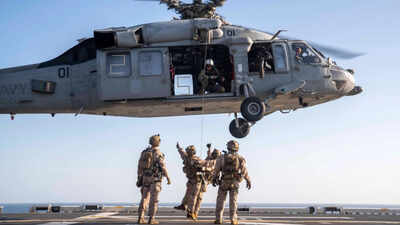
Helicopters have changed how armed forces across the world looked at mobility. A helicopter grans an armed force the flexibility of using an aircraft without being dependent on an airbase.
A helicopter can deliver troops as close to the target as possible, if not on top of it. In military operations this capability can mean the difference between success and failure. Helicopter borne operations bring with them the factor of speed, which in turn surprises the enemy. This leads to an initial paralysis as the adversary reorients to take on an enemy that has landed virtually on top of them. The most important aspect here is the ability of these helicopters to provide support to those on the ground and also extricate them when required.The US has a long history of troop insertions using helicopters, using this method to overwhelm an enemy and leave before the enemy can fully organise a coherent response. Although helicopters have proven their worth in their role as a medical evacuation platform and as an unparalleled search and rescue platform, it is in the role of a raider that the helicopter initially showed off its use as an offensive platform. Although the attack helicopter is now seen as the manifestation of the chopper in an offensive role.
The first major helicopter raid carried out by the US in November 1970 at the Son Tay Prisoner of War (PoW) camp hundreds of kilometers deep behind enemy lines. The aim of the mission was to land helicopters at the camp and extricate 61 PoWs at that camp. The US Army's Special Operations Command notes that this operation was a proof of concept for future operations.A decade later the Americans attempted to launch a similar operation in Iran, in April 1980, to rescue 53 American diplomatic staff held captive in Tehran, the Americans lost a total of one helicopter and one aircraft destroyed and 6 helicopters abandoned, as mentioned in a Singaporean Ministry of Defence assessment.
The operation was a failure for the Americans and a propaganda win for the Iranians.Helicopter borne operations were also central to the US invasions of Grenada (1983) and Panama (1989), as reported by the US Naval institute and the US Army Heritage and Education Center.In 1993, the Americans once again embarked on a disastrous mission in Somalia. In this operation 21 American soldiers were killed as per the North Carolina based U.S.
Army Airborne and Special Operations Museum. Between both these raids many successful heliborne missions were carried out in both Iraq and Somalia.Although the conflict in Afghanistan was noted for its use of helicopters, the high point of the conflict for heliborne operations was Operation Neptune Spear that killed Osama Bin Laden. There were major helicopter dependent operations in Afghanistan such as Operation Moshtarak and Operation Anaconda.
The gusto of heliborne operations continued in the conflict against ISIS in Syria and Iraq. The killing of ISIS head Al-Baghdadi too had US helicopters transporting Special Forces troops, according to the US military.This year too the versatility of helicopters was on display on two separate occasions. The first was Operation Absolute Resolve in Venezuela, where the country's president was detained by the Americans in a daring mission, while the other mission was the rescue of a downed US Air Force officer just south of Isfahan, the third most populous city in Iran after Tehran and Mashad.Despite the drawback of flying low and slow, where they are easy targets, helicopters have a niche role in the military. That crucial role is the ability to drop troops and material exactly where they are needed and pull them out when needed. This gives commanders an immense amount of flexibility, which isn't provided by any other platform.








 English (US) ·