

 1 hour ago
2
1 hour ago
2
ARTICLE AD BOX
Amid US President Donald Trump's warning of new tariffs over the dumping of Indian rice, it is worth remembering how dramatically the US-India food dynamic has shifted over the past few decades. India, which was once reliant on low-grade American wheat, is now the world's largest rice exporter, supplying nearly a quarter of US rice imports.
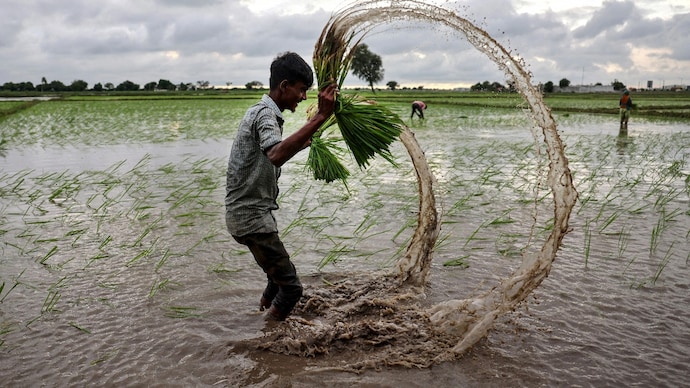
India once received millions of tonnes of food aid from the US, but today, it's one of the biggest rice exporters to America. (Image: File)
US President Donald Trump warned that he might introduce new tariffs on agricultural imports, especially on rice from India. The accusation was that India, the world's largest rice exporter, was dumping the grain in the US. It is quite a story of tables being turned as the US supplied India with substandard wheat in the 1960s when the country was looking for food aid to feed millions of hungry mouths.
The allegations of rice dumping come even as the US and India are negotiating a trade deal, which experts say is stuck because India has drawn a red line on agriculture and dairy imports. While the US claims India's farm sector is subsidised, it, in fact, is the other way around. Trump's threats of tariffs on rice from India over dumping came as he unveiled a $12-billion bailout package for American farmers.
Dumping refers to countries selling their surplus produce or products for ridiculously low prices, thereby threatening the importing country.
That India could be dumping rice is a turnaround tale for the country and its agriculture sector. It is the very same India that relied on wheat aid from the US in the 1960s. And the US supplied wheat fit for animal feed for human consumption, according to several reports.
Just around six decades ago, India depended heavily on America's Public Law 480 "Food for Peace" programme, under which the US shipped millions of tonnes of wheat to India. At its peak, India received over 10 million tonnes annually, which was often low-grade, reddish American wheat, also called lal gehun, and baked into hard, dark chapatis.
The food aid the US sent to India was not just low-grade but also contaminated with parthenium weed seeds, which is known as Congress Grass.
But soon, India turned the script through comprehensive agricultural transformation and policy changes of the Green Revolution, and went on from being a dependent to a global exporter of wheat and rice.
Today it is the world's largest rice exporter, shipping more than 22 million tonnes a year.
It must be noted that through this shift, the consumption pattern has also evolved in America. Rice was once a marginal item in the diet of Americans, but its consumption has doubled since the 1970s. And India, which once received aid from the US, is now one of the biggest suppliers of Indian basmati and non-basmati rice to America.
RICE ON AMERICAN PLATES: HOW THE PATTERN HAS CHANGED
A lot has changed since the 1960s when the US sent wheat aid to India, including how the American plate looks today. The consumption pattern in the US has changed drastically, and the US consumes way more rice per capita than it did back in the day, for various reasons.
As of 2025, US per capita rice consumption has more than doubled since the 1970s. It rose from around 5.2 kg per capita annually in 1970 to about 11.8 kg in 2023-24, according to USDA Economic Research Service data.
This was seemingly caused by demographic shifts, as Asian and Hispanic populations, which consume more rice traditionally, now comprise larger shares of the US total population.
Gluten-free trends and new rice products have also boosted demand.
Notably, the US produces its own rice, harvesting over 9 million tonnes of produce, as of 2023 data. However, imports fill speciality gaps, which have tripled since 2001 to exceed 25% of supply by 2022-23.
India, Thailand, Pakistan, the Philippines, and China are its main suppliers.
In 2024, US rice imports hit $1.61 billion, showing the reliance it has on Asian exporters for aromatic varieties such as basmati and jasmine.
Of this, India exported around $380 million worth of rice to the US, or almost a quarter of its total imports, according to United Nations Comtrade data.
But the journey from this level of global presence has a history of dependence and oppression by centuries of colonial rule.
THE ACUTE HUNGER AND FOOD SHORTAGE INDIA FACED IN THE 1960s
Post-Independence, India was grappling with poverty and acute hunger.
The ripple effects of nearly two centuries of colonial policies were still very fresh in the 1960s, when there was widespread hunger in the country.
The British regime had left Indian agriculture stagnant—the yields were low, the soils had depleted, and millions of farmers were either landless or in debt.
By the mid-1960s, the average Indian survived on barely 417 grams of food a day. For a typical adult, the total weight of food consumed per day is usually 1.5 to 2.5 kg.
This was the time when Prime Minister Jawaharlal Nehru urged citizens to replace wheat with sweet potatoes. India's staple carb, rice, had become critically scarce during this period.
FOOD CRISIS IN INDIA, PL-480 SHIPMENT, AND US BLACKMAIL
Amid the shortage struck the catastrophe of the 1965 monsoon failure, which resulted in India's food grain production during the 1965-66 crop year falling to 72.3 million tons, or about 20% below the bumper 89-million-ton harvest of 1964-65.
The monsoon failure led to a countrywide shortage in food production, causing a famine in Bihar in 1966 that killed over 2,500 people.
A further crisis was only averted after the Indira Gandhi government was able to secure large aid shipments of wheat from the US under the US Public Law 480 (PL-480), or the "Food for Peace" programme, which it then distributed across the country through a system of fair-price shops.
The food insufficiency was such that it is called the "ship to mouth" survival era of India.
At its peak, India would receive more than 10 million tons of American wheat.
But while the US Food Aid helped India avert another famine, Indian leaders quickly found out that American Aid came with its own caveats. The US used its massive food surplus to influence and control nations.
This was seen during the administration of Lydon B Jhonson when the US used India's criticism of its actions in Vietnam as an excuse to delay aid shipments. A daily wait for grain ships during this era became a national trauma.
As noted by a US-State Government History document, this deadlock was only resolved after PM Indira Gandhi went to Washington DC and gave personal assurances to Johnson to implement agricultural reforms and temper criticism of US policy regarding Vietnam.
FROM FOOD DEFICIT TO FOOD SECURE: THE GREEN REVOLUTION
The deficit harvest of 1966 and the US wielding of vital food aid under PL-480 convinced the Indira Gandhi administration to take immediate steps to turn India into a food secure nation at the earliest, as noted by Ramachandra Guha in his book, India and Gandhi.
Under geneticist MS Swaminathan, who later came to be known as the Godfather of the Green Revolution, the late 1960s saw India adopting new farming techniques and technologies including high-yielding wheat varieties, which were introduced by Indian researchers experimenting with Mexican wheat varities.
India expanded the use of artificial irrigation and chemical fertilisers, increased use of mechanised equipment like tractors and threshers, and new government-funded procurement and marketing institutions like the Minimum Support Price (MSP).
These changes raised wheat yields and aggregate grain output, shrinking import requirements and eventually building buffer stocks.
By 1974, India had achieved complete self-sufficiency in wheat production.
But while wheat self-sufficiency was the immediate goal, the Green Revolution had larger effects. Improvements in irrigation, input supply chains, procurement, subsidies, and rice cultivation in many regions, especially West Bengal, benefited heavily.
The following decades saw India steadily increase rice production and develop a competitive global advantage in both staple (non-basmati) and premium (basmati) rice varieties.
By the early 2020s, India had become the world's largest rice exporter by volume, shipping a record 22.2 million metric tonnes in 2022.
FLIPPING THE SCRIPT: INDIAN FOOD EXPORTS TO THE US AND THE WORLD
In less than six decades, India went from a "ship-to-mouth" situation to a global exporter of agricultural products. By the 1990s itself, India was exporting both wheat and rice to the world.
The total value of agricultural commodities exported by India from March-June 2020 was $3.5 billion.
In 2024-25, the Agricultural & Processed Food Products Export Development Authority noted Indian agri-food exports to the US reaching a value of $1.93 billion. This included basmati rice ($337 million), cereal preparations (US$ 161 million), and pulses ($66 million).
Today, Indian agricultural, horticultural, and processed foods are exported to more than 120 countries, including Japan, Afghanistan, Bangladesh, Bhutan, the Maldives, Nepal, and Sri Lanka, the European Union, and the US.
This, even as it feeds its entire population, including more than 800 million people, through a Public Distribution System (PDS) scheme.
For a country once heavily reliant on foreign food aid, India today sends food aid to countries in need.
Hence, as President Donald Trump once again wields the stick of tariffs to threaten India, it might be worth recalling the 1960s, when the US administration similarly used the PL-480 programme, and how India endured severe shortages and eventually gave it back to the US, including rice.
- Ends
Published By:
Anand Singh
Published On:
Dec 10, 2025






 English (US) ·