

 10 hours ago
3
10 hours ago
3
ARTICLE AD BOX
AP govt assures adequate water, power supply for Vizag data centre project
Visakhapatnam: Growing concerns are emerging among various sections of society in Visakhapatnam over the proposed and upcoming data centre projects, particularly regarding their water and electricity consumption, as well as environmental issues such as heat generation and noise pollution.Discussions, both online and offline, have centred on the potential impact of establishing multiple large-scale data centres in a relatively small city. Some organisations have also raised concerns over alleged environmental damage during the construction phase of these projects.While the Andhra Pradesh government is seeking to transform Visakhapatnam into an artificial intelligence (AI) hub with a proposed combined data centre capacity of around 6 GW, opposition groups and environmental activists have questioned whether the projects would benefit the city in the long term.
Critics argue that concentrating 6 GW of data centres in a single city could place significant pressure on local resources and ecosystems, particularly if projected infrastructure upgrades are delayed.Environmental Concerns Over Emerging TechEnvironmental activist Bolisetti Satyanarayana pointed out that in the European Union, data centres above 500 kW are subject to comprehensive environmental assessments and reporting requirements covering energy consumption, water usage and carbon emissions.
“However, in our state, it is deeply concerning that data centres are not only being welcomed with a red-carpet approach but are also being treated merely as building projects.
Data centres must be removed from the category of ordinary building projects and classified as major industrial projects. Every such project should be subjected to mandatory environmental impact assessments, public consultations, and strict compliance with environmental clearance norms,” he said.The government has countered the concerns, contending that the projects have been planned alongside future expansions in water supply, power generation, and industrial infrastructure. It sees them as a catalyst for developing an AI and digital economy ecosystem in Visakhapatnam.The CEO of a leading tech giant recently claimed that the next generation of AI data centres could use only as much water annually as a single neighbourhood restaurant.
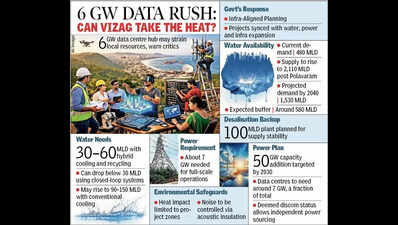
According to him, upcoming AI data centres employ closed-loop liquid cooling systems in which water is filled into the cooling loop once and continuously recirculated.Maximum Efficiency, Minimum FootprintVisakhapatnam MP M Sribharat said the state government undertook extensive planning to ensure that the projects do not strain resources or adversely impact the environment. “The present water demand within Vizag city, including domestic and industrial consumption, stands at around 480 MLD (million litres per day).
Once the Polavaram pipeline project is completed, the water supply capacity will increase to more than 2,000 MLD.
Even if Visakhapatnam’s population grows from the current 25 lakh to over 50 lakh by 2040, and industrial activity expands significantly, the total demand is estimated to remain below 1,500 MLD, leaving a buffer of around 500 MLD,” he reasoned.He further said the government is exploring the establishment of a 100 MLD desalination plant to ensure uninterrupted water supply, particularly during periods of drought or inadequate rainfall.
“Andhra Pradesh plans to add around 50 GW of power generation capacity by 2030, while the proposed data centres are expected to require only 6.5 to 7 GW. Moreover, the government has accorded deemed discom status to data centres, enabling them to procure uninterrupted power supply independently,” he added.Addressing concerns over heat and noise pollution, Sribharat said all the proposed data centre projects have secured the required environmental clearances and would operate within prescribed environmental norms. “The heat generated by data centres dissipates within a limited radius and is unlikely to have any significant impact beyond the project sites. On the noise front, developers will employ acoustic insulation measures to minimise sound levels, ensuring that nearby communities are not adversely affected,” the MP said.








 English (US) ·