

 1 hour ago
3
1 hour ago
3
ARTICLE AD BOX
For the first time since Iran’s Supreme Leader Ayatollah Ali Khamenei was killed in strikes by Israel and the US, India Tuesday referred to the West Asia situation as “conflict in Iran and the Gulf region” and said “many lives have been regrettably lost and we express our grief in that regard”.
In Tehran, the Indian embassy said it has moved Indian students from the Iranian capital to safer locations and only a few students remain in the city – around 9,000 Indians, including students, are said to be in Iran.
The embassy, in an advisory, said, “In view of the developing situation, all Indian nationals in Iran are advised to exercise utmost caution, avoid unnecessary movements and remain indoors as far as possible.”
In New Delhi, Randhir Jaiswal, spokesperson for the Ministry of External Affairs, issued a detailed statement – without naming Khamenei – to make four points: express “deep concern and great anxiety” over the fast-deteriorating situation, impact on Indian nationals in the region along with trade and traffic, express condolences over the deaths due to the strikes, and that Delhi’s efforts to help those in distress.
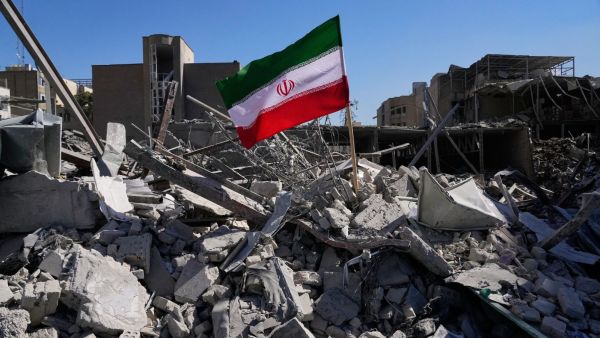 An Iranian flag is placed among the ruins of a police station struck Monday during the U.S.–Israeli military campaign in Tehran, Iran, Tuesday, March 3, 2026. (AP Photo)
With Iran retaliating by targeting countries hosting US personnel and, in the process, widening the theatre of conflict, Jaiswal also linked the conflict to India’s “critical stakes” in the “security and stability of the region” and said “some Indian nationals have lost their lives or are missing” following the attacks in the last few days.
The MEA statement came on the day Prime Minister Narendra Modi reached out to more leaders of countries in the region. Without naming Iran, Modi spoke to the leaders of Qatar, Oman and Kuwait, condemning the violation of their sovereignty and territorial integrity and “the urgent need to restore peace and stability in the region through dialogue and diplomacy”. This was in line with his earlier conversations with the leaders of the UAE, Saudi Arabia and Bahrain.
External Affairs Minister S Jaishankar also spoke to Kaja Kallas, the European Union’s Vice President and High Representative on Foreign and Security Policy, on “the ongoing conflict in Iran and the Gulf”.
Story continues below this ad
The MEA spokesperson expressed deep concern over the situation in the region “in the holy month of Ramadan” – the use of the Arabic word for the month of Ramzan was addressed to countries in West Asia.
“We had expressed our deep concern at the commencement of the conflict in Iran and the Gulf region on 28 February 2026. Even at that time, India had urged all sides to exercise restraint, avoid escalation and prioritize the safety of civilians. Unfortunately, in the holy month of Ramadan, the situation in the region has deteriorated significantly and continuously,” he said.
“In recent days, we have not only witnessed an intensification of the conflict but also its spread to other nations. The destruction and deaths have mounted, even as normal life and economic activities come to a halt. As a proximate neighbour with critical stakes in the security and stability of the region, these developments evoke great anxiety,” he said.
He also outlined the impact of the conflict on India. “There are almost one crore Indian citizens who live and work in the Gulf region. Their safety and well-being is of utmost priority. We cannot be impervious to any development that negatively affects them. Our trade and energy supply chains also traverse this geography. Any major disruption has serious consequences for the Indian economy. As a country whose nationals are prominent in the global workforce, India is also firmly opposed to attacks on merchant shipping. Already, some Indian nationals have lost their lives or are missing as a result of such attacks in the last few days.”
Story continues below this ad
Without taking names while addressing the issue of deaths in the region, Jaiswal said, “In this background, India strongly reiterates its call for dialogue and diplomacy. We raise our voice clearly in favour of an early end to the conflict. Already, many lives have been regrettably lost and we express our grief in that regard.”
Assuring the people of the country and the Indian diaspora in the region, he said, “Indian embassies and consulates in the affected countries remain in close touch with Indian nationals and community organizations, issuing regular advisories as appropriate. They have also extended all possible help to those stranded by the conflict. The embassies and consulates will continue to be proactive in addressing various consular aspects of this conflict.”
“We are in touch with the governments of this region as well as other key partners. Prime Minister and External Affairs Minister have held discussions with their counterparts,” he said. “The government will continue to closely monitor the evolving situation and take relevant decisions in the national interest,” he said, without spelling out any plan for evacuation of Indians from the region.




 English (US) ·