

 1 hour ago
4
1 hour ago
4
ARTICLE AD BOX
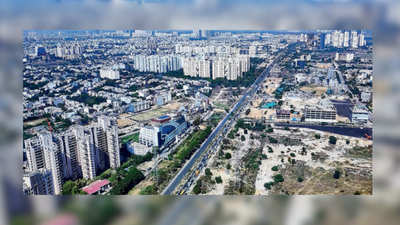
GURGAON: The city recorded its cleanest April air since 2021, with the average AQI dropping to 181 — and though this marks a significant improvement from the hazardous levels of 2017 and 2018, the number still sits firmly in the unhealthy category, indicating the pollution burden is far from lifted.
Notably, the low improvement comes despite the excess rainfall received in April this year, which would typically be expected to suppress particulate matter more substantially, making the persistence of moderate pollution levels all the more telling.
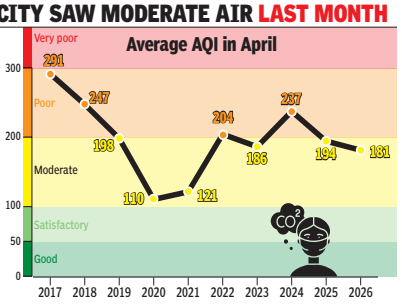
According to long-term data from Central Pollution Control Board (CPCB), the city’s April AQI has followed a dramatic but uneven trajectory since 2017. The city’s worst April on record was 2017, when average AQI stood at 291, nearing very poor levels, followed by 247 in 2018.
Some easing came in 2019 at 198, before the sharpest improvement arrived in 2020 and 2021 — when AQI dropped to 110 and 121 respectively — coinciding with reduced activity during the pandemic and its immediate aftermath. From 2022 onward, pollution rebounded. April AQI rose to 207 in 2022, remained elevated at 188 in 2023, and peaked again at 237 in 2024, the city’s worst April since 2018. Recovery followed, with 194 in 2025 and 181 this year — but current levels remain significantly worse than the cleaner pandemicera baseline.
Overall, April AQI has improved by nearly 38% since 2017, though gains have been inconsistent. This month’s reading still exceeded the satisfactory benchmark of 100 by 81 notches, underlining that the city’s air quality crisis is far from over. “Despite rainfall in Gurgaon this year, air quality has seen minimal improvement, with pollution levels largely unchanged and more days in the poor category,” said Manoj Kumar, analyst at the Centre for Research on Energy and Clean Air (CREA). According to CPCB standards, AQI between 101 and 200 is moderate, while 201 to 300 is poor. Even moderate AQI can trigger respiratory discomfort among sensitive groups, including those with asthma and heart or lung conditions. The decade-long data suggests the city has moved away from extreme pollution episodes but is yet to establish sustained clean-airgains.








 English (US) ·