

 1 week ago
12
1 week ago
12
ARTICLE AD BOX

Hormonal health in men is rarely discussed openly, yet mounting global research suggests that testosterone levels are declining across generations — not just as a natural consequence of ageing, but at a faster rate influenced by modern lifestyle factors. Younger men in their 20s and 30s are increasingly reporting symptoms once associated with middle age, including fatigue, low motivation, reduced muscle mass, mood changes, and declining libido.
Hormonal health in men rarely becomes dinner-table conversation. Across countries, researchers are observing a gradual decline in average testosterone levels in men over the past few decades.
It is not just about ageing. Younger men, even those in their 20s and 30s, are reporting symptoms once linked mainly to middle age.Testosterone is more than a “male hormone.” It shapes muscle mass, bone density, mood, energy, fertility, and even motivation. When levels dip, the effects can ripple through daily life. So what is driving this shift, and why is it rarely discussed openly?
6 foods that help you balance your hormones
What is testosterone, really?
Testosterone is produced mainly in the testes, under signals from the brain’s hypothalamus and pituitary gland.
This chain is called the hypothalamic-pituitary-gonadal axis.Levels naturally rise during puberty, peak in early adulthood, and slowly decline with age. The National Institutes of Health explains that normal total testosterone levels in adult men usually range between 300 to 1,000 nanograms per deciliter, though lab ranges vary.

Testosterone is produced mainly in the testes, under signals from the brain’s hypothalamus and pituitary gland.
A slow decline of about 1 percent per year after age 30 has long been considered normal. But research published in International Journal of Molecular Sciences suggests that the drop seen in modern generations is steeper than what aging alone can explain.
We spoke to Dr Ravi Shankar J C, Consultant - Urology (Advanced Endourology, Andrology, Renal Transplant, Robotic Urology) at Manipal Hospital, Kanakapara Road, who explained, " We all know that testosterone is the main male hormone. It provides energy, supports our bones and muscles, elevates our mood, and improves sexual health. As men age, their testosterone levels usually drop, but in some men, the drop is faster, and the symptoms can be seen earlier.
This silent drop is usually attributed to stress, busy life, or just normal aging, and therefore, many patients don’t get tested.
"
The evidence behind the drop
Several large studies have raised concern.A long-term analysis published in the Journal of Clinical Endocrinology & Metabolism examined American men over time and found that testosterone levels declined across generations, even after adjusting for age and health factors.Similarly, the Centers for Disease Control and Prevention tracks reproductive and hormonal health trends through national surveys like NHANES.While not every dataset agrees on the scale of decline, many endocrinologists now accept that environmental and lifestyle factors may be accelerating hormonal shifts in men.Dr Ravi told TOI Health, "The common signs of hormonal imbalance in men include loss of interest, poor erections, tiredness, less muscle mass, more abdominal fat, lack of sleep, feeling low or angry, mood imbalances, and trouble concentrating.
These changes can affect confidence, interpersonal relationships, and may also negatively impact performance at work. Many men feel uncomfortable bringing it up and seek professional guidance.
"
Modern life: A hormone disruptor
The world today looks very different from the world of 1970. That difference may matter.
- Chronic stress: Long work hours and financial pressure raise cortisol. High cortisol can blunt testosterone production over time.
- Sleep deprivation: Testosterone is produced mainly during deep sleep. A research published in JAMA notes that sleep restriction can significantly reduce testosterone levels in healthy young men.
- Ultra-processed diets: Obesity and high sugar consumption are all associated with decreased testosterone. Through the action of an enzyme called aromatase, excess body fat increases the conversion of testosterone into estrogen.
- Chemicals that disrupt hormones: Industrial chemicals, plastics, and pesticides can all affect how hormones are signaled.
Each element by itself might not appear significant. Together, they create a hormonal environment that strains the male body.
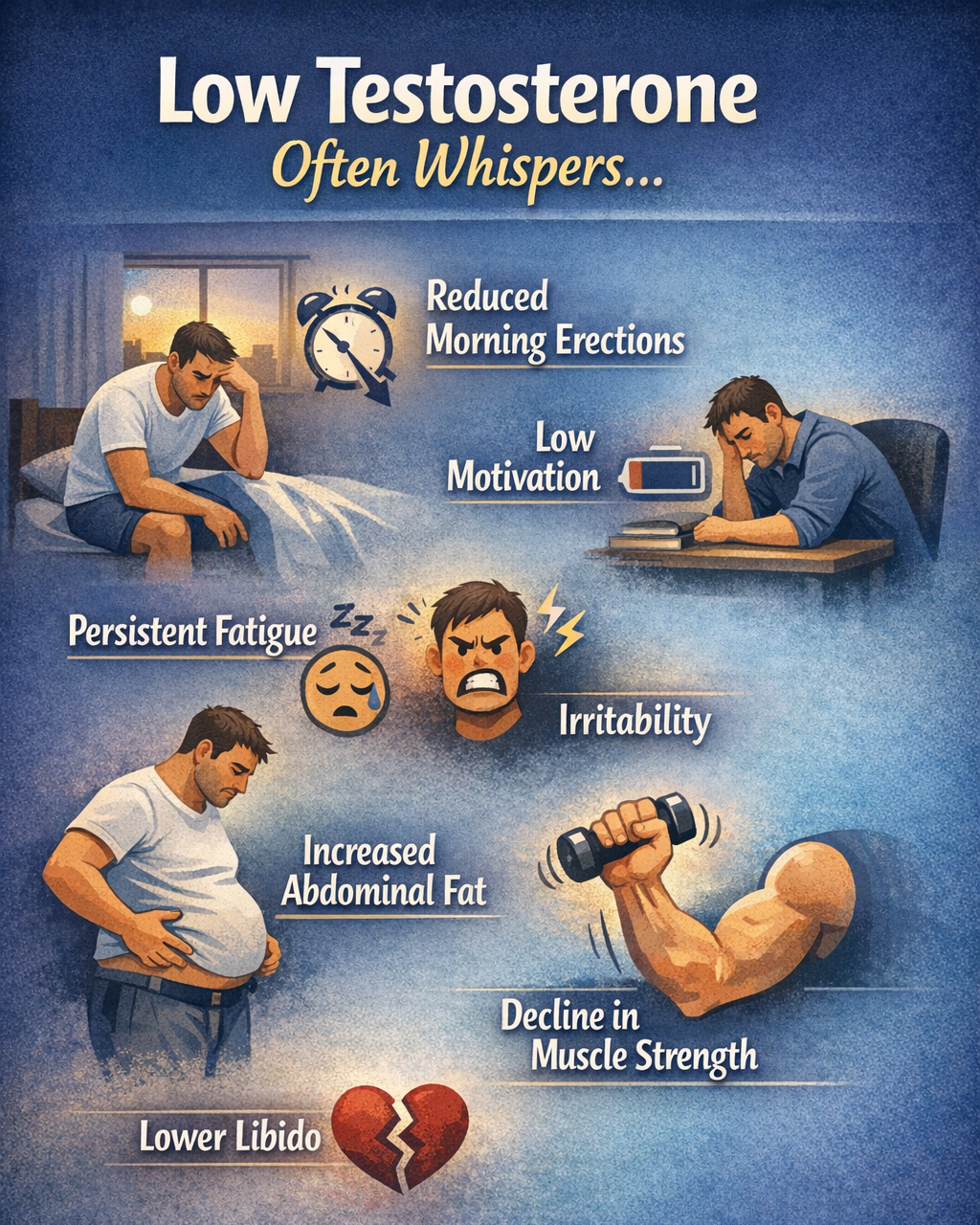
Ignoring these signs can affect relationships, career performance, and mental health.
The subtle signs men ignore
Low testosterone does not always show up as dramatic weakness.
Often, it whispers.
- Reduced morning erections
- Low motivation
- Persistent fatigue
- Irritability
- Increased abdominal fat
- Decline in muscle strength
- Lower libido
These symptoms are often blamed on “just stress” or “getting older.” But when several appear together, they deserve medical attention.The National Library of Medicines offers guidance on male hypogonadism and when testing may be appropriate:Ignoring these signs can affect relationships, career performance, and mental health.
Fertility and the bigger concern
Testosterone is closely linked to sperm production. A drop in levels may contribute to fertility challenges.The World Health Organization has documented global concerns around declining sperm counts in several regions. While the reasons are complex, hormonal shifts are part of the conversation.Fertility specialists increasingly see younger couples seeking help. That trend reflects broader lifestyle and environmental patterns, not just individual biology.

Early detection prevents long-term complications such as osteoporosis, depression, and metabolic disease.
Can this be reversed?
The body responds to daily habits more than many realize.
- Strength training: In healthy males, resistance training continuously raises testosterone levels. A noticeable impact can be achieved with just three concentrated sessions each week.
- Restorative sleep: Hormone production is supported by seven to eight hours of good sleep.
- Weight control: Naturally increasing testosterone can be achieved by reducing extra belly fat.
- Sunlight and vitamin D: Reduced testosterone is linked to low vitamin D levels. Testing when necessary and safe exposure to sunshine can be beneficial.
- Reduce your intake of alcohol and highly processed foods because they are both associated with hormone suppression.
In diagnosed situations, medical therapy, such as testosterone replacement, may be recommended.
However, clinical examination and blood testing must come before treatment. Using over-the-counter "boosters" for self-medication frequently has no scientific backing and can be harmful.Dr Ravi further explained, "The good thing is that hormonal imbalance can be checked and treated. A simple morning blood test, along with your detailed history, can show whether testosterone is really low or if any other factor is associated with the problem.
Depending on the result, urologists may suggest lifestyle changes or treatment of any other health-related issues. In some men, testosterone therapy can be given under close monitoring.
So, if you notice any of these symptoms, don't ignore them and discuss them openly with your urologist."
Why men don’t talk about it
There is still stigma around male hormonal health. The 'society' expects men to be strong, energetic, and emotionally steady.
When energy dips, silence replaces discussion. Normalising medical conversations about fatigue, libido, and mood can shift outcomes. Early detection prevents long-term complications such as osteoporosis, depression, and metabolic disease.Medical experts consulted This article includes expert inputs shared with TOI Health by: Dr Ravi Shankar J C, Consultant - Urology (Advanced Endourology, Andrology, Renal Transplant, Robotic Urology) at Manipal Hospital, Kanakapara RoadInputs were used to highlight the health risks of unsupervised supplement use and why medical consultation is essential before trying so-called natural testosterone boosters.







 English (US) ·