

 1 hour ago
6
1 hour ago
6
ARTICLE AD BOX
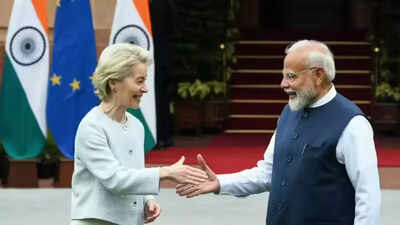
The India–European Union free trade agreement (FTA), expected to be announced on January 27, is likely to lower costs and expand trade rather than harm domestic industry, the Global Trade Research Initiative (GTRI) said on Sunday.
What benefit both the sides?
As global trade becomes increasingly shaped by tariffs, geopolitics and supply-chain realignment, GTRI said the India–EU economic "relationship stands out for its clarity of purpose."The two are not rivals but partners "operating on different rungs of the value chain," with India focused on labour-intensive and downstream production, while the EU supplies capital goods, advanced technology and industrial inputs."This structural complementarity explains why an India-EU free trade agreement is likely to lower costs and expand trade rather than threaten domestic industry," GTRI Founder Ajay Srivastava said.
The trade size and FTA gains
In FY2025, India–EU goods trade crossed $136 billion. GTRI said tariff reductions under the FTA would primarily reduce input costs, deepen value-chain integration and increase trade volumes, classic FTA gains that benefit producers and consumers on both sides.
Indian exports to the EU, including smartphones, garments, footwear, tyres, pharmaceuticals, auto parts, refined fuels and cut diamonds, largely replace the EU’s imports from third countries rather than compete with European manufacturing, which has long offshored these activities.The EU exports high-end machinery, aircraft, core electronic components, chemicals, quality medical devices and metal scrap to India.
These products feed India’s factories, recycling industry and MSME clusters, improving productivity and export competitiveness."Tariff elimination therefore compresses input costs instead of crowding out industry," Srivastava added.
India’s imports from the EU
India’s goods imports from the EU stood at $60.7 billion in FY2025 and were concentrated in capital-, technology- and input-intensive products.High-end machinery was the largest import category at $13 billion, including turbojets ($810 million), industrial control valves ($418 million) and specialised industrial machines ($343 million).
India does not manufacture such advanced capital equipment at scale and depends on these imports for its industrial and infrastructure sectors.Electronics imports totalled $9.4 billion, led by mobile phone parts ($3.7 billion) and integrated circuits ($890.5 million), which are critical for India’s smartphone assembly and electronics manufacturing ecosystem.India also imported aircraft worth $6.3 billion, medical devices and scientific instruments worth $3.8 billion, and specialised medicines worth $1.4 billion—products that India largely does not produce domestically.Waste and scrap imports stood at $2.1 billion, including aluminium scrap ($632 million) and brass scrap ($534 million). GTRI said India relies on imported scrap as domestic availability is insufficient for its recycling industry and MSMEs.
India’s exports to the EU
India’s exports to the EU amounted to $75.9 billion in FY2025 and were dominated by downstream and labour-intensive sectors. Refined petroleum products were the largest export category at $15.0 billion, led by diesel exports of $9.3 billion and aviation turbine fuel worth $5.4 billion.Electronics exports stood at $11.3 billion, including $4.3 billion worth of smartphones, underlining India’s growing role as a large-scale manufacturing and assembly hub.Textiles and apparel remained a key export segment. Garment exports totalled $4.5 billion, with girls’ suits alone accounting for $822 million. This was supported by textile exports worth $1.6 billion and made-ups valued at $1.2 billion—sectors that Europe largely exited decades ago.Other major export categories included machinery and computers worth $5.0 billion, including turbojets valued at $756 million. Organic chemicals exports stood at $5.1 billion, iron and steel at $4.9 billion, and pharmaceuticals at $3.0 billion.Gems and jewellery exports to the EU totalled $2.5 billion, driven mainly by cut and polished diamonds worth $1.6 billion.Automotive exports reached $2.2 billion, led by auto parts ($1.6 billion), followed by tractors ($181.8 million), motorcycles and scooters ($164.7 million), dumpers ($72.2 million) and cars ($32 million).Other labour-intensive exports included tyres worth $890 million, footwear valued at $809 million, and coffee exports of $775 million.
Alcohol trade remains limited
Alcohol trade between India and the EU remains marginal. India exported wines worth $1.4 million and spirits worth $24.5 million to the EU.Imports from the EU were higher, with wines valued at $7.9 million and spirits at $87.8 million, reflecting Europe’s dominance in premium alcohol products.




 English (US) ·