

 1 hour ago
8
1 hour ago
8
ARTICLE AD BOX
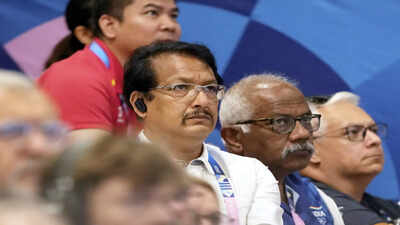
Chateauroux: Indian shooter Manu Bhaker’s coach Jaspal Rana during the 25m Pistol Women’s Final event at the 2024 Summer Olympics, in Chateauroux, France. (PTI Photo/Ravi Choudhary) (
India woke up to heartbreaking news on Friday morning. Jaspal Rana, one of the country's greatest shooters and the man who coached Manu Bhaker to double Olympic glory, passed away at a hospital in Delhi, at the age of 49.
He had fallen ill on the flight back from the ISSF World Cup in Munich, and doctors placed a stent after his condition worsened following landing in New Delhi.
He didn't make it. Just like that, Indian shooting lost the person who, arguably more than anyone else, gave it both its spine and its soul.
Born in Uttarakhand
Jaspal Rana was born in 1976 in Uttarakhand, into a family with deep roots in service and discipline. His father, Narayan Singh Rana, was a former ITBP official serving in the Special Protection Group, which gave young Jaspal early exposure to weapons.
He could shoot both pistol and rifle equally well, but chose pistol because the results were better. Smart call, as it turned out. For his contributions, he received the Arjuna Award in 1994, the Padma Shri in 1997, and later the Dronacharya Award in 2020 for the coaching work that would define the second chapter of his life.
The coach who mattered more than he was credited
Even during his playing days, Rana had a gift for reading a shooter's mind. So when the gun was put down, he picked up the clipboard.
He worked with Manu Bhaker from 2018, helping her become a Commonwealth Games champion and a Youth Olympics gold medallist. Paris 2024 saw Manu become the first Indian athlete to win two medals in a single Olympic Games. And on coaching philosophy, he was refreshingly clear. "The way I work, I don't impose my views on the shooter. These days, kids are smart, they know what to do. I only tried to tweak a few things." He believed in the mental side of the sport as much as the technical, creating training conditions that mimicked match pressure, with self-imposed fines for missed shots.
“Kids should be taught how to bounce back”
Winning was never the whole point for Rana. He always said the real work happens after a loss, not before one. He'd watched young shooters collect gold medals and then completely fall apart the first time results didn't go their way, because nobody had prepared them for that moment. Any kid can be trained to perform well on a good day. The harder, more important job is teaching them what to do when things fall apart mid-competition, when the score's going wrong and the nerves are kicking in.
That resilience, that ability to reset quickly, was something he believed you build through practice, just like technique. It doesn't arrive on its own. It has to be taught, repeatedly, until it becomes second nature.
“Shut the phone and stay away from social networking”
Rana had very little patience for distraction, and he saw social media as one of the biggest ones sitting in every young shooter's pocket. For a sport like shooting, where the entire contest is about stillness, focus and blocking out noise, the constant scroll of reactions and comments is basically the opposite of everything you need.
He wasn't being old-fashioned about it. He'd watched talented athletes lose concentration and confidence because of what strangers said about them online, or because they got addicted to the validation and couldn't function without it.
The phone, in his view, was a training hazard first and a reward later. Put it down. Come back to the present.
“Teenagers are the worst to teach”
In an interview with ESPN he said it with a half-laugh, but he meant every word.
Teenagers are convinced they already know everything, and in shooting, that brand of confidence without discipline can quietly destroy a career before it properly starts. Rana had to constantly find ways to reach athletes who were technically talented but emotionally still working out who they were. Too much ego, not enough patience, and a spectacular ability to tune out advice they didn't feel like hearing.
“You have to find a way to dam that energy and make it useful without stopping the intensity”
This was probably his most insightful coaching thought, and ESPN caught it at exactly the right moment.
Young shooters, especially the naturally gifted ones, come loaded with aggression and raw energy. The wrong move is to flatten all of that in the name of calmness. Rana believed the fire needed to stay alive; it just had to be redirected. Channel it into focus, into competitive drive, into the mental sharpness that separates a decent shooter from a truly great one.
Don't kill the intensity. Shape it. That was his entire coaching philosophy, captured in one sentence.
“We don't have time to relax saying we are on top. There's only one place to go and that is down”
He knew exactly what complacency looked like because he'd watched careers quietly end because of it. The moment a shooter starts believing their current form is permanent, the decline has already begun. In the same ESPN interview, he was direct about why: countries like China and South Korea were watching India's 2018 surge and were not going to sit still. Rana refused to let his athletes celebrate too long or too loudly.
There was always the next competition, the next rival closing the gap, the next version of yourself that needed to be sharper. Staying hungry wasn't a motivational line for him. It was how he coached, and how he'd always competed himself.


 English (US) ·