

 1 hour ago
4
1 hour ago
4
ARTICLE AD BOX
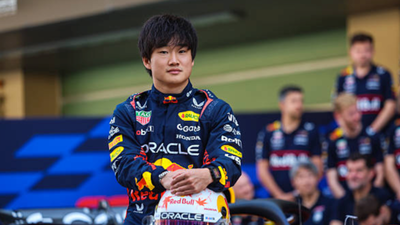
Yuki Tsunoda (Image Source: Getty)
Yuki Tsunoda's height is not the only factor making him a remarkable driver; his strength, courage behind the wheel, and the potential to become the first Japanese driver to win the most races in F1 history also play a role.
Yuki Tsunoda’s very low height, which is merely 1.59 meters (5 ft 3 in), has conferred on him the label of the tiniest driver in F1. His height has been discussed throughout practically his entire racing career, which started in 2021, as it is still quite rare in F1.
Yuki Tsunoda: Delving into the height and its impact
Tailoring to his height, he often cracked jokes about being short, mainly with his funny reply, "Grow," when he was asked about his future ambitions. From a technical point of view, he needs to be well-adjusted in the cockpit due to his height, which is not only a source of discomfort and control issues but also offers advantages.
His lighter weight provides an argument for better balance and possibly faster car acceleration, while his not very tall stature emphasizes that Formula 1 places greater emphasis on skills, reflexes, and mental toughness rather than on physical size.
Tsunoda’s spot on the grid is a testimony to the many physical types in the sport and also proves once again that the victory goes to the skilled one, no matter the height.
A brief comparison between Yuki Tsunoda and other F1 drivers
The moment one starts weighing Tsunoda against his contemporaries, his eccentricity is laid bare even further. Lando Norris, who is sometimes thought of as just a little shorter than the average at 1.70 m (5 ft 7 in), still has an 11 cm height advantage over Tsunoda. This stark difference clearly shows how uncommon Tsunoda’s physique is in present-day Formula 1. There’s a huge gap between them; nonetheless, Tsunoda has built a good name for himself for aggressive driving and quick reflexes.
His victory indicates that height is not an obstacle in motor racing. Instead, his presence, along with bigger drivers such as Russell and Ocon, only goes to prove how diverse the physical types are in Formula 1.
Tsunoda may have the disadvantage of being less visible because of his height, but on the other hand, he has the advantage of being judged solely by his performance, not his height.








 English (US) ·