

 1 day ago
5
1 day ago
5
ARTICLE AD BOX
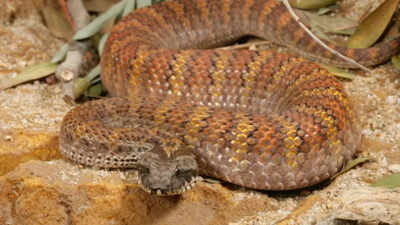
(Photo credit: Shutterstock)
Death adders represent one of the most remarkable, yet dangerous species of snakes native to Australia and parts of New Guinea. The name may deceive you into thinking that it belongs to the group of true 'adders', yet it is not.
However, it bears a lot of similarities with vipers from other geographical areas. It is important to pay attention to a particular species for two main reasons: it possesses highly toxic venom; moreover, it has an excellent camouflage which even experienced trekkers fail to detect.Learning how to distinguish a death adder from others becomes crucial while traveling through forests, bushlands, and grasslands in which the snake can be found.
"Part of the ground"
A distinctive feature of a death adder is the snake's body type. While most species possess long slender bodies, a death adder is a short and thick one, looking like a triangle or an oval when the head is lowered. In addition to this feature, a death adder has quite a few spines on its tail.One can notice this by looking at its coloration. Death adders have stripes and cross-bandings of brown, gray, reddish, or black colors.
These stripes are dull and irregularly patterned. This helps them to blend into their background perfectly so that the snake becomes invisible on forest floors. Field guides written for the fauna of Australia often highlight how spotting these snakes is done accidentally rather than deliberately.
The head and tail- subtle but important characteristics
The head of the death adder is triangular and flat. It resembles the heads of vipers. However, it is less triangular.Another distinguishing feature lies in the tail of the death adder. Its end part is thin and pointed. It usually ends with a worm-shaped appendage. This is the lure for its prey. The snake makes its tail wiggle like a worm or insect. In doing so, it attracts frogs and lizards into an attack position.BehaviourWhile most hunting snakes actively hunt their prey, the death adder employs the ambush method. They can stay perfectly still for hours, or even days on end at times.
Stillness is one of the key characteristics of this type of snake; for instance, when a piece of stick or a bunch of dry leaves moves and reveals itself to be a snake, it’s likely to be a death adder.In cases where it’s threatened, it doesn’t make a run for it but stays in place and may make rapid strikes, especially if disturbed. Their speed is one of the fastest in snake species.
Habitat hints: Where you will most likely find one
The death adder lives mainly in:* Dry forests and woodlands* Grasslands with lots of leaves on the ground* Coastal heath regions* Sandy or rocky areas with lots of cover from camouflageThey favor areas that provide good cover in order to launch surprise attacks against their victims.
As noted by studies published in field guides by organizations such as the Australian Museum, death adders are typically more active around twilight hours (morning and evening).
Research revelations: What science says about them
There is a study and field review carried out by Australian herpetologists and documented in reports by the CSIRO (Commonwealth Scientific and Industrial Research Organisation) that shows that death adders use camouflage and hiding rather than movement.
In addition, the study indicates that death adders have a hunting technique that consumes less energy but has high success rates when compared to other venomous snakes.Even media reports by institutions such as the National Geographic Society have portrayed death adders as “masters of disguise” because their survival is based on going undetected and not outrunning danger. Together, the studies cited above highlight one clear fact about death adders: You are much more likely to stand close to a death adder than to watch it move.
Death adders are frequently confused with harmless snake species like small pythons and baby brown snakes. This is why:* Death adders are smaller and thicker in build* Death adders remain still for a prolonged period of time* They have wider and triangular heads* They have a lure-like tail tipThe error made here is that all snakes which are thick are pythons, although death adders belong to the elapid family, not the constrictor family.
Safety precautions and concluding remarks
The cardinal rule when trying to identify a death adder is not to trust yourself in your ability to see it from a safe distance. As camouflage experts, even experienced persons may overlook these snakes.If you find yourself in a habitat where they are found, wearing appropriate footwear, using a walking stick to stir the ground in front of you, and being careful about your footsteps will go a long way in protecting you from them.Death adders are truly an outstanding creation of natural selection, featuring perfect camouflage, rapid attack abilities, and patience in hunting. However, all these attributes also make them extremely deadly snakes for any accidental encounter. Identifying a death adder is largely a matter of interpreting stillness rather than motion.









 English (US) ·