

 57 minutes ago
5
57 minutes ago
5
ARTICLE AD BOX
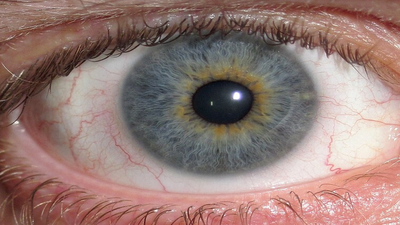
Close-up image of human eye| Image Credit: Wikimedia Commons
Whether blue, green, hazel, or brown, eye colour is one of the very first characteristics that people will observe in another individual. However, there is one characteristic of the eyes that goes beyond their appearance.
Human eyes, in particular, are characterised by a large portion of white space around the coloured iris.Scientists have spent decades trying to understand why human eyes evolved this way. Despite much speculation and debate, research suggests that the white part of the human eye can be crucial for communication, among other factors.The feature that makes human eyes uniqueOne of the earliest scientific studies on the topic came about in 1997 through Japanese researchers Hiromi Kobayashi and Shiro Kohshima, according to Nature. By comparing the eye structures of many primate species, they found that humans are especially conspicuous, though some apes also show lighter sclera.In the paper, the two proposed that this would allow one individual to easily notice the other's point of focus. This ability would help people know immediately where another individual is directing their gaze.The researchers argued that humans possess the most conspicuous exposed sclera among primates.Why gaze matters so much in human interactionBeing able to follow another person's gaze is a surprisingly powerful social skill. This allows individuals to figure out the focus of another person's attention, coordinate actions and understand intentions.
According to PubMed, in 2007, psychologist Michael Tomasello and colleagues proposed a theory which would later be called the "cooperative eye hypothesis". Published in the Journal of Human Evolution, it suggested that the highly visible sclera of humans had evolved due to the high level of cooperation among humans.In order to study this hypothesis, the scientists conducted experiments where they studied the responses of human infants and great apes to eye cues.
They observed that the human infants had a greater tendency to react to eye gazes, whereas the latter group paid more attention to head movements when figuring out where the person was looking.

Close up shot of the human eye| Image Credit: Wikimedia Commons
The role of eye contact in early developmentSensitivity to eye gaze has also been shown to emerge unusually early in life. Several studies show that even newborn babies prefer faces that are looking at them directly. As children age, they develop the skills to track the eye gaze of those around them.The capability seems crucial for learning purposes. A child learns to connect words with objects in their environment when they follow the gaze of adults towards objects while simultaneously hearing their names. Some researchers suggest an association between early gaze-following abilities and later language development.Eye gaze is a natural way of pointing, allowing people to communicate with each other more effectively.New research supports the theory but adds nuanceDespite its significance, the cooperative eye hypothesis has remained controversial within scientific circles.Recent studies have demonstrated that humans are not the only species of primates with lighter scleras. Some chimpanzees and other great apes can also exhibit differences in the degree of scleral pigmentation, casting doubt on the notion that white scleras alone account for human communication skills.A study has also argued that the contrast between the iris and the sclera may be significant. Additionally, it has been pointed out that there are differences in human population groups regarding scleral pigmentation and not all of them are uniformly white. Yet, reportedly, a group of scientists presented experimental evidence that supports the idea that white sclerae enhance gaze detection capabilities.Additionally, researchers digitally manipulated images of chimpanzee eyes to increase scleral visibility and found that participants became better at judging gaze direction.
This indicates that in addition to colour contrasts, the visibility of the eye contours plays an important role in gaze perception, especially in humans.More than communicationThe sclera is believed to carry even more data beyond eye-gaze signals.Changes in scleral appearance can sometimes provide clues about health and ageing. Sclera may become redder or yellower with age or health changes.Sometimes, changes in the appearance of the sclera can indicate underlying medical conditions.
It has been shown that when making assumptions about health and age, people tend to pay close attention to the condition of one’s eyes. Increased redness and yellowish colour of scleras usually indicate poor health and advanced age.Although scientists continue to debate the evolutionary reasons behind the unusually visible human sclera, they all agree that we have very expressive eyes. Whether directing the attention, communicating or reading emotions, our eyes seem to be capable of conveying a lot of information.









 English (US) ·