

 1 hour ago
2
1 hour ago
2
ARTICLE AD BOX
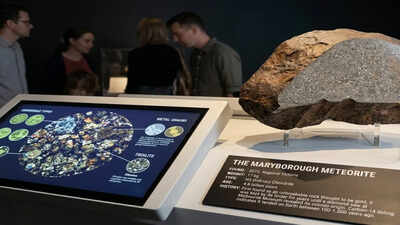
David Hole kept a strange rock for years, which led to the discovery of an ancient meteorite. Image credit - Gemini
A heavy rock that Australian slide guitarist and singer, David Hole, found in Maryborough, Victoria, in 2015 turned out to be an odd one. Since there is an abundance of gold deposits in this area, he assumed the rock might be a valuable ore.
However, after he kept it for almost 17 years, he still had no proof that it contained any precious metal.The rock never behaved in accordance with the properties of gold. Simple tests failed to detect gold in the mineral since the rock looked rough and dark on the outside. After a thorough examination, experts determined that the object in question is actually a meteorite dubbed the Maryborough meteorite.It dates back some 4 billion years and is rather rare to be encountered on our planet.Reasons why people often overlook meteoritesThere are several reasons why people do not recognise meteorites. To start with, most gems and metals have distinctive appearances and colours. On the contrary, meteorites often look mundane and boring, and weathering can significantly alter their appearance.As noted by scientists from Monash University, the Maryborough meteorite demonstrated signs of "incipient weathering". And this is why the rock remained unnoticed for such a long period of time.
On one hand, the rock’s weight indicated its value. From another perspective, the rock had nothing that could reveal its true nature. Such situations occur often enough. There are numerous examples of meteorites that can be found after thorough scientific analysis.The findings made by scientists within the rockAfter the rock was delivered to scientists for further research, it revealed a completely new story.
Researchers conducted petrographical and mineral chemical investigations, during which thin slices of the rock were studied under a microscope.During the examination, scientists detected chondrules – small, rounded grains that appeared during the first stages of solar system formation. Moreover, scientists discovered metal minerals like kamacite and taenite, which are typical of meteorites.Based on these findings, the rock was classified as an H5 ordinary chondrite.
The type of meteorite suggests that the rock experienced a high degree of heating and changes on the parent body before falling onto our planet.
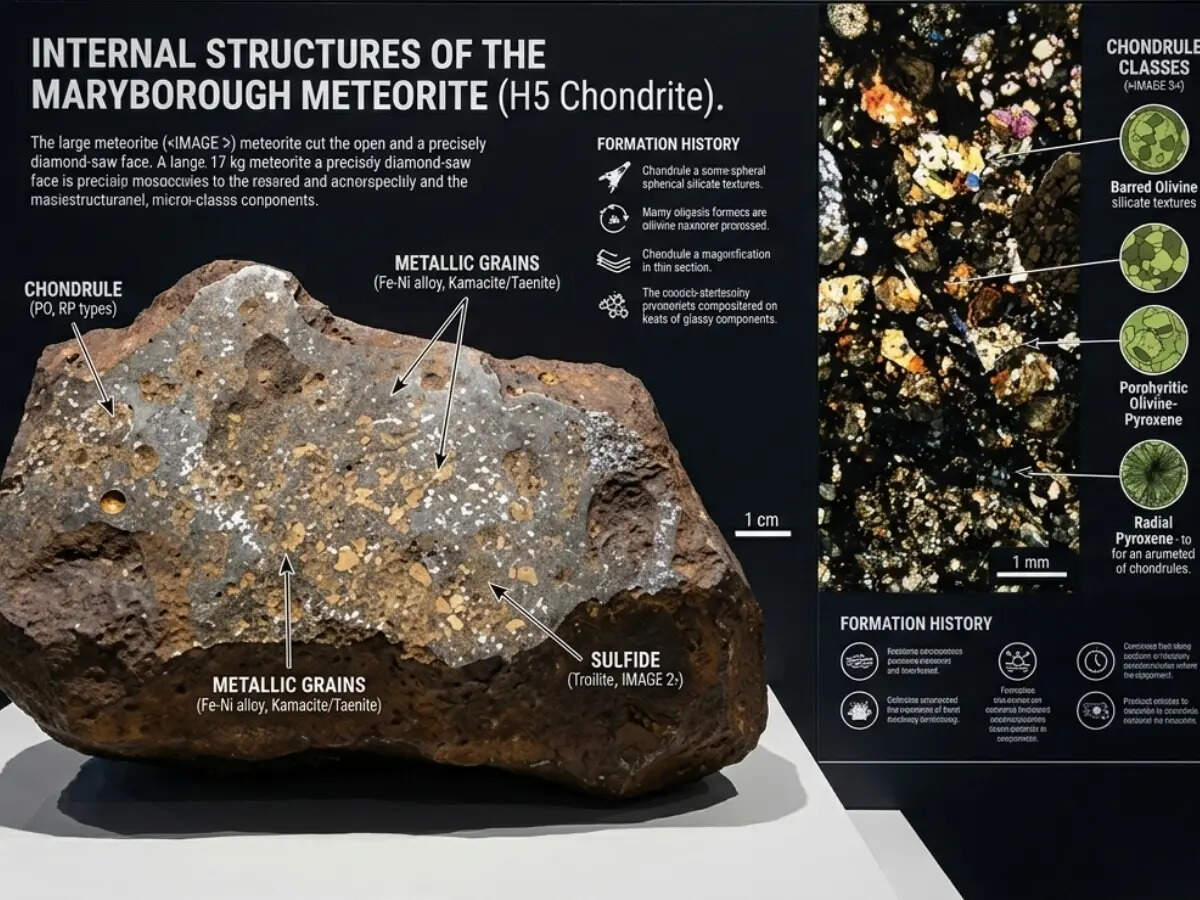
The rock turned out to be a rare meteorite from space. Image credit - Gemini
H5 chondrites and space"H5 ordinary chondrite" is quite a mouthful, but it has a simple meaning. "H" stands for high content of iron, and "5" for a degree of heating.As per the study of Monash University, there are signs of recrystallised matrix and distinct metal phases in the Maryborough meteorite, suggesting it underwent intense heat exposure billions of years ago in space.Meteoritic rocks like that have great significance to research, since they represent the original building blocks of the Solar System, allowing scientists to trace how planets formed over time.NASA points out that chondrites are one of the oldest substances in the Solar System and provide valuable information about its formation.Why discovery of Maryborough meteorite is significant for scienceEvery time a meteorite is officially discovered, it enriches scientific data.
The Maryborough meteorite is particularly valuable, since such objects are not often found in this area.From the moment of identification, the rock becomes a valuable asset to researchers all over the world, and not merely an interesting object for amateurs anymore.Research is conducted in terms of the effect that the environment may have on meteorites. Because of this rock's exposure for many years, it gives valuable insights into how environmental factors can affect space rocks.Such information will certainly be useful for scientists in studying meteorites and for museums in collecting and preserving space material.From a shelf to the scientific worldThe experience with the meteorite from Maryborough demonstrates how often important findings can be overlooked by specialists. The rock lay unnoticed and unremarkable for years.Only thanks to scientific analysis was its true character identified.
Without proper research, it would have been simply an extraordinary stone.The case of David Hole's gold rock is rather a typical reminder right under one's nose. In this particular case, what appeared to be a common mineral became much more remarkable over time.These items are overlooked because they do not fit one's expectations. Meteorites are neither shiny metals nor sparkling gems. These materials have historical value.The Maryborough meteorite links an unremarkable site in Australia with the early solar system. The presence of cosmic material at such a place is evidence enough of what they might be.An inconsequential discovery with a great historyUltimately, what the rock David Hole had kept for 17 years lacked any sort of value in terms of metals. Instead, its value was found in where it originated.It was an ancient meteorite, more than 4 billion years old. It was an example of the materials that would become planets. An insignificant discovery led to the revelation of great historical events.









 English (US) ·