

 1 week ago
13
1 week ago
13
ARTICLE AD BOX
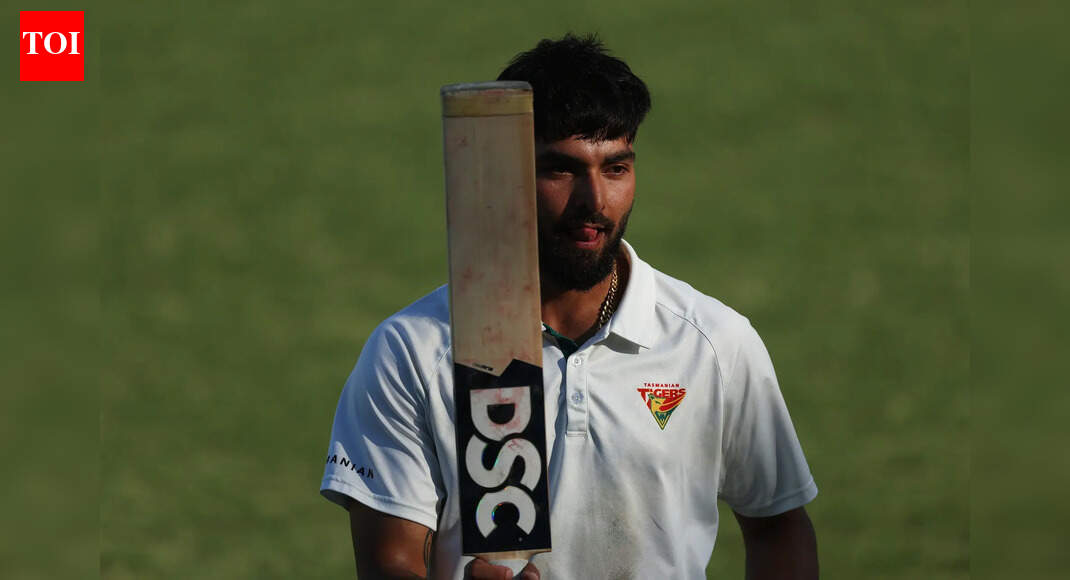
 The possibility of dew in Raipur will determine whether Washington Sundar or Nitish Kumar Reddy will play in the India XI vs South Africa in the 2nd ODI. (PHOTO: AP)
What was the par score when batting first at Ranchi? 330, perhaps. What’s the par score when chasing in that first ODI? 400, or thereabouts. Such was the effect of dew. India got relatively lucky in the sense that the dew initially helped them with the new ball to get the ball skidding on, and South Africa lost wickets in a clutch. Had they preserved wickets in the first powerplay, South Africa might well have cantered home. Despite that collapse, Marco Jansen bashed the living daylights out of India to threaten a heist.
The caravan is now in Raipur, where evening condensation is likely to pop up dewy droplets and gatecrash all well-laid plans of the teams. It’s a massive stadium outside the city, near a pretty water body, with a 60-65 thousand capacity, the third-largest stadium in the country after Ahmedabad and Kolkata. But South Africa’s Temba Bavuma isn’t worried about 65,000 Indians screaming from beyond the stands, but realises the importance of toss and dew. “I think the right decision (to bowl first) was made. The majority of our runs (in the chase) were scored by the guys coming in down … We haven’t considered the crowd to be honest.”
The dew also raises headaches over selection, particularly for India. South Africa went with just one spinner, packing their team with pacers to handle the dew.
For India, who is the better bowler when bowling first, Washington Sundar or Nitish Reddy? Sundar, clearly. He is also the better bowler of the two in most conditions, but when the dew-soaked ball gets mighty difficult to grip for spinners, India might perhaps be tempted to use Reddy. In the latter half of the chase in the first ODI, Indian’s seamers mostly used cross-seam balls and such. But the toss situation can’t be predicted.
At one point, when Marco Jansen was smashing the white ball all around the Ranchi stadium, the ball had to be fetched from beyond the boundary. It looked like a bar of soap when the ball-boy threw to the nearest fielder, with moisture dripping off like water. Two more Indians deployed the towel treatment before it reached the bowler, who too whipped out his towel. The first real appearance of dew came in the 17th over, and from the 25th over on, it fell copiously and India had to scamper around, trying to find a way. In the end, a piece of luck arrived when Jansen heaved a long-hop from Kuldeep Yadav to deep midwicket, and the game turned again.
From 34th over, one ball
There is another factor that is creating issues. Ranchi was the first ODI in India that had the new ICC rule that stated: “Two new balls will be used for the first 34 overs of an ODI innings, after which the fielding team will choose one of the balls for the remaining overs.”
As it turned out, Jansen fell off the first ball of the 34th over, but South Africa’s tail too batted on without much fuss. It’s a team that has batsmen all the way down, and is well poised to make use of that one-ball rule better than India, whose three seamers and Kuldeep aren’t known for fireworks with the bat. The one-ball run from the 34th over was done to bring parity between ball and bat, as it can potentially help reverse swing, but this series in this region of the country this month isn’t helping that. Instead, in an ironic twist, with dew piling on, that one ball is now playing into the batsmen’s hands.
Story continues below this ad
At the end of the first ODI, Kuldeep spoke about the challenge of bowling with that one very-soaked ball. “It was very challenging, the ball was getting really wet. We kept putting dust and asked the umpire for a replacement, that was the plan. I bowled a few balls slower through the air, but you can’t just rely on stock balls. You have to mix things up and keep batters guessing. That was my plan … I was mixing up the scrambled seam and seam up. Just tried to go back off the length. It was easy to connect off a full length.”
Raipur stadium might have one trick up its sleeve to help out the beleaguered bowlers: its massive size. The boundaries are usually at least 80 metres long here, say the locals, and the batsmen might not be able to hit as many sixes with a dewy-soft ball, in theory.
In the bigger scheme of things, this ODI series is viewed differently by the two teams. For India, it has already become an all-consuming affair around Virat Kohli and Rohit Sharma. South Africa see it as an avenue to give chances to youngsters as they build their ODI team. Bavuma said as much: “We’re in a different space, it’s a different team compared to the Test side. It’s about giving chances to young guys.”
South Africa are building with young guys, India are reconnecting with older stars, while dew is doing its own thing.







 English (US) ·