

 2 days ago
8
2 days ago
8
ARTICLE AD BOX
Last Updated:April 15, 2026, 13:40 IST
GE Aerospace and HAL agree to co produce F414 jet engines in India with major technology transfer, powering Tejas Mark 2 and future AMCA fighters, boosting Indian air power


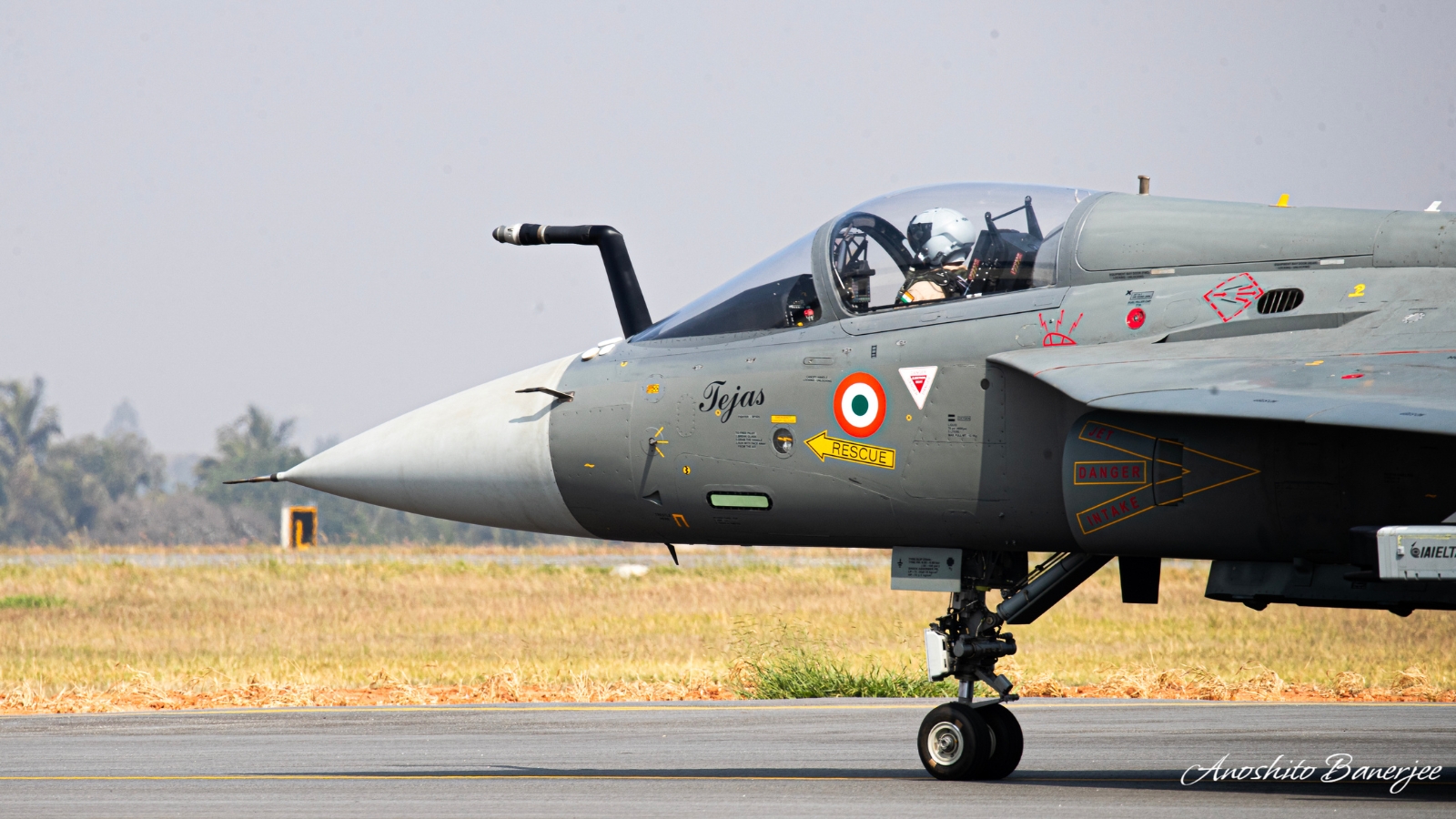
Indian Air Force HAL Tejas Mk1 at Aero India 2025 in Bengaluru. (Image Courtesy: Anoshito Banerjee)
General Electric Aerospace and Hindustan Aeronautics Limited reached a technical agreement on Monday on co-producing F414 jet engines in India, with nearly 80 per cent of the manufacturing technology and intellectual property rights set to transfer to HAL, sources told the Tribune. A formal contract is expected before the end of the current financial year.
The agreement covers the engine that will power the Tejas Mark-2, a heavier successor to the Tejas Mark-1A currently in service with the Indian Air Force. India plans to produce 99 F414 engines domestically in the first tranche, against an IAF requirement of 120 to 130 Tejas Mark-2 fighters. The same engine is also slated to power the first two squadrons of the Advanced Medium Combat Aircraft, India’s fifth-generation programme in development.
GE holds roughly 80 per cent of the F414’s intellectual property. The remaining share is distributed among other American suppliers. Both portions are going to India, in a technology transfer Washington has never before made to New Delhi on fighter jet propulsion.
Rita Flaherty, GE Aerospace’s Vice President for Sales and Business Development (Defence and Systems), put the weight of that plainly. “We can count on one hand all the companies in the world that can do this kind of capability," she said, “and now we are bringing this to India, so India can do it for themselves."
To understand what that means, one must travel back in time to 1961.
Marut – The Spirit Of Tempest
The HAL HF-24 Marut, India’s first indigenously designed jet fighter, made its maiden flight that June. Kurt Tank, the German aeronautical engineer who built the Focke-Wulf Fw 190 for the Luftwaffe, had designed it. The airframe was sound. But the Marut flew its entire service life on the Bristol Siddeley Orpheus engine, chronically underpowered for the aircraft’s potential. India tried to source something more capable, including through a collaboration with Egypt, which was working with Austrian engineer Ferdinand Brandner on a higher-thrust engine. That programme collapsed. The Marut went to war in 1971 on the same engine it had always run, and was retired in 1990 without ever coming close to what its airframe was built to do.
The lesson was absorbed slowly. In 1989, India launched the Kaveri programme, tasking the Gas Turbine Research Establishment in Bangalore to build a domestic engine for the Tejas Light Combat Aircraft. The Kaveri has been tested, modified, and tested again across 35 years. It has never powered an operational Indian fighter. The Tejas flew instead on the General Electric F404, an American engine, which made India dependent on GE for the very aircraft it had designed and built itself.
Transfer Of Technology
This week’s agreement is the first time the United States has transferred fighter jet engine technology to India at this depth. The previous benchmark was the Cold War, when the Soviet Union, and later Russia, licensed MiG-series and Sukhoi-30MKI engine production to Indian facilities. That was Moscow’s technology, on Moscow’s terms. The F414 agreement is structurally different: a NATO-aligned power handing a non-NATO partner the IP to manufacture one of the West’s frontline fighter engines within its own borders.
The ground was prepared over years. India and the US signed the Industrial Security Agreement in 2019, followed by a 2021 protocol for exchanging classified defence industry information between both nations. Prime Minister Narendra Modi’s state visit to Washington in June 2023 produced the formal commitment to a technology transfer and joint venture for F414 production. Three years of technical negotiations followed, covering precisely what transfers and how. Those talks have now concluded.
Commercial negotiations between GE and HAL come next. Global component costs have risen, and pricing will take time. Once the final contract is signed, HAL will set up a dedicated manufacturing facility with GE’s support, with an operational target of two years from signing. According to the Tribune report, the IAF is currently at its lowest fighter squadron strength in decades stretched across a dual-front security environment shaped by both China and Pakistan, which makes the pace of the commercial phase consequential. GE has also indicated it is open to engagement on engines in the 120kN thrust category for next-generation Indian platforms beyond the Tejas and AMCA.
GE, IAF Sign F404 Engine Depot Contract
Separately, GE Aerospace has signed a contract with the IAF to establish an in-country depot for maintenance of F404-IN20 engines that power the 35 Tejas jets currently in service, and the 180 Tejas Mark-1A aircraft on order. The sixth F404-IN20 engine has already been delivered to HAL. The depot will be owned and operated by the IAF, with GE providing technical expertise, training, spare parts, and specialised tooling. Foreign Secretary Vikram Misri met US Under Secretary of War for Acquisition and Sustainment Mike Duffey in Washington the week before the announcement.
India has been trying to build a jet engine since the Cold War. The Marut never got one powerful enough to match its airframe. The Kaveri, after 35 years, has not powered a single operational sortie. On Monday, General Electric and HAL announced the agreement that gives India the technology to change both those facts, for every combat aircraft this country builds after this one.
Handpicked stories, in your inbox
A newsletter with the best of our journalism
First Published:
April 15, 2026, 13:40 IST
News india India Gets 80% of GE's F414 Engine Technology In First-Ever US-India Fighter Jet Transfer
Disclaimer: Comments reflect users’ views, not News18’s. Please keep discussions respectful and constructive. Abusive, defamatory, or illegal comments will be removed. News18 may disable any comment at its discretion. By posting, you agree to our Terms of Use and Privacy Policy.
Read More






 English (US) ·