

 1 day ago
6
1 day ago
6
ARTICLE AD BOX

Barclays is, guess what, 335 years old! Over this period, there have been plenty of disruptions. Each time, the London bank overcame those, often coming out stronger. Now, it has to deal with the AI disruption.
And C S Venkatakrishnan, group chief executive, says India is at the centre of the change that’s going to happen with AI and productivity.The bank has 90,000 employees worldwide, of which 30,000 are in India – across Noida, Mumbai, Chennai, Pune and Bengaluru. On Feb 19, it opened a new office in Gurugram. Venkat, as most call him, was here for the launch, and we got to meet him. “Banking has always dealt with technology in two ways.
One, we are early adopters of it. Time has meant money, and anything that allows information and transactions to be processed quickly, uses technology.
Second, we finance it, be it railways, shipping, aircraft manufacturing, internet companies and now AI,” says Venkat.But banks don’t always move fast enough. Over the past decade, fintech startups have eaten into the business of banks. Venkat admits banks were complacent through the i n ternet age.
“So, they can’t be sleeping through this next revolution (AI-led),” he says.He also notes that banks work in a highly regulated environment and take customer protection seriously. This is why, he says, many fintechs struggle to get a banking licence and they are rarely the primary account. “They are often the secondary account, to keep little money to transact quickly, but not the place where you put your pay cheque,” says Venkat, who was born in Mysuru, studied at Massachusetts Institute of Technology (MIT), and worked at JP Morgan Chase for over two decades before joining Barclays in 2016.
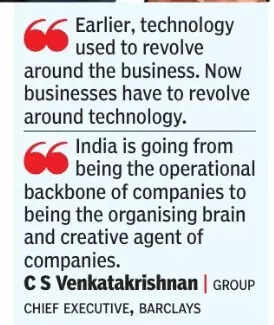
In November 2021, he was appointed as group CEO.India as knowledge hubVenkat says India is the key for AI-led transformation of the bank. “The fact that we are opening another office in Delhi NCR is an indication that we intend to be more prominent in India. All services centres began as cost arbitrage centres, moving jobs from Europe or US to India. That has ended. If it does exist at all, it is tiny. What you now have is a great knowledge advantage in India,” he says.About 60% of the bank’s finance function sits in India. Its Asian investment bank is run from here. Know your customer (KYC), transaction monitoring and credit risk analysis are supported from India. Core technology, contingency operations and digital transformation are also anchored here.
.
So, how will AI change the bank? “I can’t tell you that I know what it will look like say 10 years from now. But I can tell you the steps we need to take on that journey,” says Venkat.
Annual credit updates for corporate borrowers – once labour-intensive – can now be done by bots by pulling together financial data, including credit reports, earnings and updating the reports. KYC processes can now be done automatically. Trading is getting transformed.
“Nobody is calling to say can I buy $100 million of whatever share. Once trading is electronic, then anticipating trades, servicing trades is also electronic.
A salesperson does not have to look at buying patterns and cross sell. An AI agent that sits on the data can do that. We support a lot of these operations out of India,” says Venkat. Portfolio construction and servicing can be automated too. Even portfolio suggestions. But if the money value is high, Venkat says, discussing the idea and deciding to go ahead with it will probably still be a human feature. And also when things go wrong.
“I think people prefer to hear from a human. Especially if it’s their money. Also, as people get wealthier, they care about a sense of human contact,” says Venkat.Understand tech & domainBankers of the future will need to understand technology and the role it plays – skills rarely required earlier. But traditional competencies remain: understanding financial products, risks, markets and customer objectives.“Banks do four simple things,” explains Venkat. “They store your money, they move your money, they lend you money, they invest your money.
The storage and movement can be automated. Much of the servicing can be automated. But, the decisions behind them and what is appropriate to a customer, are very hard to automate. And that will remain the role of the banker,” says Venkat.In India, Barclays seeks programming, quantitative and data-analysis skills, coupled with deep domain expertise in finance. “You can’t just lift someone from here and put them in a pharmaceutical company or vice versa,” he says. “There is deep domain knowledge in finance that is required.”







 English (US) ·