

 1 hour ago
5
1 hour ago
5
ARTICLE AD BOX
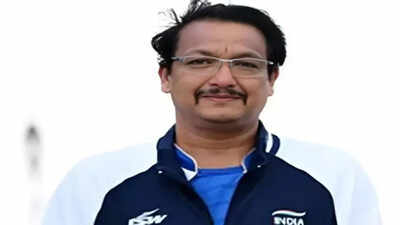
Indian shooting legend and celebrated coach Jaspal Rana passed away on Friday at the age of 49 .
Jaspal Rana’s death has sent shockwaves of grief across the nation. The Olympian and former Indian shooter died at a hospital in Delhi on Thursday. He was 49.He had recently undergone a stent procedure after experiencing chest discomfort during the ISSF World Cup in Munich, Germany.
Rana’s brother, Subash Rana, told the media that he initially mistook the discomfort for acidity and continued with his travel plans.
However, when the discomfort returned, he sought treatment."Mr. Jaspal Rana presented with an acute heart attack that was already three days old. He had been travelling and continued to experience chest pain before arriving at the hospital in a very critical condition," Dr. Balbir Singh, Group Chairman - Cardiac Sciences, Pan Max & Chief of Interventional Cardiology and Electrophysiology, Max Super Speciality Hospital, Saket told TOI Health."The artery responsible for the heart attack was completely blocked. It was found that his heart's pumping function was severely weakened, and he was in heart failure. Patients who present late after a heart attack are at risk of serious complications, including cardiac rupture, which can lead to sudden death," Dr Singh added. "Mr. Rana had recovered significantly and was fit for discharge today. However, he unfortunately suffered a sudden cardiac rupture while asleep, which led to his demise.
""One worrying trend from the past two decades or so is that heart attacks, which used to show up more often in people in their 50s and 60s, are now increasingly being spotted in those in their 30s and 40s," Dr. G Dimpu Edwin Jonathan, Consultant - Interventional Cardiologist, Aster RV Hospital, Bangalore said."If you’re above 30 to 35 years of age, especially if you’re living under chronic stress, or you have a family history of young people having heart attacks, it’s wise to get routine blood tests and also sit down with a cardiologist to gauge cardiac risk.
A sign that’s often overlooked is a kind of heart attack that shows up and feels exactly like gastritis or classic heartburn," he suggests. "When heartburn comes with extreme tiredness, giddiness, nausea, vomiting, or even profuse sweating, please don’t delay, get an ECG done right away, to rule out a heart attack.
For anyone with a family history of heart attacks, waiting until symptoms appear isn’t a smart strategy."
Key signs that indicate trouble in the heart
The American Heart Association points out that many heart attacks start slowly, with mild discomfort that's easy to brush off or mistake for something else entirely. The most recognizable warning sign is chest discomfort. Most people having a heart attack feel it in the center of the chest, and it can last more than a few minutes, or it may go away and come back. It doesn't always feel like sharp pain. It can feel like uncomfortable pressure, squeezing, fullness, or even just a vague heaviness.
A lot of people describe it as something sitting on their chest. And because it doesn't always feel like what they expected, they wait.
But chest discomfort isn't the only thing to watch for. Symptoms can also show up as pain or discomfort in the arms, back, neck, jaw, or stomach, sometimes without any chest involvement at all. Shortness of breath is another major warning sign, and it can happen with or without chest discomfort. Other signs the AHA flags include breaking out in a cold sweat, nausea, feeling unusually tired, lightheadedness, and a rapid or irregular heartbeat.





 English (US) ·