

 1 week ago
7
1 week ago
7
ARTICLE AD BOX
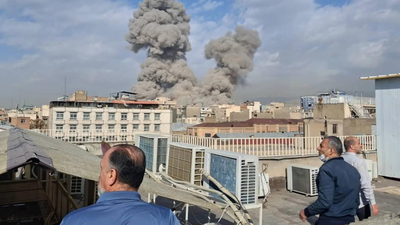
The United States and Iran have been adversaries since the 1979 Islamic Revolution and the hostage crisis at the US embassy in Tehran, a rupture that set the tone for decades of hostility.Saturday’s US and Israeli strikes, dubbed “Operation Epic Fury”, mark the latest and most direct escalation in a conflict long defined by proxy battles and covert operations. Israel has consistently described Iran’s nuclear ambitions as an existential threat, framing the latest action as part of that broader security calculus.A timeline of the crisis:
1979: The hostage crisis
On November 4, 1979, Iranian student activists stormed the US Embassy in Tehran, taking 52 American diplomats and citizens hostage in protest against Washington’s decision to admit Iran’s deposed monarch, Mohammad Reza Pahlavi, for medical treatment.
The crisis unfolded months after the Islamic Revolution had toppled the shah and brought Ayatollah Ruhollah Khomeini to power, ending decades of monarchy and reshaping Iran’s political order.Public anger had been building over widespread poverty, political repression and the shah’s close ties to the United States. After the embassy seizure, the then US President Jimmy Carter severed diplomatic relations with Iran in April 1980 and imposed sanctions.
A US military rescue attempt later that month failed, killing eight American servicemen. The hostages were eventually released on January 20, 1981, after 444 days in captivity, marking a decisive rupture in US–Iran relations.
2002: 'Axis of evil'
On April 30, 1995, US President Bill Clinton imposed a sweeping ban on American trade and investment with Iran, alleging that Tehran supported “terrorism.” The US pointed to Iran’s backing of groups such as Hezbollah, Hamas and Palestinian Islamic Jihad, and subsequently targeted foreign firms investing in Iran’s oil and gas industry, as cited by AFP.
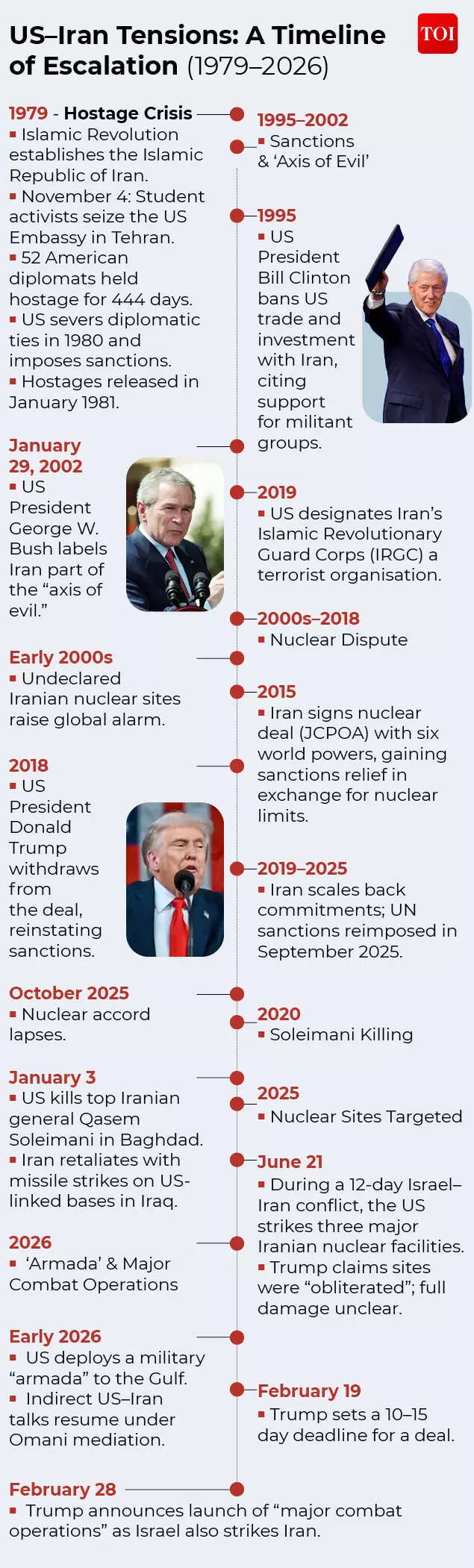
iran timeline
On January 29, 2002, US President George W Bush described Iran as part of an “axis of evil,” along with Iraq and North Korea, accusing them of supporting terrorism and seeking weapons of mass destruction. In April 2019, Washington formally designated Iran’s Islamic Revolutionary Guard Corps (IRGC) as a “terrorist organisation.”
2018: Nuclear deal, withdrawal and renewed sanctions
In the early 2000s, revelations about previously undeclared nuclear sites in Iran triggered international suspicion that Tehran was pursuing nuclear weapons, a charge it has repeatedly denied.A 2011 report by the International Atomic Energy Agency (IAEA) said there was “broadly credible” intelligence suggesting Iran had undertaken activities related to developing a nuclear explosive device until at least 2003. In 2005, then President Mahmoud Ahmadinejad restarted uranium enrichment, insisting the programme was intended for peaceful, civilian use.In 2015, Iran signed a landmark nuclear agreement in Vienna with six major powers, China, France, Germany, Russia, the United Kingdom and the United States, agreeing to curb its nuclear activities in return for sanctions relief.
The accord received backing from the United Nations.The deal unraveled in 2018 when US President Donald Trump withdrew from it and reimposed sanctions. Iran subsequently reduced its compliance with the agreement. Efforts to restore the pact failed, UN sanctions were reimposed on September 28, 2025, and the agreement expired the following month.
2020: Qasem Soleimani killed
On January 3, 2020, a US drone strike in Baghdad killed Major General Qasem Soleimani, commander of Iran’s elite Quds Force and widely regarded as one of the country’s most powerful figures after Supreme Leader Ayatollah Ali Khamenei.Then US President Donald Trump said Soleimani had been planning an “imminent” attack on American diplomats and forces in the region, though US officials did not publicly provide detailed evidence to substantiate the claim.Iran retaliated days later by launching ballistic missiles at two Iraqi bases housing US troops, escalating tensions between the two countries.
2025: US strikes nuclear sites amid collapsing talks
During the 12-day conflict between Israel and Iran, the United States carried out strikes on three major Iranian nuclear facilities on June 21, 2025.
US President Donald Trump said the sites had been “obliterated,” although the full extent of the damage was not independently confirmed.The strikes came amid stalled nuclear negotiations between Washington and Tehran, which had resumed in April but failed to produce an agreement. A fresh round of talks had been expected when Israel launched a series of airstrikes on Iran on June 13, prompting the White House to reassess its approach.In the early hours of June 22, the US escalated its involvement, bombing three nuclear sites in what Pentagon officials described as causing “severe damage” to Iran’s nuclear capabilities. Tehran vowed retaliation.
2026: Deployment of 'Armada'
In late December 2025, Trump threatened military action against Iran over its violent crackdown on a widespread protest movement, though his focus soon shifted back to Tehran’s nuclear programme.
He subsequently ordered the deployment of a US “armada” to the region.Indirect talks between Washington and Tehran resumed in early February 2026 under Omani mediation. The United States pressed for a broader agreement addressing Iran’s nuclear activities, ballistic missile programme and regional support for armed groups, while Tehran sought to confine negotiations to the nuclear issue.On February 19, Trump said he was giving Iran “10, 15 days, pretty much maximum” to reach a deal, warning that “otherwise bad things happen.”
On February 28, he announced the launch of “major combat operations,” as Israel also carried out strikes on Iran.
2026: Operation Epic Fury
Trump said the United States had launched “major combat operations” in Iran in coordination with Israel, describing the action as aimed at “eliminating imminent threats.” In a video statement, he alleged that Tehran continued to advance its nuclear programme and develop missiles capable of reaching the United States.The strikes, carried out on Saturday under Israel’s operation “Lion’s Roar,” included a reported attack near the offices of Supreme Leader Ayatollah Ali Khamenei in Tehran. Iranian media reported explosions at multiple locations nationwide, with smoke seen rising over the capital, indicating a coordinated and wide-ranging assault.





 English (US) ·