

 1 hour ago
4
1 hour ago
4
ARTICLE AD BOX
Throughout his writing career, Vinod Kumar Shukla made the quotidian radical. He crafted sentences that seemed to listen more than they spoke, wrote poetry and prose that foregrounded the moral gravity of ordinary lives. In doing so, Shukla, who died in Raipur at the age of 88, reshaped modern Hindi literature.
Born on January 1, 1937, in Rajnandgaon (now in Chhattisgarh), Shukla’s abiding memory of his early years was of watching movies in the theatre opposite his house. The early proximity to images, movement and narrative would later find echo in his work: his writing inhabited the threshold between reality and reverie, where the mundane acquired a faint, unsettling glow, often grim, but never completely bereft of hope.
“I believe, and it is only my personal view, that my imagination is also my reality. Sometimes, in the face of relentless reality, that imagination seems truer. So often, in times of distress, we tell each other ‘sab theek ho jayega (everything will be alright)’. Can anything be further from the truth? Everything will never be alright. But it seems, at that moment, to be possible,” he once said in an interview to this newspaper.
Shukla’s literary career spanned more than five decades, during which he produced poetry, short stories, novels and essays that resisted easy classification.
His words carried a philosophical charge, questioning power, labour, desire and freedom. His first poetry collection, Lagbhag Jai Hind (1971), announced a voice distinct from the rhetorical nationalism common at the time.
Later volumes such as ‘Sab Kuch Hona Bacha Rahega (Everything Is Yet To Happen)’ often unfolded through small observations—a landscape drying out, a thought half-formed—yet they opened on to vast emotional and metaphysical spaces. “His contribution is so vast that it is difficult to even know where to begin. He brought something entirely new — he took reality as it is and made magic out of it. His way of seeing the world was entirely his own,” says writer Sara Rai, who co-translated Shukla’s story collection, Blue Is Like Blue, with poet Arvind Krishna Mehrotra.
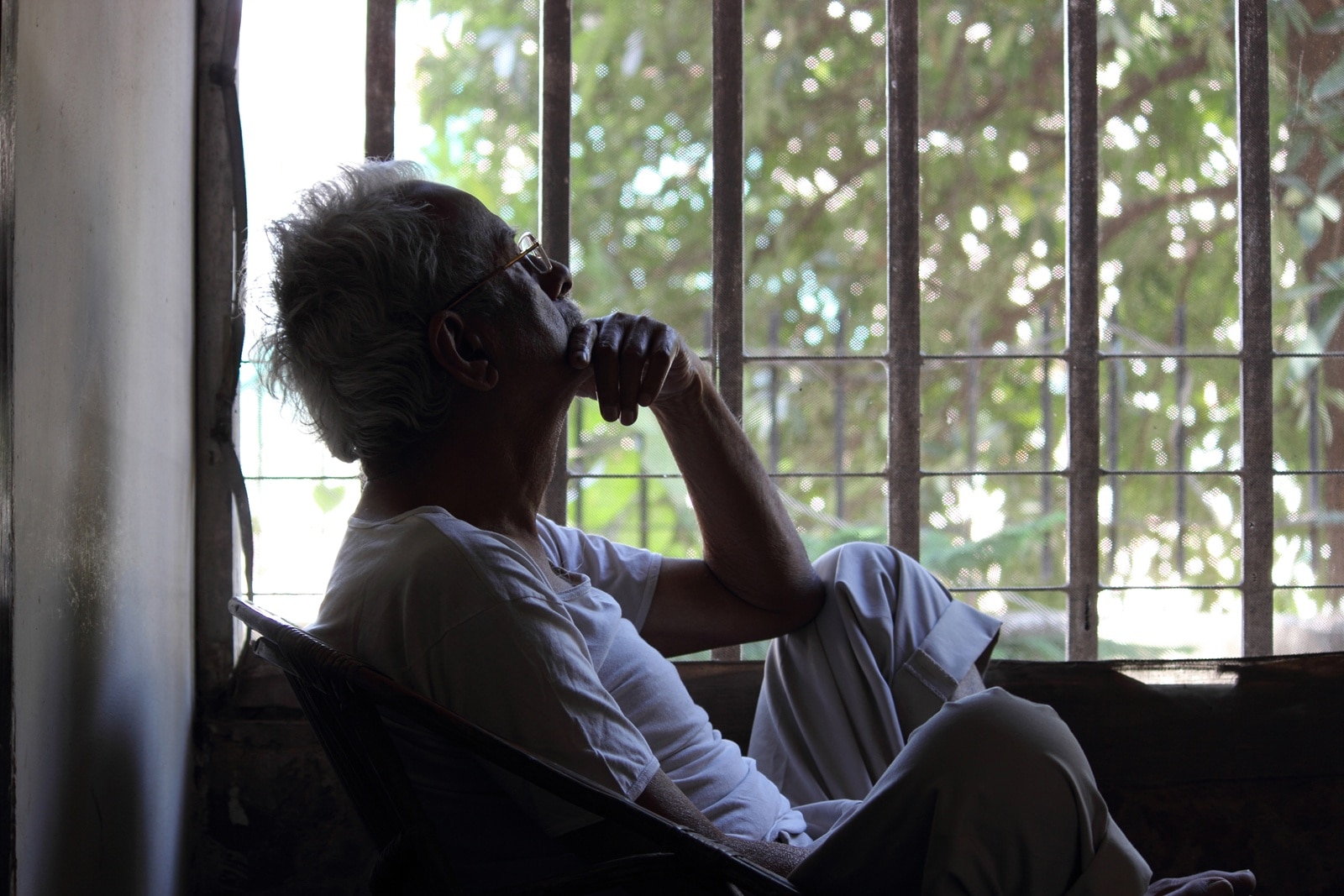 Hindi writer and poet Vinod Kumar Shukla.
This originality of vision extended to Shukla’s fiction too. His 1979 novel Naukar Ki Kameez (The Servant’s Shirt), later adapted into a film by Mani Kaul, is a slender, unsettling meditation on class, dignity and the violence of social hierarchies. Perhaps his most celebrated work, Deewar Mein Ek Khirkee Rahati Thi (A Window Lived in a Wall), which won the Sahitya Akademi Award in 1999, exemplifies Shukla’s ability to make the abstract intimate. In Shukla’s work, walls, windows, rooms and roads become metaphors.
Story continues below this ad
His characters are rarely heroic; they endure, observe and occasionally glimpse a freedom that remains just out of reach.
Bureaucrats, labourers, teachers, children, and also forests and forgotten towns pulse with rich interior lives. His prose often seems to hover in mid-air, as if pausing to allow the reader to catch up with its thought, to linger and pay it the attention it deserves. This slowness captures Shukla’s quiet defiance of modern urgency.
President Droupadi Murmu in a post on X said, “The demise of Shukla, who enriched prose and poetry immensely through his intuitive and powerful compositions, has caused an irreparable loss to the literary world.”
PM Narendra Modi shared his condolences on X and said Shukla will be remembered for “his invaluable contribution to the world of Hindi literature”.
Story continues below this ad
Despite his influence, Shukla remained distant from urban literary centres. Trained originally in agricultural science, he spent much of his life in Chhattisgarh, far from Delhi’s publishing circuits. Writer Sumana Roy recalls how she, with the help of MP Shashi Tharoor, had to fight for the inclusion of Shukla’s Blue Is Like Blue in the list for the best book of the year at the 2020 Mathrubhumi International Festival of Letters.
The book eventually went on to win that year’s best book award. “Shukla’s writing, in this book in particular, reminds us of an India that had grace and dignity even in its penury — in a story where a character cycles back home to be sure that he has not misplaced the little money he has to last him through the month, we encounter a part of our lost self that had not been eroded and harassed by capitalism,” says Roy.
This distance from power centres, however, shaped Shukla’s vision, grounding his work in soil, weather and labour, and lending his writing an ecological awareness long before the term became fashionable. Recognition arrived late but decisively. In 2023, Shukla became the first Indian writer to receive the PEN/Nabokov Lifetime Achievement Award, cited for the originality and integrity of his body of work.
In 2025, he was awarded the Jnanpith, India’s highest literary honour, a belated acknowledgment of a writer who often described writing as a response rather than a “project”, in which one sentence led to another, guided by intuition and occasion. “Perhaps, it’s not so important to find out why one writes after all,” he had remarked in the same interview.
Story continues below this ad
In an era increasingly defined by noise, certainty and speed, Vinod Kumar Shukla leaves behind a literature of hesitation, compassion and wonder — a reminder that the smallest sentence, handled with care, can hold an entire life. (With inputs from Anusree K C)








 English (US) ·