

 1 hour ago
4
1 hour ago
4
ARTICLE AD BOX
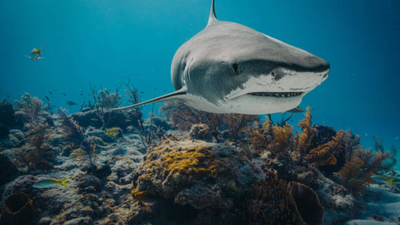
On a Saturday afternoon in May, Cheslei Akima and Alika Dickerson were paddling about a mile off the coast of Olowalu on Maui's western shore. Calm water, good weather, a routine outing.
Then, without any warning, everything changed. "All of a sudden, like 10 feet in front of the kayak, a fin sticks up, and I'm thinking to myself, 'What is that?' And then it starts coming at us," Akima told Hawaii News Now. What came at them was a tiger shark and it was bigger than their 12-foot kayak.The shark latched onto the side of the kayak and started shaking it, and wouldn't let go. Dickerson struck the shark repeatedly in an effort to free the kayak, but the first blows had little effect.
"On the third time, it finally let go. It sank down a little bit and just splashed us with its tail, swimming away," he said. "I was in shock." So how did they know it was a tiger shark? And if you're ever in their position — what do you actually do?
How to identify a Tiger Shark
Akima knew immediately because of one thing: the stripes. She said the shark had light gray stripes and looked longer than their 12-foot kayak, both features of the apex predator. That's the most visible identifier, though it comes with a caveat.
Juvenile tiger sharks have bold, dark vertical bars, but these markings fade as the shark ages, so adults display only faint stripes. A large adult can be harder to identify by stripes alone.What doesn't fade is the head. Tiger sharks have a blunt, square head with eyes on the corners and large, flared nostrils, completely unlike a great white, which has a narrower, more pointed snout. The overall body shape is distinctive too: a wide, blunt snout, a caudal keel, and colouring that varies from brownish and olive to dark grey above, with a pale or yellowish-white belly. Size is the other giveaway. Most individuals encountered by divers range between 11 and 14 feet in length, though females can reach more than 18 feet. When a shark is longer than your boat, the species identification becomes, unfortunately, quite straightforward. The State of Hawaii Division of Aquatic Resources considers tiger sharks "the most dangerous sharks in Hawaiian waters" due to their large size and feeding habits at the very top of the inshore food chain.
And there's a specific reason the Olowalu area is particularly high-risk. University of Hawaii marine biologists who have tracked shark behaviour around Hawaii for years have found that Olowalu is actually a mating hub for tiger sharks — and the timing of their mating activity overlaps with humpback whale season, indicating sharks are also feeding there.
What to do if a Tiger Shark comes at you
Dickerson's instinct, to fight back, physically and without hesitation, was exactly right.
Retreating passively is not a viable strategy with a shark that has already committed to an approach. What Dickerson did, striking repeatedly until the animal released, is the approach that works. The punches proved sufficient to interrupt the shark's hold, allowing the pair to regain stability and distance themselves.If you're in the water rather than on a kayak, staying calm enough to face the shark rather than thrash away from it matters enormously. Splashing and erratic movement signals distress, which to a shark reads as prey behaviour. Keep eye contact if you can. Back toward a wall, a reef, a boat, anything that reduces the angles from which the animal can approach. And get out of the water as directly and calmly as the situation allows.Akima and Dickerson say the experience isn't stopping them from getting back in the water. "Gotta get back," they said. That's either admirable or slightly terrifying, depending on your perspective.









 English (US) ·