

 1 hour ago
5
1 hour ago
5
ARTICLE AD BOX
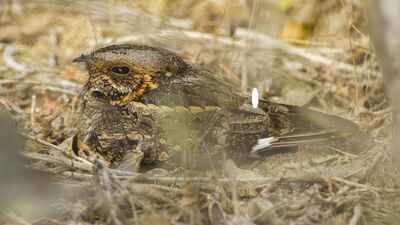
Most animals respond to the changing seasons. Some follow temperature, others track rainfall or the lengthening and shortening of days. The red-necked nightjar appears to be paying attention to something else entirely.
For this nocturnal bird, the moon is not simply a source of light in the night sky. It acts more like a recurring timetable. Every month, as lunar brightness rises and falls, the bird adjusts how it feeds, how much energy it stores and even when it undertakes some of the most demanding events in its life.What might look like ordinary behaviour spread across a year turns out to be linked to a cycle lasting just under 30 days. According to a study published in Science Advances, titled “Moonlight drives the energy balance and annual cycle of a nocturnal forager”, the red-necked nightjar's annual routine is closely tied to the lunar month, creating a pattern that repeats again and again throughout the year.
Why the Nightjar follows a 29-day lunar cycle
Nightjars spend their days resting almost invisibly against sandy ground and scrubland vegetation. After sunset, they take to the air in search of flying insects.Unlike bats, however, they do not use echolocation. Vision does much of the work. That dependence on sight creates a problem whenever the moon disappears from the night sky. The research team, led by scientists studying a population in Spain's Doñana region, found that activity levels rose and fell in step with lunar illumination.
During bright nights around the full moon, birds remained active for much longer periods.
Darker nights told a different story.According to the study, the birds concentrated much of their hunting effort around dusk and dawn when moonlight was absent, reducing activity during the middle of the night. The pattern appeared repeatedly across years of monitoring, suggesting it is a deeply established part of their behaviour rather than a short-term response to local conditions.
The Nightjar gains and loses weight with the Moon's cycle
The moon's influence extends beyond movement. Food intake itself fluctuates through the lunar month. Bright nights allow the birds to continue catching insects long after sunset, while darker nights limit opportunities. Over time, these differences create alternating periods of surplus and shortage.As per the researchers, nightjars possess unusually large gizzards that act as temporary food-storage chambers.
They can consume large quantities of insects when conditions are favourable, then rely on those reserves when hunting becomes more difficult. Even so, the monthly imbalance never completely disappears.Body mass measurements collected over many years revealed a repeating pattern. The birds tended to gain weight after periods of increased moonlight and gradually lose some of those reserves as darker nights returned.
Rather than existing in a stable state, they appear to cycle between accumulation and depletion every lunar month.
Nightjar's survival strategy during dark nights
There are limits to how much stored energy can solve the problem. The study found that during periods when hunting success drops, nightjars sometimes reduce body temperature and metabolic activity in a process known as torpor. The state resembles a temporary shutdown rather than sleep, allowing the birds to conserve energy until feeding conditions improve.What caught the researchers' attention was how closely this behaviour matched the lunar cycle. Torpor became more common when moonlight was scarce, and energy intake declined. In some cases, the timing corresponded closely with moonset, suggesting the birds were responding not only to hunger but also to changing levels of nocturnal illumination.As per the authors, this creates a recurring physiological rhythm in which the birds repeatedly switch between energy acquisition and energy conservation as the month progresses.
Nightjar times migration and nesting with the Moon
The monthly cycle does not stop at feeding behaviour. Some of the most important stages of the nightjar's year also appear to be arranged around periods of favourable moonlight. Tracking data collected from tagged birds showed that migration was not evenly distributed across the calendar. Instead, departures clustered around particular points in the lunar cycle.Spring migration frequently occurred nearly two weeks after a full moon, according to the study. Breeding patterns showed a similar tendency. Females were more likely to be incubating eggs during specific phases of the lunar month, producing hatching dates that coincided with brighter nights and improved feeding opportunities.The researchers suggest that this timing may help parents meet the considerable energy demands of raising chicks. A newly hatched bird requires a steady supply of insects, and moonlit nights offer a better chance of finding them.







 English (US) ·