

 4 days ago
12
4 days ago
12
ARTICLE AD BOX
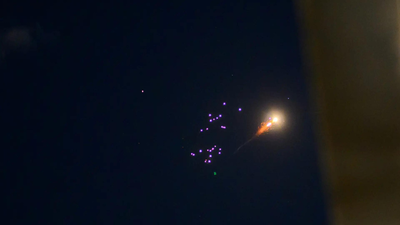
United States forces have intercepted hundreds of Iranian ballistic missiles in recent days, as Tehran responded to joint American and Israeli strikes with large-scale barrages across the region.
According to General Dan Caine, Washington has “intercepted hundreds of ballistic missiles targeting US forces, our partners and regional stability”.Each successful interception, however, comes at a cost. Advanced missile defence systems rely on sophisticated interceptors that are expensive, complex to manufacture and available only in limited numbers. Analysts warn that if Iran sustains its current rate of fire, the pressure on US and allied stockpiles could intensify.Kelly Grieco of the Stimson Center told news agency AFP that there is “a risk the United States and its partners could run out of interceptors before Iran runs out of missiles”, although she added that outcome is far from certain. The contest, she argues, is as much about destroying Iranian launchers as it is about shooting down incoming threats.
A race between launchers and defences
At the outset of the conflict, Israeli estimates suggested Iran possessed roughly 2,500 ballistic missiles — potentially more than the combined interceptor inventories of the US and Israel.
Since then, both countries have sought to reduce that threat through air strikes on missile storage facilities and launch sites.

President Donald Trump has indicated the campaign could last four to five weeks, though he has said US forces are “substantially ahead” of projected timelines. Defence Secretary Pete Hegseth has offered varying estimates, reflecting the uncertainty surrounding the duration of the war.The longer the conflict endures, the more acute the question of supply becomes. Grieco notes that interceptor production “simply cannot keep pace with demand”, particularly when multiple theatres — from Europe to the Indo-Pacific — require the same systems.Joe Costa of the Atlantic Council has warned that a prolonged confrontation with Iran could strain stocks needed for other contingencies, including those involving China.
Scale versus sophistication
The current exchanges highlight the contrasting military models of Iran and Israel. According to the 2026 Global Firepower Index, Israel ranks 15th globally while Iran follows closely at 16th, reflecting broadly comparable overall capability despite differing strengths.Iran’s advantage lies in scale. With a population of around 88 million and hundreds of thousands of active personnel, it fields one of the region’s largest ballistic missile arsenals.
Estimates suggest Tehran may hold more than 3,000 missiles, spanning short- and medium-range systems.Israel, by contrast, relies heavily on technological sophistication and layered missile defence. Systems such as Iron Dome, David’s Sling and Arrow are designed to counter threats at varying ranges, forming a shield against massed attacks. The United States supplements this architecture with its own high-end interceptors deployed across Gulf bases.Yet even the most advanced shield has limits. Iran has also invested heavily in drones, which are cheaper to produce and can force defenders to expend interceptors. While drones typically require fewer high-end systems to defeat, they add to the overall strain.
Strategic consequences
The strategic risk is not necessarily that the United States will suddenly exhaust its defences, but that sustained high-intensity exchanges could deplete inventories faster than they can be replenished.
Interceptors take time to build, and supply chains are already stretched.If US and Israeli forces can degrade Iran’s launch capacity quickly, the pressure may ease. If not, missile exchanges could define the tempo of the war — and test the resilience of Western defence industries.In that sense, the conflict is becoming not just a battle of firepower, but of endurance: a race between Iran’s missile reserves and America’s ability to sustain its shield.







 English (US) ·