

 6 days ago
14
6 days ago
14
ARTICLE AD BOX
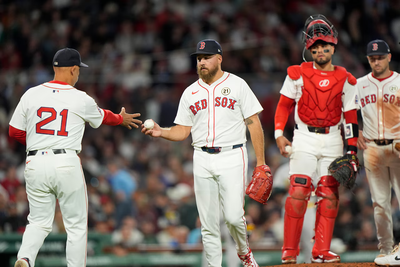
Boston Red Sox (Image via AP Photos)
The Boston Red Sox are dealing with a simple problem going into the 2026 season. They have more outfielders than available spots, and most of them need to play every day.Jarren Duran, Wilyer Abreu, Ceddanne Rafaela, and Roman Anthony are all expected to start.
That leaves Kristian Campbell without a clear role. He signed an eight-year, $60 million deal in April 2025, but right now, there is no obvious place for him in the lineup.
Too many options in Boston Red Sox's outfield, not enough space
Boston Red Sox’s outfield is already set. Duran is coming off a strong 2025 season, hitting .285/.342/.492. Abreu handles one corner with steady defense. Rafaela and Anthony are also regulars.Campbell can play multiple positions, but that has not helped his case.
The team added Caleb Durbin, which makes it harder for him to get time in the infield. The outfield is already full.Because of this, there is a growing view that Boston should move him now instead of waiting.
Trade idea focuses on pitching help
If Boston trades Campbell, the return is expected to be a starting pitcher. A team like the Miami Marlins makes sense. They need hitters and have pitching depth.Boston could include Campbell with lower-level prospects and target a controllable starter.
Moving him would also clear about $7.5 million per year from the payroll through 2032.For Miami, the deal would offer a young player who can play every day and is already signed long term.
What each side gets from a deal

Boston Red Sox (Reuters Photo)
For Boston Red Sox, the benefit is clear. The team can add a starting pitcher to a rotation that already includes Garrett Crochet and Brayan Bello. At the same time, they keep their main outfield group intact.Campbell would get regular at-bats on a team that can afford to give him time.
That could help him get back to the level he showed in the minors.Miami would take on some risk because of his recent performance, but they would also get a young player under team control for years.
Pros and cons of a potential Kristian Campbell trade
| Aspect | Pros | Cons |
| Boston Red Sox | Streamlines roster; acquires pitching; keeps elite OF intact | Lose versatile depth if injuries hit; sell low on extension talent |
| Campbell | Full-time at-bats to rebuild value; fresh start | Smaller market; weaker lineup protection |
| Marlins | Long-term OF solution at discount; upside bat | 2025 struggles (.223 AVG, poor DRS); contract risk |
Kristian Campbell’s 2025 numbers explain the situation
Kristian Campbell did not produce enough in 2025 to force his way into the lineup. He showed some early promise but could not keep it going.
| Season | AB | AVG | HR | RBI | OPS | Games | Pos (G) | DRS |
| 2025 MLB | 229 | .223 | 6 | 21 | .664 | 67 | 2B(59)/LF(2)/CF(7) | -16 |
| Minors Career | 920+ | .385 SLG est. | High minors pop | Awards-heavy | Strong MiLB | N/A | IF/OF | N/A |
At the same time, the players ahead of him performed well. That made it harder for the team to justify giving him more chances.
Background and long-term value
Kristian Campbell was born on June 28, 2002, in Chattanooga, Tennessee, and played at Georgia Tech. He is 6’3” and weighs 191 pounds. He can play both infield and outfield.His minor league record suggests there is still potential. That is part of why he could still have value in a trade.
Final situation before Opening Day
Boston Red Sox does not have to trade Campbell, but the current roster makes it a real option. The team has strength in the outfield and needs help in the rotation.Also read: MLB trade rumors: New York Yankees look at $4.2 million Washington Nationals star as shortstop option while Anthony Volpe recoversA trade would address both issues. It would also give Campbell a better chance to play every day somewhere else.






 English (US) ·