

 1 day ago
7
1 day ago
7
ARTICLE AD BOX
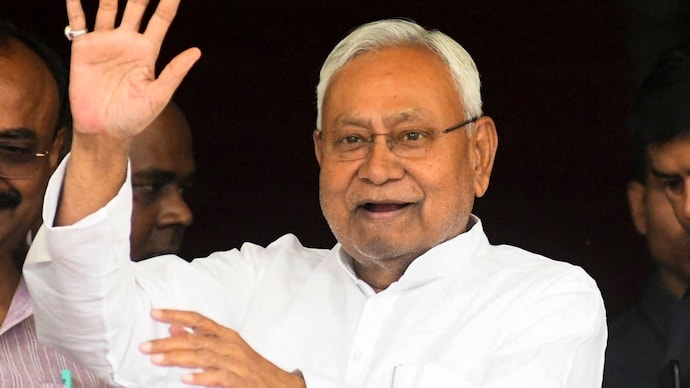
Nitish Kumar's unmatched record of 10 swearing-ins and 6 resignations tells a deeper story of shifting alliances, power strategy, and Bihar's evolving politics, but what drives this repeated cycle of exits and comebacks?
Nitish Kumar’s cycle of resignations and returns
Patna,UPDATED: Apr 14, 2026 16:13 IST
In Indian politics, the career of Nitish Kumar stands out for one clear reason - the rare combination of repeated oath-taking and repeated resignations.
He has taken oath as Chief Minister of Bihar 10 times, which is widely seen as a record. At the same time, with his resignation today, he has stepped down from the post six times, also a record for any Indian politician.
This dual record of “10 oaths and 6 resignations” defines Nitish Kumar’s political journey. It reflects not just longevity in power, but also a pattern where stepping down has often been followed by a quick return to office under a new political arrangement.
Nitish Kumar first became Chief Minister on March 3, 2000, but that government lasted only a few days. He resigned on March 10, 2000, after failing to prove a majority. However, this early exit did not stop his rise. In November 2005, he returned to power and has since remained a central figure in Bihar politics.
From 2005 onwards, his political journey has been marked by a cycle: resign, realign, and return. This pattern became very clear over the years. In 2010, he took oath as Bihar Chief Minister for the third time.
In 2014, he resigned, taking moral responsibility for his party’s poor performance in the Lok Sabha elections. However, he took oath again as Chief Minister for the fourth time in February 2015 after dislodging Jitan Ram Manjhi.
Later in 2015, he took oath again as Bihar Chief Minister for the fifth time in alliance with the RJD after the Assembly elections. In 2017, he resigned after breaking ties with the Mahagathbandhan and returned to power within hours, taking oath for the sixth time as Chief Minister with the NDA.
He was sworn in as Chief Minister for the seventh time after the Assembly elections in 2020. In 2022, he again resigned after leaving the NDA and formed a government with opposition parties, taking oath as Chief Minister for the eighth time.
In 2024, the same pattern repeated when he quit the Mahagathbandhan and returned to the NDA, taking oath as Chief Minister for the ninth time. He finally took oath as Chief Minister of Bihar for the tenth time after the 2025 Assembly elections.
Each of these resignations and returns was not just a political compulsion, but also a strategic move. It allowed Nitish Kumar to reset alliances and continue in power. That is why his record is not just about numbers, but about a distinct style of politics.
At the same time, another important fact adds a new dimension to this story. Nitish Kumar has never secured a full majority on his own party’s strength. His party, Janata Dal (United), has always depended on alliance partners to form the government.
Whether it was with the Bharatiya Janata Party under the NDA, or with the Rashtriya Janata Dal and Congress in the Mahagathbandhan, alliances have been the backbone of his rule.
Even in 2010, when his government was seen as very strong, the victory belonged to the alliance and not to JD(U) alone. JD(U) secured 115 seats in 2010, the highest it has achieved in the last 20 years, but still seven short of the majority mark of 122. In 2020, his party’s reduced numbers made this dependence even more visible.
So, on one side, there is the headline number, 10 times taking oath as Chief Minister. On the other, there is the equally striking number, six resignations from the same post, a record that remains unmatched.
Supporters say this shows his flexibility and ability to keep Bihar politically stable despite changing situations. Critics argue that frequent resignations and alliance shifts raise questions about consistency and mandate.
But beyond the debate, one conclusion is clear. Nitish Kumar has created a political model where power is maintained not by a single mandate, but by managing alliances and timing decisions carefully.
As Bihar once again stands at a political turning point, the focus remains on these two numbers,10 oaths and six resignations, a record that remains unmatched.
- Ends
Published By:
Sonali Verma
Published On:
Apr 14, 2026 16:13 IST
Tune In








 English (US) ·