

 4 hours ago
5
4 hours ago
5
ARTICLE AD BOX
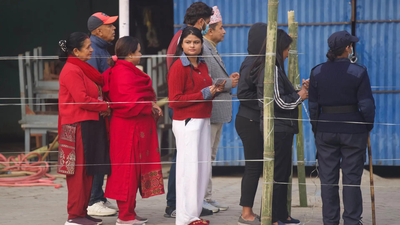
Nepal began voting on Thursday in its first nationwide election since last year’s dramatic youth-led uprising toppled the government and reshaped the country’s political landscape.
The high-stakes poll comes after months of political turmoil sparked by what many have called a “Gen Z revolution” — protests driven largely by young Nepalis angry over corruption, unemployment and entrenched political patronage.Across the Himalayan nation of about 30 million people, long queues formed outside polling stations as security forces patrolled the streets. Authorities banned vehicles and political gatherings on election day to prevent unrest.
Nearly 19 million voters are eligible to cast their ballots in an election that many see as a referendum on the political establishment that has dominated the country for decades.For many young voters, the election is deeply personal. Dipika Saru Magar, a 25-year-old student who travelled 16 hours from Kathmandu to vote, had taken part in last year’s protests holding a banner that read: “No More Afno Manche [nepotism], Bhansun [pulling strings], Chaplusi [bootlicking].”
Yet despite the energy that drove the uprising, she remains cautious. “I feel the new government may not be able to meet the expectations of the general public,” she said.Interim prime minister Sushila Karki, who came out of retirement to lead the country after the protests forced the previous government from power, urged voters to participate peacefully. “Every vote is important in determining our future,” the 73-year-old former chief justice said in a statement as polling began.
A Gen Z uprising that reshaped Nepal
The election follows one of the most dramatic episodes in Nepal’s recent political history. In September 2025, young Nepalis poured onto the streets of Kathmandu and other cities, initially protesting a government ban on social media.The demonstrations quickly expanded into a nationwide movement against corruption, nepotism and economic stagnation. Protesters clashed with security forces, while crowds set fire to several government buildings including parliament, the Supreme Court and the central secretariat.Authorities say 77 people were killed during the unrest, many of them protesters shot by police. The violence ultimately forced the resignation of Prime Minister Khadga Prasad Oli and the dissolution of parliament.
Millions vote in high-stakes poll
Thursday’s election is being closely watched as a test of whether Nepal’s political system can respond to the anger that erupted last year.Nearly 18.9 million voters are registered — an increase of more than 900,000 since the last election in 2022.
More than half of them are between the ages of 18 and 40, giving younger voters unprecedented influence over the outcome.A total of 6,541 candidates are competing for 275 seats in the House of Representatives. Of those seats, 165 are elected directly under a first-past-the-post system, while the remaining 110 are allocated through proportional representation.
The rise of a rapper-turned political challenger
One of the most closely watched figures in the election is Balendra “Balen” Shah, the 35-year-old rapper-turned-politician and former mayor of Kathmandu.Shah became a national figure after his surprise victory in the 2022 mayoral race and later emerged as a prominent voice during the anti-government protests. Campaigning on promises to tackle corruption and improve education and healthcare, he has positioned himself as the face of political change.Running under the banner of the National Independent Party, Shah has drawn large crowds on the campaign trail and strong support among younger voters frustrated with traditional parties.In one of the most symbolic contests of the election, Shah is challenging former prime minister KP Sharma Oli in an eastern constituency that has long been considered Oli’s stronghold.
Old parties face growing public anger
Despite the surge of support for newer political forces, Nepal’s traditional parties remain powerful.The Nepali Congress and the Communist Party of Nepal (Unified Marxist–Leninist) continue to command loyal voter bases and well-established party machinery.
Together with other communist factions, they have dominated Nepalese politics for years.However, public frustration with corruption and political patronage has eroded trust in these parties. Many voters say the constant rotation of coalition governments has failed to deliver economic opportunity or political stability.As one voter, IT professional Biki Shrestha, put it: “This election will decide whether my four-year-old son will live in Nepal or migrate to another country.
We need change.”
Security concerns and logistical challenges
Given the violence during last year’s protests, authorities have mounted a massive security operation for the election.More than 340,000 security personnel have been deployed nationwide, including nearly 150,000 temporary “election police”. Vehicles have been banned on polling day, and campaign activities are prohibited.Logistics also pose major challenges in the mountainous country.
Ballot boxes from remote areas often need to be carried by hand or transported by helicopter, which can delay the counting process.
What happens next?
The Election Commission says results from the directly elected seats could begin appearing within 24 hours after counting starts. However, the proportional representation tally could take several days.In the previous election in 2022, it took nearly two weeks for final results to be announced due to the logistical difficulties of collecting ballots across Nepal’s rugged terrain.Even once results are declared, Nepal is unlikely to see a single party win a clear majority. That means the next government will almost certainly be formed through coalition negotiations.Whoever emerges victorious will inherit a daunting list of challenges. The next administration will face pressure to investigate last year’s killings, tackle corruption and create economic opportunities for young Nepalis.





 English (US) ·