

 1 hour ago
3
1 hour ago
3
ARTICLE AD BOX
Indian politics reached a new flashpoint this week as a Congress-led coalition of 118 MPs signed a no-confidence motion against Lok Sabha Speaker Om Birla, alleging partisan conduct. The motion has triggered a national debate. But what exactly does a Lok Sabha Speaker impeachment involve, and how hard is it to actually pull off?
The procedure is rooted in Article 94 of the Constitution. Under the Constitution, the Speaker of Lok Sabha may be removed from office by a resolution passed by a majority of all the then members of the House, provided that at least 14 days’ prior notice of the intention to move the resolution is given. That’s not a simple majority — it’s an effective majority, meaning more than 50% of the House’s full strength, regardless of vacancies or absentees.
How does impeachment of Lok Sabha Speaker work?
First of all, for the notice to be admitted in Parliament, it must be signed by at least 50 Members of Parliament. Once submitted, the Secretary General examines its admissibility. After the mandatory 14-day window, the motion may be taken up — and crucially, the Speaker does not preside over proceedings while it is under consideration.
That last point matters. Speaker Om Birla has not been chairing House proceedings since the notice was submitted February 10. Under Article 96, the chair is handed to another presiding officer during the debate, who is a member of the Chairperson’s panel.
Can the Speaker vote when the impeachment motion is under consideration?
Article 96 also gives the Speaker the right to defend himself or herself in the House. Thus, Birla can speak and vote in Lok Sabha — but cannot preside over the proceedings.
Also, since he does not have a “division number” like other members, he will not be able to use the automated voting system if the resolution comes up for a vote; he will have to use a slip to register his vote. However, he cannot decide in the case of an equality of vote.
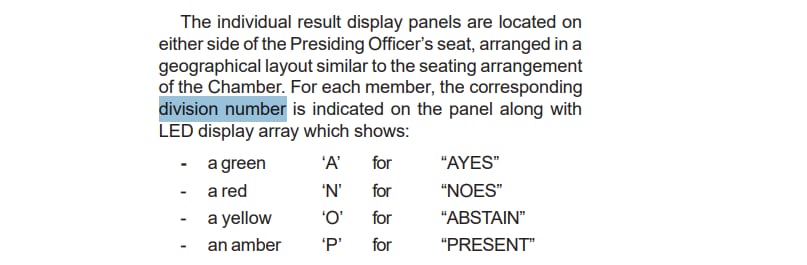 Parliament document on the automated voting system based on the division number of MPs in Rajya Sabha.
How is a Lok Sabha Speaker removed? The constitutional process explained
272+ votes needed — an effective majority of full House strength (543 seats) to remove the Speaker
Step-by-Step: The Impeachment Process
STEP 1
Signatures Gathered
At least 50 MPs must sign the notice before it can be submitted to the Secretary General
STEP 2
Admissibility Check
Secretary General examines whether the notice meets all constitutional and procedural requirements
STEP 3
14-Day Mandatory Wait
As per Article 94, a minimum 14-day notice period must lapse before the motion can be taken up
STEP 4
Speaker Steps Down from Chair
Under Article 96, Speaker cannot preside while motion is under consideration — Deputy Speaker takes over
STEP 5
Speaker Can Speak & Vote
Speaker may defend themselves in the House and cast a vote — but via paper slip, not the automated system
STEP 6
Effective Majority Vote
Removal requires 50%+ of full House — vacancies and absentees don't reduce the bar
50 Minimum MP signatures required to submit notice
14 Days' prior notice mandatory before motion is taken up
Article 94 of the Constitution governs the Speaker's removal. The effective majority threshold — not a simple majority — makes it structurally very difficult to pass when the ruling coalition commands comfortable numbers.
Who presides over the session in absence of the Speaker?
As per Article 95 of the Constitution of India, “While the office of Speaker is vacant, the duties of the office shall be performed by the Deputy Speaker or, if the office of Deputy Speaker is also vacant, by such member of the House of the People as the President may appoint for the purpose,” as per the procedure of the House.
VIDEO | Congress MP Gaurav Gogoi (@GauravGogoiAsm) in Lok Sabha, said, “How can Jagdambika Pal preside Lok Sabha when a resolution for Speaker’s removal is taken up.”
(Full video available on PTI Videos – https://t.co/n147TvrpG7)
(Source: Third party) pic.twitter.com/mjpKXzXBgt
— Press Trust of India (@PTI_News) March 10, 2026
Why the Opposition moved the motion
At least 118 opposition members submitted a notice, accusing Birla of not allowing Leader of Opposition Rahul Gandhi and other Opposition leaders to speak during the Motion of Thanks to the President’s address on the Union Budget, and for suspending eight MPs for the rest of the Budget session.
Story continues below this ad
Congress MPs further accused Birla of “openly espousing the version of the ruling party on all controversial matters,” arguing this constitutes a danger to the proper functioning of the Lok Sabha.
The BJP has pushed back hard. Union Parliamentary Affairs Minister Kiren Rijiju warned that the Congress would “regret” the move and predicted the motion’s defeat.
Opposition's case against Speaker Om Birla: What the no-confidence notice alleges
118 Opposition MPs signed the no-confidence notice
8 MPs suspended for rest of Budget session, per the motion
The Charges: What Opposition Alleges
⛔
Silencing the Leader of Opposition
Birla allegedly did not allow Rahul Gandhi and other Opposition leaders to speak during the Motion of Thanks to the President's address on the Union Budget
🔨
Mass Suspension of MPs
Birla suspended 8 MPs for the entire remainder of the Budget session — a move the Opposition terms punitive and partisan
⚖️
Siding With the Ruling Party
Congress MPs accuse Birla of "openly espousing the version of the ruling party" on all controversial matters — violating the Speaker's constitutional neutrality
🏛️
Threat to Lok Sabha's Functioning
The Opposition argues Birla's conduct constitutes a danger to the proper functioning of the Lok Sabha — the core basis for the removal motion under Article 94
BJP Pushback
Parliamentary Affairs Minister Kiren Rijiju warned Congress would "regret" the move and predicted the motion's defeat — pointing to NDA's comfortable majority in the 543-seat House.
Has Speaker’s impeachment motion ever succeeded?
Short answer: No. Three former Lok Sabha Speakers — GV Mavalankar in 1954, Hukam Singh in 1966, and Balram Jakhar in 1987 — all faced no-confidence motions. None lost their position.
The reason is structural. The motion is very difficult to pass as the ruling party or alliance usually has the numbers in their favour, except in case of a minority government.
Story continues below this ad
With the ruling NDA coalition commanding a comfortable majority in the current House, the motion is widely expected to fail. But that may not be the real point. For the Opposition, the exercise is more about making a political statement than winning the vote.





 English (US) ·