

 2 hours ago
8
2 hours ago
8
ARTICLE AD BOX

US President Donald Trump declared the "toll-free opening" of the Strait of Hormuz, billing the pact with Iran as his crowning achievement.
On June 14, US President Donald Trump declared the "toll-free opening" of the Strait of Hormuz, billing the pact with Iran as his crowning achievement.
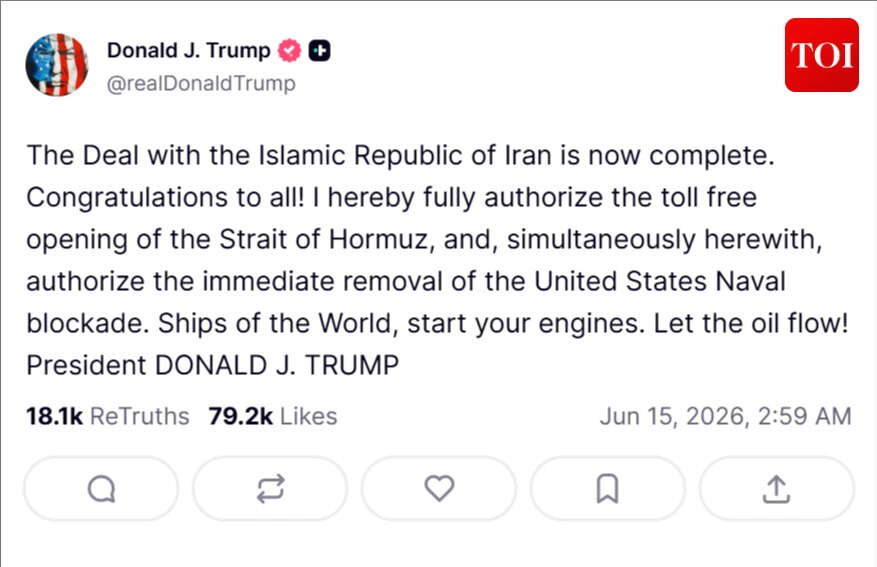
Trump's Truth Social post
The problem: Iran has consistently insisted the strait was never closed.As early as April 17, Iranian foreign minister Seyed Abbas Araghchi said plainly that "passage for commercial ships through the Strait of Hormuz is entirely open for the duration of the ceasefire."
Tehran argued the waterway's apparent shutdown wasn't their doing at all but the byproduct of a "dual blockade": the US Navy choking Iranian ports from April 13 while Iran tried to seal the Gulf.The 108-day showdown cost the US nearly $1 billion a day, shattered global supply chains, sparked a worldwide energy crisis, and left hundreds dead — all while the president celebrated "reopening" a strait Iran says it never closed.The irony is almost theatrical in its cruelty.
Eye-watering price tag for the US
The financial cost of America's Operation Epic Fury is staggering.In just over 100 hours from the offensive's start on February 28, Washington spent approximately $3.7 billion, according to analysts at the Center for Strategic and International Studies (CSIS). That pace translated to nearly $900 million per day in the opening phase.The cumulative cost across six days reached $11.3 billion, the Pentagon recently told Congress — but CSIS revised that figure upward to approximately $12.7 billion once attrition, equipment losses, and base damage were included.
By Day 12, cumulative costs hit $16.5 billion; by Day 22, the operation had already consumed more than $27 billion. By mid-May 2026, the Pentagon disclosed a revised estimate of $29 billion for the first 32 days.CSIS analysts estimate Operation Epic Fury cost the US nearly $1 billion per day on average during the early phase, with combined operational costs pushing daily spending as high as $2 billion before settling closer to $500 million per day.After nearly 60 days of war, the Penn Wharton Budget Model at the University of Pennsylvania projected total direct costs could land between $38 billion and $47 billion, with a base-case estimate of approximately $42.5 billion.These figures capture only direct, unbudgeted federal military spending.They exclude pre-strike repositioning costs (estimated at roughly $630 million), routine operations and maintenance for ships, aircraft, and personnel in theater (about $196 million in the first six days alone), and allied resupply transfers.
Extending those omitted routine O&M costs across all 62 days adds another $2–3 billion not captured in public estimates.
Over 40 aircraft lost or damaged
The Congressional Research Service (CRS) compiled a devastating tally of American air losses.At least 42 US military aircraft were lost or damaged during Op Epic Fury, launched against Iran on February 28.The final number could still change due to ongoing combat activity and classification concerns.
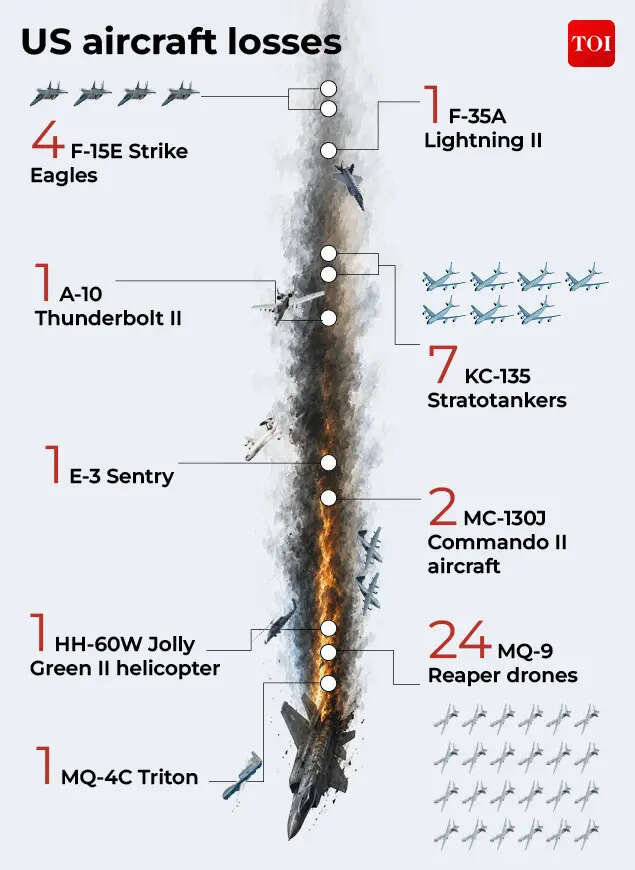
US aircraft losses
The losses span multiple platforms: F-35 stealth fighter, F/A-18 Super Hornets, EA-18G Growler electronic-warfare aircraft, MQ-9 Reaper drones, and several helicopters used for reconnaissance and search-and-rescue.CRS data indicates at least 18 aircraft were completely destroyed — many struck by Iranian surface-to-air missiles while conducting low-altitude strikes on hardened airfields and missile silos.
The remainder suffered damage from friendly fire, anti-aircraft fire, ground collisions during emergency landings, or battle-related systems failures requiring extensive repairs.The attrition rate represents the highest single-operation loss of US air assets since the Gulf War.Naval aviation units from the USS Abraham Lincoln and USS Nimitz carrier strike groups accounted for roughly 60% of losses, with Air Force assets making up the balance, according to the CRS report.
Human toll
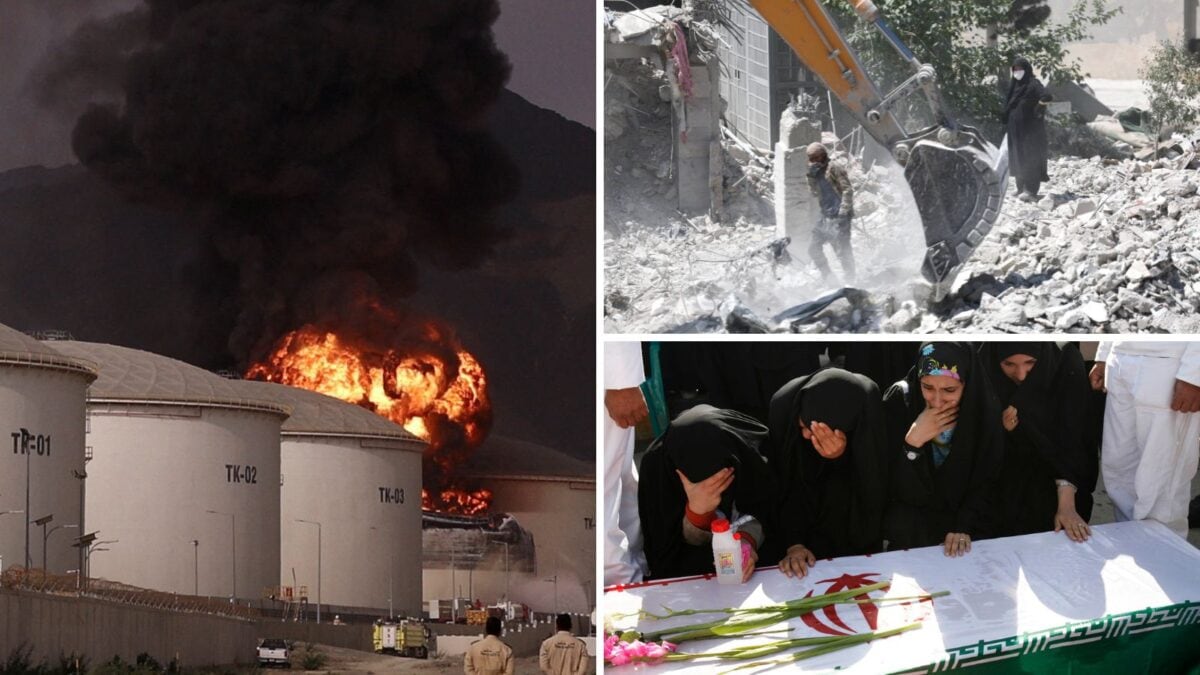
The human cost of the conflict has been grim. At least 10,200 US air sorties were flown, with more than 13,000 targets struck and over 150 Iranian naval vessels destroyed during 38 days of major combat.According to Iran's state-run Foundation of Martyrs and Veterans Affairs, over 3,400 Iranians were killed. Iran's ministry of health stated US-Israeli strikes resulted in at least 2,076 fatalities since February 28, with victims ranging from infants to octogenarians.
Preliminary figures show 3,696 dead in Lebanon, and 28 killed in Gulf states.US Central Command data provided on April 8 recorded 13 US service members killed and 381 wounded in the 40 days since Operation Epic Fury began. Seven service members were killed by enemy fire, including soldiers who died on March 1 in Saudi Arabia during an Iranian airstrike. The initial assault on February 28 killed five service members and wounded five others; one seriously wounded soldier later died, bringing the US total to six killed in that action.
14 seafarers killed
Posturing over the Strait of Hormuz resulted in the deaths of 14 seafarers — six of them Indians — according to the UN maritime agency.The latest fatalities occurred in June when three commercial ships were struck by US military forces, one attack killing three Indian sailors.
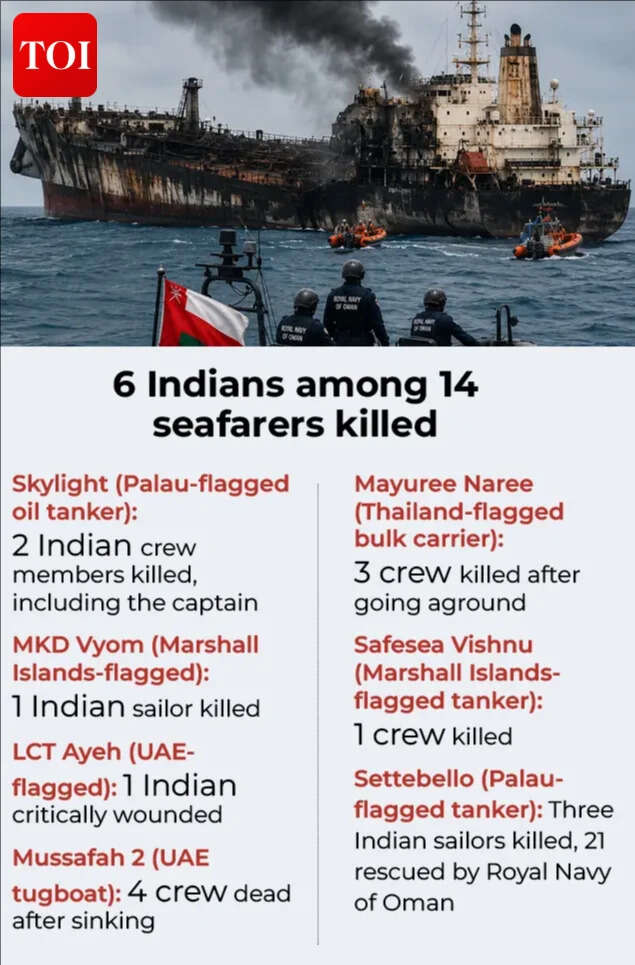
6 Indians among 14 seafarers killed
At least 17 merchant ships were damaged, of which seven were abandoned, and two merchant ships were captured.One tugboat was sunk, and one port worker was killed with two wounded in Bahrain.
Global supply chain collapse
The worldwide disruption was catastrophic. The International Maritime Organization reported on April 21 that about 20,000 merchant sailors and 2,000 ships were stranded in the Persian Gulf due to the double blockade. By May 11, Saudi Aramco CEO Amin Nasser said over 600 tankers were stuck inside the Persian Gulf, with another 240 waiting outside the strait.Major container shipping companies — including Maersk, CMA CGM, and Hapag-Lloyd — suspended transits through the strait.
Tanker traffic dropped by about 70%, with over 150 ships anchoring outside the strait to avoid risks. Soon afterward, traffic dropped to near zero. Daily tanker transits, which previously averaged 50–60, reached a virtual standstill.
Brent crude hits $126/barrel
The oil-price shock caused by the conflict was historic in both speed and scale.Brent crude surpassed $100 per barrel on March 8 for the first time in four years, briefly hitting $126 per barrel before settling around $118.
Dubai crude reached $166 on March 19, its highest on record, driven by the sudden drop in Persian Gulf exports and panic buying among Asian importers.
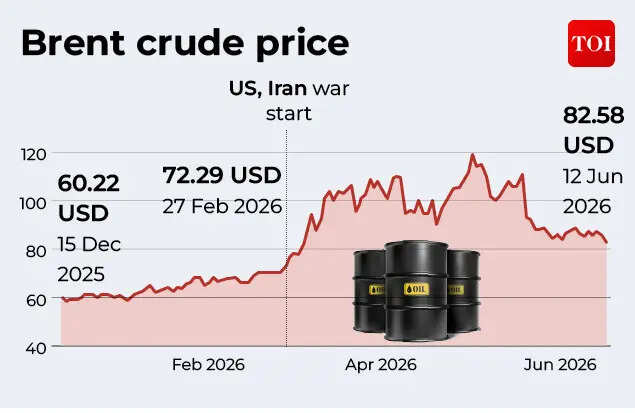
Brent crude price
The price surge was faster than during any other recent conflict, including the Ukraine war, Gulf War, or Iraq War, with prices climbing nearly 50% in just three weeks.The spike sent shockwaves through global markets.Airlines slashed capacity, shipping companies rerouted vessels at higher costs, and consumers faced rising fuel prices that threatened to push inflation back above central bank targets.European and Asian futures markets recorded their largest single-day gains since 2022.By April 8, the ceasefire announcement sent Brent plunging roughly 15% to $93.82, though it held in the $90–95 range, still more than 30% above pre-war levels.Even after the dip, oil remained expensive enough to strain fragile post-pandemic economic recovery in emerging economies, particularly in India and China, where import bills ballooned.
The volatility underscored how tightly the global economy remains linked to the Strait of Hormuz, where just 20% of the world's oil normally flows.
Energy disruption
Roughly 20% of the world's oil and 20% of liquefied natural gas (LNG) normally pass through the strait, about 80% of which is shipped to Asia. The crisis became the largest disruption to world energy supply since the 1970s oil shocks, halting vital flows to China, India, Japan, and South Korea.Oil exports from the region dropped 60% from 25 million barrels per day before the war to around 10 million by March 15, creating immediate shortages and forcing buyers to seek costly alternatives.Gulf Arab states cut production by at least 10 million barrels per day by March 12 as security concerns mounted and tanker traffic stalled. Saudi Arabia reduced production by 20%, from 10 million barrels per day to 8 million, after shutting two offshore fields including Safaniya, the world's largest offshore oil field.Iraq's three main southern oil fields saw production drop by 70% from 4.3 million barrels per day to 1.3 million as port facilities faced attack risks and shipping lanes became unsafe..LNG exports from Qatar, the world's third-largest exporter, were similarly constrained, with at least 40 LNG tankers stranded outside the strait. The disruption triggered emergency fuel releases from strategic reserves in the US, Europe, and Asia, but even those measures couldn't fully offset the supply gap.Energy-dependent economies faced rolling price hikes, with gasoline and electricity costs spiking across emerging markets, threatening to derail economic recovery and deepen inflation pressures globally.
The Bottom Line
Since Operation Epic Fury began on February 28, the price paid has been enormous — in money, in lives, and in livelihoods. Tens of billions of US dollars were spent, scores of aircraft lost or damaged, thousands killed or wounded across the region, and millions more affected by halted trade and shattered supply chains.Global energy markets spiked, oil exports from the Gulf plunged, and hundreds of tankers and merchant crews were stranded or endangered.Entire industries rerouted or paused, and ordinary people from Gulf ports to Asian refineries felt the squeeze.All of that disruption and destruction came for an outcome described by the US as the "toll-free opening" of the Strait of Hormuz — a reopening Iran has consistently said was unnecessary because the strait was never truly closed.The result reads as a costly paradox: a vast and violent effort to restore access to a chokepoint that, according to one side, was never sealed.







 English (US) ·