

 44 minutes ago
4
44 minutes ago
4
ARTICLE AD BOX
AI-generated image used for representational purpose.
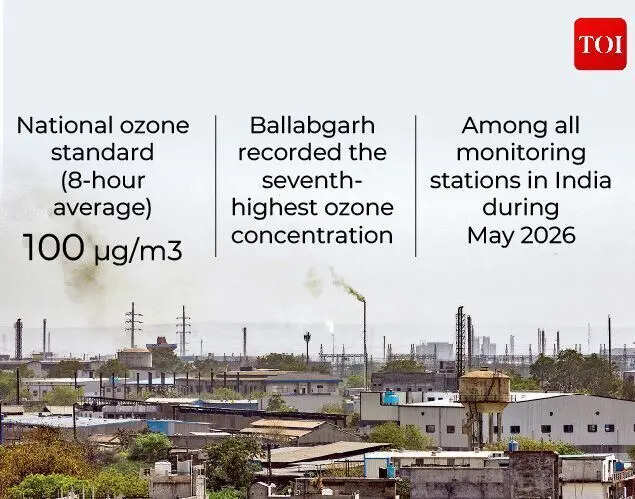
GURGAON: Haryana is among the country’s emerging ozone hotspots. Ground-level ozone has emerged as a growing air quality concern in Haryana even as particulate pollution remained relatively subdued during May.Twelve of the state’s 30 monitoring stations recorded breaches of national standards during the month, according to data from Central Pollution Control Board’s (CPCB) continuous ambient air quality monitoring network. Nathu Colony in Ballabhgarh recorded the seventh-highest ground-level ozone concentration in India during May.
National ozone standard
CPCB data shows that 40% of Haryana’s monitoring stations reported at least one day when the maximum rolling eight-hour ozone concentration exceeded the National Ambient Air Quality Standard (NAAQS) of 100 micrograms per cubic metre (µg/m3).Nationally, CPCB data analysed by Centre for Research on Energy and Clean Air (CREA) showed that while winter air quality management remains focused on particulate matter, Haryana may increasingly need to address ozone pollution during the summer months.Unlike particulate pollution, which is often concentrated around emission sources, ozone can travel long distances and affect areas far from where its precursor pollutants are emitted, making it a regional air quality challenge requiring coordinated action across sectors and districts.
Nathu Colony, Ballabhgarh
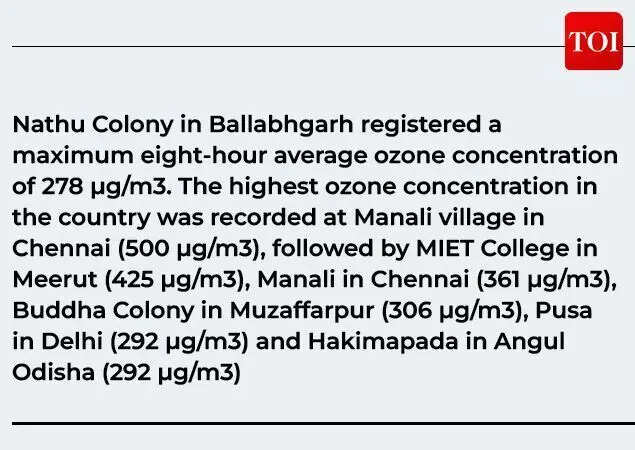
The findings underscore the rise of a pollutant that is increasingly becoming a summer air quality challenge across the state, even as particulate pollution levels ease after winter.The national analysis by CREA found that Nathu Colony in Ballabhgarh registered a maximum eight-hour average ozone concentration of 278 µg/m3, nearly three times the national standard.The highest ozone concentration in the country was recorded at Manali village in Chennai (500 µg/m3), followed by MIET College in Meerut (425 µg/m3), Manali in Chennai (361 µg/m3), Buddha Colony in Muzaffarpur (306 µg/m3), Pusa in Delhi (292 µg/m3) and Hakimapada in Angul, Odisha (292 µg/m3).Ballabhgarh ranked seventh nationally, ahead of stations in Moradabad, Tonk and Sri Ganganagar.Health experts warn that exposure to elevated ozone concentrations can irritate airways, reduce lung function, worsen asthma and other respiratory illnesses, and increase hospital visits among vulnerable populations. The pollutant can also damage crops and natural vegetation.
Top ozone hotspots in May
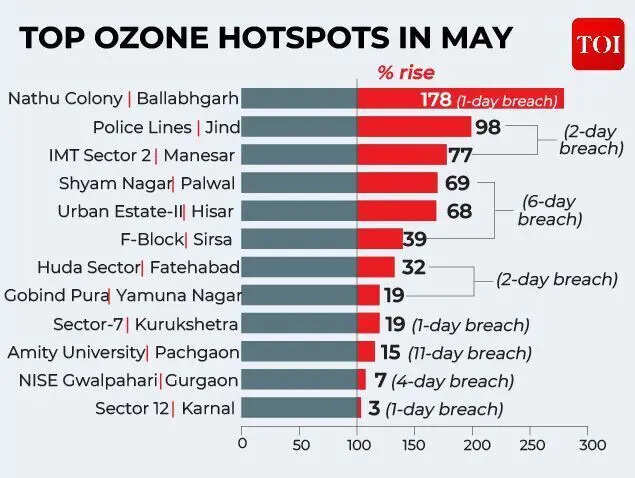
Within Haryana, F-Block in Sirsa recorded the highest number of exceedance days, with ozone levels crossing the prescribed limit on 13 days during May.
Amity University in Panchgaon followed with 11 exceedance days.Shyam Nagar in Palwal and Urban Estate-II in Hisar recorded six exceedance days each, while the NISE monitoring station at Gwal Pahari in Gurgaon reported four days above the standard.Analyst at CREA Manoj Kumar told TOI, “The distribution of ozone hotspots across Haryana reflects the secondary nature of ozone pollution. Ozone is formed through sunlight-driven reactions between NOx and VOCs, and its concentrations are strongly influenced by atmospheric transport and photochemical processes, often leading to peak levels away from the original emission sources.”








 English (US) ·