

 1 hour ago
5
1 hour ago
5
ARTICLE AD BOX
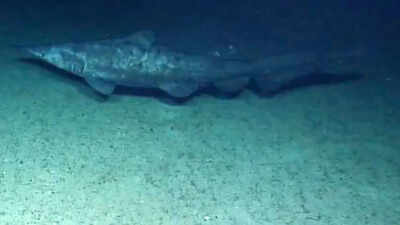
The deep ocean remains one of the least observed environments on Earth. Vast stretches of water thousands of metres below the surface are rarely visited, and many of the animals that live there are known only from accidental encounters.
Among the most elusive is the goblin shark, a strange-looking species whose appearance has earned it a reputation as one of the ocean's most unusual predators. Despite being recognised by science for well over a century, sightings have been exceptionally uncommon. Most knowledge about the animal has come from individuals caught in fishing gear rather than direct observations in their natural habitat. Now, scientists have confirmed what they describe as the first peer-reviewed footage of a living goblin shark moving freely in the wild, opening a new window into a species that has remained largely hidden from view.
First confirmed wild goblin shark sighting traced to 2019 footage
The first confirmed sighting did not happen recently. It actually dates back to 2019 during a deep-sea expedition conducted aboard the research vessel EV Nautilus. At the time, a remotely operated vehicle exploring a seamount near Jarvis Island recorded footage of a pale, unfamiliar shark nearly three-quarters of a mile beneath the ocean surface. Those aboard the vessel recognised that the animal was unusual, but its importance was not immediately understood.
The encounter was brief. Lights from the vehicle and the sound of its motors appeared to disturb the shark, which quickly disappeared into the darkness. The footage was archived alongside thousands of hours of other deep-sea recordings. Only later did marine researchers revisit the material and realise they might be looking at one of the rarest shark observations ever captured.
Rare goblin shark sighting reveals a wider Pacific Ocean range
The discovery attracted attention for another reason. Goblin sharks had not previously been documented in that part of the Central Pacific.
When scientists reviewed the footage in detail, they realised the sighting represented a substantial expansion of the species' known distribution. It suggested that the shark's range may be much broader than researchers once believed. The finding also highlighted the ecological importance of underwater mountains known as seamounts.
These structures rise from the ocean floor and often support rich ecosystems despite being isolated from continental coastlines.
For deep-sea animals that remain poorly understood, such habitats may play a larger role than previously recognised.
What makes the goblin shark unlike any other shark species
The goblin shark, scientifically known as Mitsukurina owstoni, belongs to a lineage that has existed for roughly 125 million years, according to the recent study published Journal of Fish Biology titled, ‘First in situ observations of the goblin shark Mitsukurina owstoni’. It is the last surviving member of an ancient shark family, which is why marine biologists often describe it as a living fossil.Its appearance sets it apart immediately. The shark possesses a long, flattened snout that projects forward from its head, giving it a silhouette unlike that of more familiar shark species. Beneath that distinctive profile lies one of its most remarkable adaptations: jaws capable of rapidly extending outward to seize prey.Unlike many sharks that rely heavily on vision, goblin sharks inhabit depths where sunlight never reaches.
Their elongated snout contains specialised sensory organs that help detect electrical signals produced by other animals, allowing them to locate food in complete darkness.
A second sighting adds another piece to the puzzle
The story did not end with the 2019 footage. In 2024, another goblin shark appeared on camera during a separate deep-sea research project near the Tonga Trench in the South Pacific. This observation came from baited camera systems deployed along the trench slope, more than a thousand miles from the earlier sighting location.That encounter provided evidence that goblin sharks may also inhabit environments associated with deep ocean trenches. Until now, scientists had little direct information about how the species used these extreme habitats. Taken together, the two observations offered rare confirmation that the shark occupies a wider variety of deep-water settings than previously documented.
Why so little is known about goblin sharks
Unlike coastal shark species that are regularly studied, goblin sharks spend their lives in environments that are difficult and expensive to access.
Most scientific records come from individuals accidentally caught by commercial fishing operations. Encounters with living animals in their natural surroundings are extraordinarily rare, which has left major gaps in understanding their behaviour and life history.Questions about their reproduction, population size, migration patterns and lifespan remain largely unanswered. Even basic observations of how they move through the water or search for prey have been scarce. Every confirmed sighting therefore carries significance beyond the individual animal itself. It provides information that researchers simply cannot obtain from specimens recovered after capture.









 English (US) ·