

 1 hour ago
3
1 hour ago
3
ARTICLE AD BOX
Two judges, in two separate courts, took two different calls on recusal on the same day while hearing cases involving political leaders Arvind Kejriwal and Rahul Gandhi. These developments have brought into focus a key question: what governs judicial recusal in India?
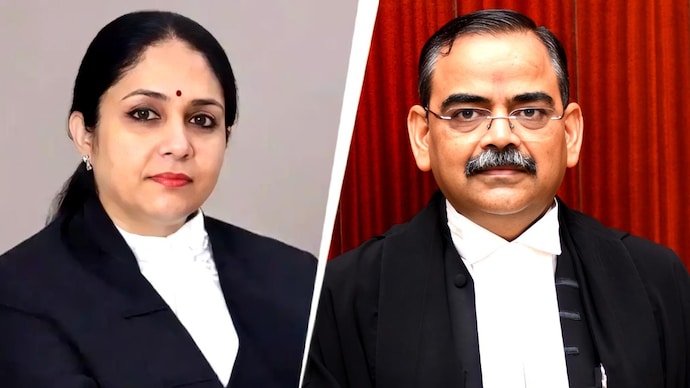
Justice Swarna Kanta Sharma of Delhi High Court and Justice Subhash Vidyarthi of Allahabad High Court
UPDATED: Apr 22, 2026 18:26 IST
April 20 brought the issue of judicial recusal into sharp focus, with parallel developments in the Delhi High Court and the Allahabad High Court raising fresh questions about when and why judges step aside from cases.
At the Delhi High Court, Justice Swarna Kanta Sharma took two different calls on recusal in the span of a single day. While she refused to recuse herself from hearing petitions challenging the discharge of Aam Aadmi Party (AAP) leaders in the Delhi Excise Policy corruption case, she stepped aside from hearing a bail plea filed by AAP leader Naresh Balyan.
Meanwhile, nearly 550 kilometres away, Justice Subhash Vidyarthi of the Lucknow bench of the Allahabad High Court recused himself from hearing a plea against Congress leader Rahul Gandhi. The case arose from a plea filed by a Karnataka-based BJP worker, S. Vignesh Shishir, alleging that Gandhi holds dual citizenship of India and the United Kingdom in violation of Indian law.
These developments have once again brought into focus a key question: what governs judicial recusal in India?
AN ETHICAL GUARDRAIL, NOT A LEGAL MANDATE
Legal experts say recusal in India is not governed by a rigid statutory framework but operates as an ethical safeguard rooted in judicial propriety.
“Indian courts have consistently maintained that recusal is voluntary and guided by conscience. There is no comprehensive statutory framework governing when or how a judge must withdraw. However, courts have recognised that even the appearance of bias can matter. In Ranjit Thakur v. Union of India (1987), the Supreme Court noted that a judge may step aside if there is a ‘reasonable apprehension’ of bias from the perspective of a litigant, even if no actual bias exists,” said Pranav Sachdeva, Advocate-on-Record, Supreme Court.
At the same time, courts have been cautious about allowing recusal to become a litigation strategy.
“The Supreme Court has warned that if litigants were permitted to insist on a judge’s withdrawal, it could lead to ‘bench hunting’ or forum shopping, undermining the administration of justice. Courts have, in some cases, even imposed costs on parties for filing unfounded recusal requests,” Advocate Swati Aggarwal noted.
She added that common grounds for recusal include personal or familial ties with a party, prior involvement in the matter, or financial interests in the outcome, all rooted in the principle nemo judex in sua causa - no one should be a judge in their own cause.
KEJRIWAL'S PLEA AND THE COURT'S RESPONSE
The debate over recusal gained prominence in proceedings involving AAP chief and former Delhi Chief Minister Arvind Kejriwal, who sought Justice Sharma’s recusal from hearing the CBI’s challenge to a trial court order discharging him and other AAP leaders.
Appearing in person, Kejriwal argued that he had a reasonable apprehension of bias. He pointed to Justice Sharma’s prior observations, which he said were contrary to the trial court’s findings after extensive hearings and examination of voluminous records. This, he argued, created a perception that the issue had already been pre-determined.
He also raised concerns about her participation in events organised by a lawyers’ body with a particular ideological leaning, as well as an RTI response alleging that several cases had been assigned by the Centre to her family members in recent years.
Justice Sharma, however, rejected these arguments, drawing a clear distinction between a real conflict of interest and an attempt to create one.
She held that a conflict must be “real, direct, and substantial,” based on tangible material - not on assumptions or remote inferences. She also cautioned against litigants undermining the judicial process through unfounded allegations.
Emphasising the broader principle, she observed that while justice must be seen to be done, it must also be seen as free from manipulation, intimidation, or pressure. Mere apprehension or unease, she held, cannot be a ground for recusal.
A PARALLEL CASE IN HYDERABAD
In the Allahabad High Court, Justice Vidyarthi’s recusal followed a different course. After initially observing that prima facie cognisable offences appeared to be made out against Rahul Gandhi, he revisited the legal requirement of issuing notice to the proposed accused.
Subsequently, social media posts by the petitioner were seen as casting aspersions on the court. Noting that the petitioner appeared to have lost faith in the judicial process, Justice Vidyarthi recused himself from the case, stating that such circumstances warranted his withdrawal.
THE BROADER BALANCE
Together, these cases highlight the delicate balance courts must maintain – between ensuring impartiality and preventing the misuse of recusal as a tool for forum shopping.
In India, recusal ultimately rests on a judge’s conscience, guided by precedent, ethics, and the need to preserve public confidence in the judiciary. The enduring principle remains clear: justice must not only be done, but must also be seen to be done - without being swayed by unfounded perceptions or strategic pressures.
- Ends
Published By:
Priya Pareek
Published On:
Apr 22, 2026 18:26 IST









 English (US) ·