

 1 hour ago
5
1 hour ago
5
ARTICLE AD BOX
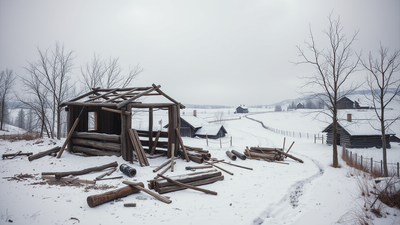
Picture a village in old Russia. Wolves have been spotted nearby. Everyone stops what they are doing and gets indoors. They wait. They know the wolves will eventually move on, retreat back into the trees, and leave the village in peace.
The danger will pass. Life will return to normal. Then someone looks around at the pile of unfinished work sitting exactly where they left it and says something that became a proverb.Unlike the wolf, this went nowhere.
Russian proverb of the day
"Work is not a wolf, it won't run away to the forest."
Where the proverb comes from
The saying is one of the most recognisable in the Russian language, recorded as far back as the 19th century in Vladimir Dal's celebrated collection Proverbs and Sayings of the Russian People, one of the most important documents of Russian folk wisdom ever assembled.Its original meaning, the one that circulated in tsarist Russia, was actually a warning rather than a comfort. Wolves were a real and constant threat to rural life. Farmers had to intercept them before they took livestock and disappeared into the forest. The wolf had to be dealt with urgently, because it would not wait.Work, by contrast, stays. It does not move. It does not leave. No matter how long you put it off, it will be sitting there when you return to it.
The original message was therefore: do not delay, because the pile will only grow.Over time, however, something interesting happened to the proverb. By the Soviet era it had quietly flipped. The same words began to be used to justify doing nothing a shrug, a grin and a reminder that the work would still be there tomorrow. It was even immortalised this way in a beloved Soviet comedy film, Operation Y and Shurik's Other Adventures, where a man sentenced to construction work uses the line to explain why he has no intention of starting.The proverb now carries both meanings simultaneously, which is part of what makes it so enduring.
What the proverb is really about
On the surface it is a joke about procrastination. A knowing, slightly guilty observation that the task you are avoiding is not going anywhere, so there is no great rush.But the sharper version of the same words says something less comfortable. That work does not disappear on its own. That leaving it does not reduce it. That every wolf you avoid dealing with today simply waits for you in the same spot tomorrow, usually having grown a little larger in the meantime.Both readings are honest. The proverb does not resolve the tension between them. It simply holds them together and lets the listener decide which one they are using it for.
The particular quality of work that waits
There is something almost uniquely Russian in this observation. The proverb comes from a culture that has historically understood endurance, the long winter, the slow season, the work that cannot be rushed and the work that cannot be escaped.In that context, the image of work as something fixed and permanent while everything else moves around it carries real weight.
Danger comes and goes. Seasons change. People rest, celebrate, grieve and recover. But the work remains. It has a kind of loyalty to the person who created it by leaving it undone.That is not entirely a comfortable thought. But it is an honest one.
Why the proverb has two faces
Most proverbs have a single clear lesson. This one has always had two, and the fact that both have survived together says something about the Russians who kept passing it on.There is a version that says: do not panic, pace yourself, the work will be there when you are ready.
That version values steadiness over urgency and recognises that not everything needs to be done immediately.There is a version that says: do not fool yourself, the work is waiting, and waiting does not make it smaller. That version values honesty about the cost of delay.The reason both survive is that both are true depending on the day, the person and the pile of work in question.
Why this proverb still holds true
The details of Russian village life have changed entirely.
Wolves are no longer circling the outskirts of most workplaces. But the relationship between people and the things they are avoiding has not changed at all.Everyone has a version of the work that sits there. The email that needs a difficult reply. The conversation that keeps being postponed. The project that somehow never quite gets started. The proverb knows this. It has always known this.Whether you use it as permission to take a breath or as a quiet reminder that the pile is growing, it tends to land somewhere accurate. The work is not a wolf. It will not run away.It will be there in the morning, exactly where you left it.








 English (US) ·