

 1 hour ago
2
1 hour ago
2
ARTICLE AD BOX
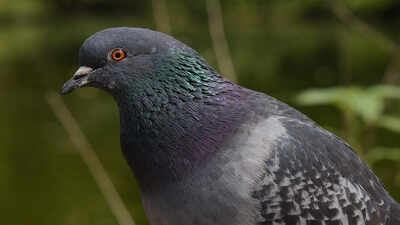
Pigeons, surprisingly, lock their gaze forward when flying, a stark contrast to their ground-level alertness. This allows for simplified visual processing and enhanced flight stability. Image Credit: Wikimedia Commons
They are everywhere in our daily routines, wandering across cities, crossing roads and streets with ease, using a mere flap of their wings. Pigeons are such an inseparable part of city life that one hardly notices what it feels like to be a pigeon, how pigeons perceive the world around them.
While observing these birds as they hunt for some food, one cannot help but notice how alert and attentive to all the details they are, turning their heads here and there.But now comes a notable discovery that could refine our understanding of bird vision. It appears that as soon as these birds rise from the ground and take to the skies, their vision changes dramatically, beyond everyone's expectations. When pigeons fly, instead of looking around or even searching for any dangers ahead, they do precisely the opposite.
They hold their gaze steady.This finding is based on research titled Pigeons Lock Their Eyes in Place While Flying. This study is notable because researchers were able to monitor a bird’s eye movements in real time while it was flying.In order to achieve such an amazing accomplishment of bioengineering, a group of scientists had to design specialised, tiny eye-tracking cameras that could be mounted on the heads of the pigeons.
Think of a tiny version of the cameras people wear on their heads during sports.The secret to flying straightIf you watch a pigeon walking on a lawn, you will notice its familiar head-bobbing routine. This is a well-known behaviour that helps them stabilise their field of view with every step they take. Because their ground vision is so dynamic, researchers long assumed that their eyes would be equally active and flexible when they were cruising through the air.The study found something different from what researchers had expected. The data showed that as soon as a pigeon finishes its take-off sequence and settles into a steady flight path, its pupils dilate significantly to let in a maximum amount of light. Immediately afterwards, its eyes appear to settle into a forward-facing position.This locking behaviour may serve an important purpose in mid-air. Navigating a complex three-dimensional environment at high speeds requires an immense amount of rapid neurological processing.
By keeping their eyes perfectly still relative to their skulls, pigeons can drastically simplify the chaotic rush of visual information flooding into their brains.This is an intelligent way that relies on the bird’s natural sense of balance and spatial perception. As long as a bird’s eyes are held motionless, the retinal motion detected in its visual system is directly related to its body position and movements.
This unadulterated stream of information helps the bird calculate its optical flow, which refers to the rate at which scenery moves across its vision.For a bird manoeuvring through urban obstacles, this visual feed may be especially useful. It functions much like a built-in gyroscope, helping the bird stay oriented and stable as its wings beat up and down.
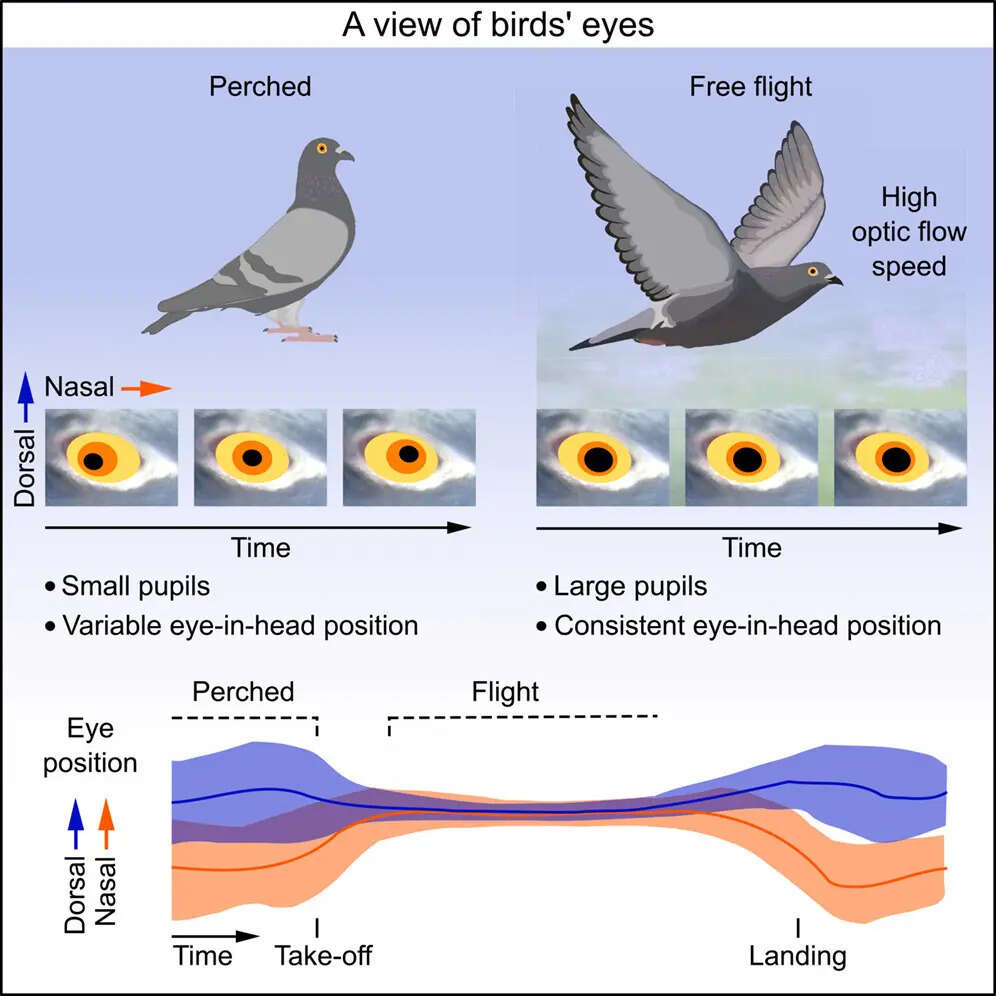
However, this fixed vision creates a significant blind spot, making them vulnerable to aerial predators. This discovery challenges existing biological understanding and could inspire drone navigation technology. Image Credits: Pigeons lock their eyes in place during flight study Fig 1
An awful blind spot in mid-airEven though this is a remarkable biological mechanism in terms of evolutionary development for controlling their flight, it poses a danger to these birds’ lives.
In their quest for attaining perfect navigational skills, pigeons end up having no way to keep track of their surroundings and spot potential threats.In nature, survival often depends on constant caution. In most cases, prey animals have eyes that give them a wide view of their surroundings because they are located on the sides of the head.When a pigeon locks its eyes during flight, it effectively creates a massive temporary blind spot around itself.
Because they are entirely focused on the path right in front of them, they become remarkably oblivious to what is happening to their left, their right, or directly above them.This unexpected vulnerability may help explain why birds of prey, such as peregrine falcons and hawks, can hunt pigeons in mid-air. A soaring raptor can initiate a high-speed dive from an angle that falls completely outside the locked visual field of its target.
The pigeon simply never sees the attack coming until it is far too late.It stands as a classic evolutionary trade-off. The birds appear to prioritise flight stability and split-second steering over constant scanning for enemies. In the grand design of nature, you can rarely have it all.The study also has implications beyond bird behaviour. For decades, textbook biology taught that most animals rely on a strict pattern of looking and shifting known as a fixate-and-saccade system.
This new data suggests that flight changes how pigeons use vision once they become airborne.Such observations might even play an important role in human innovation. Designing systems that can navigate the drone through complex environments without colliding into anything is one of the most challenging tasks that engineers face when developing new self-guided aerial vehicles. By studying how pigeons stabilise their vision during flight, engineers may improve drone navigation software.The next time you see pigeons scatter into the sky, remember that they may be keeping their gaze fixed as they fly. They are not simply scanning the view in the way they do on the ground. Instead, they are entirely locked in, staring dead ahead and focusing every ounce of their energy on the journey home.







 English (US) ·