

 45 minutes ago
6
45 minutes ago
6
ARTICLE AD BOX
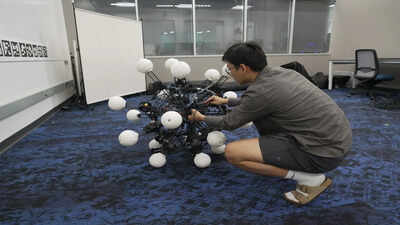
For decades, scientists have been building robots have looked to nature for inspiration, creating mechanical dogs, insects and human-like machines. But a team of researchers at Duke University may have just found the ultimate robot body shape – and it looks less like a human and more like a high-tech sea urchin.
Meet “Argus,” a 20-legged machine that has no front, back or sides. Named after the all-seeing monster of Greek mythology, Argus is arguably changing everything robot design.The breakthrough research, published on May 27 in the journal Science Robotics, suggests that the most agile robots shouldn’t mimic animals at all. Instead, they should be perfectly symmetrical – and the numbers prove that.
1500 simulations and one ‘perfect’design
To find the perfect shape, researchers in Duke's General Robotics Lab ran more than 1,500 computer simulations.
Instead of copying a dog or a human, they focused on a mathematical concept called dynamic isotropy – a score from 0 to 1 that measures how evenly a robot can accelerate in any given direction.A score of 1 means the robot can move or react identically in all directions. Most advanced robots today, including famous four-legged robot dogs and humanoids, score below 0.6 because they are naturally better at moving forward than sideways.
Argus scored 0.91, nearly reaching the theoretical limit.“When a robot can accelerate equally well in every direction, it stops needing to face the world in any particular way. Forward and backward become the same. Left and right become the same,” said Boyuan Chen, director of the lab and co-author of the study. To achieve this, the team shaped the robot's core like a regular dodecahedron (a 3D shape with 12 flat sides) and attached 20 telescoping legs, each costing $300.
Every single leg tip features a built-in depth camera, giving the robot a complete, uniform view of its surroundings.
How Argus performed in real-word scenario
The team took Argus out of the lab and onto Duke’s campus to see how it handled the real world. The 20-legged machine easily navigated concrete, grass, soft sand, thick bushes and slippery surfaces. Since the robot does not need to turn around to change direction, Argus proved to be incredibly tough and adaptable. Moreover, during testing, the robot climbed up walls and crossed rough obstacles up to 5 inches tall, carried a 10-pound payload and pushed a massive 3-foot cube, and most importantly, remained stable when researchers tried to push it over. It even kept moving smoothly even after three of its legs were intentionally broken.“Watching Argus move is unlike watching any other robot we've worked with. The first time we saw it navigate among trees and rough terrain, even under heavy collisions, we knew this was something different," said Jiaxun Liu, a doctoral student who co-authored the study.







 English (US) ·