

 12 hours ago
3
12 hours ago
3
ARTICLE AD BOX
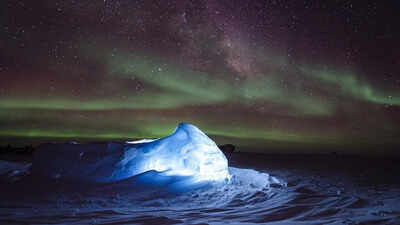
Antarctica's silent ice expanses are revealed to be teeming with sound through a unique art and science project. Electromagnetic data from space weather, captured at a polar research station, has been converted into audible sounds. Image Credits: Wikimedia Commons
We often associate Antarctica with vast, silent expanses of ice. Imagine vast swathes of pure white snow, huge ice sheets grinding against one another and the planet, and a land so distant it’s completely separate from the busy world beyond.
It is easy to assume that Antarctica is silent except for weather events. Space weather and geomagnetic storms are usually discussed in scientific terms. Such things we consider to be the green line on a researcher's screen, or the colour of the northern lights flickering silently overhead. But a unique fusion of art and science shows us that the planet's protective magnetic shield is, in fact, teeming with sound.This sonic world exists because space data can feel sterile, robotic, and hard for many people to connect with.
For decades, space physicists have used diagrams and equations to study how solar flares and radiation belts interact with Earth's magnetic field, but those tools do not always capture the drama of the process for non-specialists. By converting electromagnetic data into sound, scientists and artists have created an audio experience that makes the science easier to feel.How the eerie sounds of space weather were recorded at a polar research stationResearchers used the polar environment to capture natural radio emissions and turn them into music. According to the Science News article Otherworldly music albums feature space weather data, there is an ongoing project to archive this sonic cosmos. The British Antarctic Survey gathered the data at Halley Research Station using specially designed antennas to pick up extremely low-frequency radio waves produced when charged particles from solar storms interact with Earth's magnetic field.
This process, known as sonification, is possible because the signals can be mapped into the audible range. According to Science News, space physicist Nigel Meredith collaborated with electronic music composer Kim Cunio to translate the recordings from the polar research station. The readings, transmitted from the antenna to the speakers, let listeners hear a range of sounds in the space weather, from rapid chirps known as chorus emissions to longer whistling sounds called whistlers.

This sonic cosmos, archived into albums like 'Infinitas Formas,' allows listeners to experience the dynamic forces that shield our planet. Image Credits: Wikimedia Commons
An immense library of sound brings the space world into our homesThe project has turned this collection of sounds into a multimedia art installation. As highlighted by the project overview by the British Antarctic Survey named Sounds of Space, the project involves much more than simply being experiments in a lab environment. The artists and scientists are converting years of recordings into nine albums that let listeners hear how space weather changes over time.Every aspect of this atmospheric sound is perfectly represented in the publicly accessible audio album Infinitas Formas, a comprehensive release made available globally through the Bandcamp site and a joint effort of the artists and scientists working in Antarctica. Infinitas Formas blends harsh Antarctic radio sounds with acoustic instrumentation and electronic beats. Those involved in the project said the music becomes more intense during a solar storm and quieter as space weather calms down. In essence, this piece of music shows one way listeners can connect with the forces that shield our planet.









 English (US) ·